RECOGNITIONS
A pajal hull with Makassarese style of
rudder supports, and tripod mast in a traditional
support consisting of three pairs of vertical
posts. A second tripod mast is supported on the roof of the desk-house.
The boat sits high out of the water and is filled with a clutter of beams
and poles. The titled rectangular sails are usually of coloured light cotton.
The boats are often sllung about with fish traps the size of large waste-paper
baskets .
LOCATION
A few of these boats can sometimes be found
at Paotere harbour , UjungPandang ( the capital
city of South Sulawesi - Celebes ), but most of them berth at the south
end of the town. There are others along that coast.
PERFORMANCE
I have seen these boats at work only during
the east monsoon when the sea is sheltered by the land. The season for
flying-fish eggs is from June to September with interruptions if jellyfish
swarms appear. With their thn cotton sails that are cut full and baggy
they ghost along before light wilnds. The two sails together form a beautifully
curved aerofoil slot and the boat goes well at about 45o
to the true widn as seen from
another boat, but on account of drift
the boat makes hardly any headway. To go about they lower the small sail
and wear ship, bringing the mainsail across the bows. Both sails swing
freely and tilt in any direction around the tripod masts, which have no
stays
except the halyards.
HISTORY
The indications are that the prahu patorani
has changed little for several hundred years, but at some time in the nineteenth
century the builders of the hulls adopted the western ribs and floors.
A nineteenth-century model in the Museum fur Volkerkunde, Berlin, has more
primitive continuous ribs, as still used in a few places e.g. Aru and Nias
Islands. In the old prahu Patorani the sides were raised above the deck
by strips of matting , a traditional Indonesia method of keeping out slop.
The hull of the prahu patorani is of the
Pajala ( netting man ) type. This is a name which for centuries has probably
meant the same general design of hul of various shapes. Nowadays floors
are fitted, some of the ribs project above the gunwales, and the three
legs of the tripod mast are pivoted between three pairs of vertical posts
attached to floors. Fur further details of the history of the hull, and
ceremonies at keel
laying and launching.
USE
The flying fish normally lays its eggs
on weed or leaves floating out at sea, and the floating baskets are lures
to persuade the fish to make their courtship ritual and lay eggs. The baskets
have open ends that are crossed by an inwardly pointing fringe of sharp
fingers of split bamboo of exactly the right flexibility and separation.
During courtship the male lies beside the female and as she lays her eggs
on the basket he dashes past her, pushing her into the trap in so doing.
Often both fish are caught together. Once inside they close against each
other when the fish push outwards. The fish are dried, or sold fresh,but
at the present price of about 80.000 rupiahs per kilogram the eggs are
the valuable part of the catch; 25 - 30 tons a year are exported to Japan
where they are sold as red caviar. In 1977 - 9 the number of prahu patorani
was increasing because the fishing is so profitable.
You may notice at the front of the prahu
patorani a long stick curving upwards and decorated with pieces of wool,
pendants, wooden fish and similar trinkets. If you ask directly what this
is for you will probably not be told, but if you ask the fishermen how
much they paid for this decoration they will admit that they purhased it.
Then you can ask whether they already had luck in their fishing, and whether
they use other charms to ensure a good catch. In fact they have many, among
them are salacious stories to try to give the fish the idea of mating,
and the fish are supported to be attracted only to boats with foul-mouthed
crews.
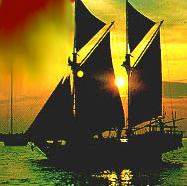 SURELY
if any ship could sail into the past it would be this traditional craft
of the Makassarese fishermen which is now used for gathering the eggs of
the flying fish. One can search these boats for western influences without
finding anything modern but the sailcloth, plastic, rope and paint. To
find one under sail puts you back a century or two . The name Patorani
means " Catching the flying fish ".
SURELY
if any ship could sail into the past it would be this traditional craft
of the Makassarese fishermen which is now used for gathering the eggs of
the flying fish. One can search these boats for western influences without
finding anything modern but the sailcloth, plastic, rope and paint. To
find one under sail puts you back a century or two . The name Patorani
means " Catching the flying fish ".