 China - The Forbidden City
China - The Forbidden City
China - The Forbidden City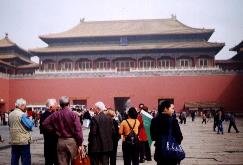
We waited outside the forbidden city also known as Palace Museum (Gugong) for another group from the travel agency to take a big group photo together inside the palace grounds. We waited more than 15 minutes as the other group had an old lady walking with a stick. That got us (my mom and I) counting our blessings. So our advice - if you want to do something badly, don't wait too long, grab the chance, seize the day, just do it!
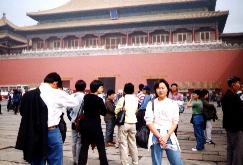
One thing I would like to note is that for all the entrances for the Chinese ancient buildings, there is a board which is a foot higher than the ground. You should always walk over it not on top of it according to Mr. Wong.
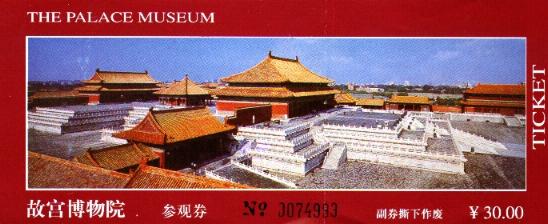
I don't know how to describe this place. It's big, it's majestic, it's beautiful, it's really impressive. I stand in awe. Once 'forbidden' for ordinary people, now, I'm walking on the emperors' grounds! Think of the 24 emperors who have lived here over a span of more than 491 years. Of course, there's also the twelve courtyards on either side of the palaces that were once inhabited by concubines, dowagers and maids. They say there's 9,999 rooms around here. It's equivalent that if you lived in each room since you are born, you would be 27 years old by the time you occupied the last room!
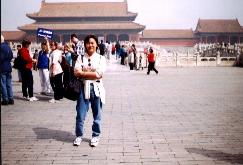
This place was built by more than 200,000 people in 1406 to 1420 for Emperor Yongle. The main palace buildings are divided into two parts - the outer court and the inner court. The outer court has three main halls standing on a three tiered, balustraded terrace of white marble: Taihehian (Hall of Supreme Harmony), Zhonghedian (Hall of Central Harmony) and Baohedian (Hall of Preserved Harmony). They are the places where the emperor receives high officials and conducted the administration of the empire. The inner court includes Qianqinggong (Palace of Celestial Purity), Jiaotaidian (Hall of Celestial and Terrestrial Union), Kunninggong (Palace of Terrestrial Tranquility). These are the places where the emperor lived and conducted day-to-day administration.
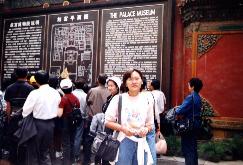
As I peeked into the halls of the palaces (we were not allowed to go in), I wonder whether these were also places where people were caned or beaten if they were found to have done wrong by the emperor. I had an eerie feeling about it. There seem to be many untold secrets around here.
We walked out to the other entrance facing the Prospect Hill, also known as the Coal Hill. I'm so glad I'd done my homework, else, it would have gone unnoticed. The last Ming Emperor is said to have hanged himself from a locust tree on hearing that the peasant rebels were storming the city. On the summit is the Ten Thousand Springs Pavilion.
When we got on the bus, there were many peddlers swarming us to sell us souvenirs. These people are very persistent. They would make fantastic salespeople in Malaysia.
As the bus drove away from the Forbidden City, I could see the battlemented wall that surrounds it. Outside the wall is a moat 50 metres wide. Truly magnificent.
Here's some pictorial explanations:
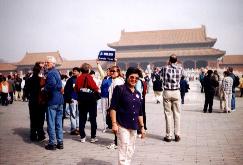 This is one of our favourite photos of mom standing in front of the palace.
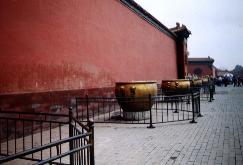 The big pots that you see here on with lion heads decorating it, has real gold paint
on its surface. You can notice scratches on it as people try to scrape the gold
off.
The big pots that you see here on with lion heads decorating it, has real gold paint
on its surface. You can notice scratches on it as people try to scrape the gold
off.
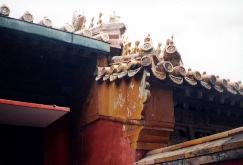 All the roofs of ancient Chinese buildings have carvings of guardians in the form of
animals at the tips of the rooftops.
All the roofs of ancient Chinese buildings have carvings of guardians in the form of
animals at the tips of the rooftops.
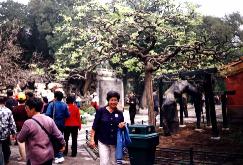 This is a very interesting bonzai like tree. The twisted branches are so elegant
and graceful - I'll call her the "Green Swan".
This is a very interesting bonzai like tree. The twisted branches are so elegant
and graceful - I'll call her the "Green Swan".
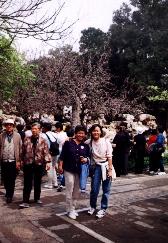 That's me and mom again in front of yet another interesting tree. This one's more
'frilly' with no leaves at all. I call it "The Bare Wires". I know, Eu Cheng, must
be grinning. Ever since I read Anne of Green Gables, I have the habit of naming
trees as well!
That's me and mom again in front of yet another interesting tree. This one's more
'frilly' with no leaves at all. I call it "The Bare Wires". I know, Eu Cheng, must
be grinning. Ever since I read Anne of Green Gables, I have the habit of naming
trees as well!
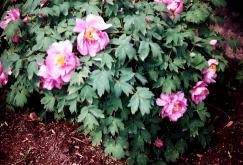 This is a beautiful flower - the size of a clenched fist.
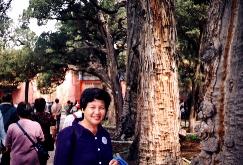 The barks of this tree is so interesting too - had to take a snap as well!
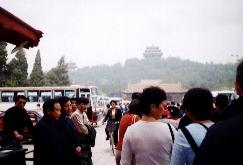 Notice the building on top of the hill in the distance? That's the Prospect Hill which
I have mentioned above. This is a great place to take aerial pictures of the
Forbidden City.
Notice the building on top of the hill in the distance? That's the Prospect Hill which
I have mentioned above. This is a great place to take aerial pictures of the
Forbidden City.