
|
Kyongbokkung Palace |
Location : 1, Sejongno,
Chongno-gu, Seoul
|
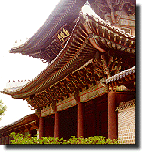
Kyongbokkung Palace (Historic
Site No. 117) was built in 1395 by King T'aejo of the
Choson Dynasty as the primary residence for the royal
family.
Among the five palaces in Seoul, it is
considered the largest and most beautiful in architectural
style. Elegant pavilions such as Kyonghoeru and Hyangwonjong,
other refined wooden and stone structures such as Kunjongjon
Hall, and the 10-story Stone Pagoda of Kyongch'onsa
Temple display a unique charm and beauty of Korean architecture.
The National Folk Museum, opened in 1975, is located
in the compound, exhi- biting many artifacts that demonstrate
traditional Korean ways of life. |
Admission
(Unit = Won)
Division |
Adults |
Students(Age 19-24) |
Remarks |
Individuals |
700 |
300 |
Group : over 30 people |
Group rates |
550 |
250 |
Under 18 : free |
Transportation
Division |
From |
To |
Duration |
Remarks |
City bus |
City Hall
On the opposite
side of Sejong
Cultural Center |
Nat'l Museum
"
*
* |
10 mins.
5 mins.
*
* |
No. 8
Nos. 32,6
*
* |
City express bus
No. 543
Subway Kyongbokkung
Line 3, then 5 min. walk
Intercity Bus termianl 82-2-436-2122
Management Office, Tel: 82-2-732-1931
Operating
hours : 09:00 - 18:00 (17:00 in winter, closed on Tuesdays)
Facilities : drinking fountains, benches<
Cultural properties
- 10-story stone pagoda of Kyongch'onsa Temple
(National Treasure No. 86),
- a pair of three-story stone pagodas of Kalhangsa
Temple (National Treasure No. 99),
- Seven-story stone pagoda of Namgyewon Monastery
(National Treasure No. 100),
- Memorial Stupa for the Most Reverend Chigwang
of Popch'onsa Temple (National Treasure No. 101),
- Memorial Stupa for the Most Reverend Hongpop
of Chongt'osa Temple (National Treasure No. 102),
- Stupa for Priest Yomgo from Hungpopsa Temple
(National Treasure No. 104),
- Five-story stone pagoda from Hongje-dong
(Treasure No. 166)
and many others
Nearby tourist spots
National Museum, Chogyesa Temple, Sejong Cultural Center, Kyonghuigung
Park
Restaurants
Ch'ongsokkol ��������82-2-735-5892

|
Ch'angdokkung Palace
& Piwon(Secret Garden) |
Location : 1, Waryong-dong,
Chongno-gu, Seoul
Ch'angdokkung Palace (Historic Site No. 122) was
originally constructed in 1405 as a detached palace after Kyongbokkung Palace was constructed.
However, since the time of the ninth monarch of the Choson Dynasty,
King Songjong, it was used as the main palace. This palace was burned
down during the Japanese invasion of 1592 and was rebuilt in 1611 during the reign of
Kwanghaegun.
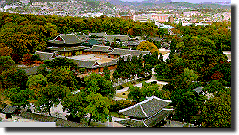
With the man-made structures in harmony with the
beautiful natural surroundings, it is one of Seoul's most frequently
visited sites.
Here one finds many important cultural assets
such as Injongjon, Taejojon and Sonjongjon halls and Naksonjae Villa.
Piwon (Secret Garden) is located behind Ch'angdokkung Palace. During
the Choson Dynasty, Piwon was used by the king and royal family
as a place for relaxation. Piwon is a beautiful garden with many
ponds, pavilions and wooded
areas containing thousand-year-old
trees. Pavilions such as Puyongjong, Yonghwadang, Chuhapnu and Osumun
Gate are scattered around the garden, boasting traditional Korean
architectural beauty. Piwon is the garden most representative
of Korea's distinct natural beauty.
Open
09:15-17:15
(Mar. - Oct.), 09:15-16:15 (Nov. - Feb.)
* closed on Mondays
Facilities : drinking
fountains, benches, shades, store
Guide Service
- Korean - every hour sharp (09:15 ~ 17:15/09:15
~ 16:15)
- Japanese - 10:30, 12:30, 14:30
- English - 11:30, 13:30, 15:30
Admission
Adults - 2,200, Students/Children - 1,100
Cultural properties
- Injongjon Hall (National Treasure No. 225)
- Tonhwamun Gate (Treasure No. 383)
- Injongmun Gate (Treasure No. 813)
- Sonjongjon Hall (Treasure No. 814)
- Huijongdang Hall (Treasure No. 815)
- Taejojon Hall (Treasure No. 816)
- Kusonwonjon Hall (Treasure No. 817)
- Chinese juniper tree (Natural Monument No.
194)
Nearby tourist spots :
Ch'anggyonggung Palace, Chongmyo, Chongmyo park.
Transportation
Division |
From |
To |
Duration |
Remarks |
City bus |
On the opposite
side of Sejong
Cultural Center
City Hall
Cheil Bank HQ.
Nat'l Museum |
Ch'angdokkung
Ch'angdokkung
Ch'angdokkung
Ch'angdokkung |
10 mins.
15 mins.
10 mins.
10 mins. |
Nos. 6, 8
Nos. 8, 20
No. 84
Nos. 205, 543, 2 |
City express |
Cheil Bank HQ. |
Ch'angdokkung |
10 mins. |
No. 16 |
Subway An-guk Line
3
Accommodation
Name |
Tel. |
Sangwon Tourist Hotel
Hotel
Samho
Ramada Olympia Hotel
Seoul Tourist
Hotel
Bukak Park Hotel
Centural Hotel
YMCA Tourist Hotel
Eastern Tourist Hotel
Sorak Youth Hostel
Kumjwa Hotel
Komodo
Hotel
Kogung(Old Palace) Hotel
Samho Hotel
(Co.)
Paekch'on Hotel |
82-2-765-0441
82-2-741-7080~5
82-2-287-6000
82-2-735-9001~5
82-2-395-7100-8
82-2-265-4121~9
82-2-734-6884
82-2-741-7811
82-2-763-9871
82-2-732-7245
82-2-734-1973
82-2-741-3831~5
82-2-741-7080
82-2-742-6671~2
|

|
Ch'anggyonggung
Palace |
Location : 2-1, Waryong-dong,
Chongno-gu, Seoul
|
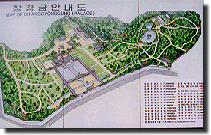
Ch'anggyonggung Palace (Historic Site
No. 123) was renovated to its original state in 1987
with the intent to eliminate all vestiges of Japanese
colonial rule.
This palace was once demoted from
Kung (palace) to Won (garden) and became a part of a
zoo by the Japanese authorities.
Honghwamun is
the main gate and Myongjongjon (main hall,oldest of
the Choson Dynasty ), |
Tongmyongjon Hall, Yanghwadang Hall and Ch'undangji
Pond are within the compound. The palace is connected with Chongmyo
(royal shrine) by a bridge.
Admission
(Unit = Won)
Division |
Adults |
Students |
Remarks |
Individuals |
700 |
300 |
Age under 19 : free |
Group Rates |
550 |
250 |
* |
Transportation
Type |
From |
Duration |
Remarks |
City bus |
City Hall
Kwanghwamun
Seoul Station
Tongnimmun |
10 mins.
10 mins.
5 mins.
5 mins. |
No. 85
Nos. 6, 8
No. 84
No. 205 |
City express No.205-1
Cultural properties
- Honghwamun Gate (Treasure No. 384)
- Myongjongjon Gate (Treasure No. 385)
- Myongjongjon Hall (National Treasure No.
226)
Nearby tourist spots
- Piwon, Ch'angdokkung Palace (Historic Site
No. 122)
- Chongmyo Shrine, Tatourgno (University Street)
- Tongdaemun (East Gate), Kyongbokkung Palace

|
Chongmyo Royal
Shrine |
Location : 1, Hunjong-dong,
Chongno-gu, Seoul
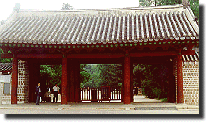
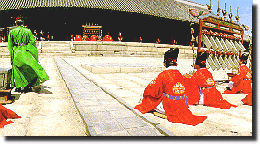
Enshrined in Chongmyo are the spirit
tablets of Choson period kings and queens and the tablets
of those who were given the title of king or queen posthumously.
Within the 190,000 square meter grounds are the Chongjon,
or main shrine, the Yongnyongjon, or annex shrine, the
Kongshindang (shrines for meritorious subjects), and
such auxiliary buildings as the kitchen, the protocol
officials' quarters, |
|
the com- pound for changing ceremonial attire,
and the ceremonial kitchen.
Chongmyo was built in 1395 by the
founder of the Choson Dynasty, King T'aejo, soon after moving his
capital to Hanyang (Seoul).
|
Upon its completion he enshrined the
ancestral tablets which were brought from Kaesong. At
present, 49 tablets are enshrined in 19 rooms of the
Chongjon, 33 tablets in 16 rooms of the Yongnyongjon,and
83 tablets in the Kongshindang. Throughout the Choson
period, memorial ceremonies were held five times a year
for those enshrined in the Chongjon and twice a year
for those enshrined in the Yong-nyongjon. |
Though the practice was abolished in 1945, since
1969 a single large memorial service has been held annually. Since
1971,this annual service has been given on the first Sunday in May
by the Association of the Chonju Yi Clan.
The Choson period
kings were from this clan.
As the annual service at Chongmyo
demonstrates the form of the Choson period royal memorial ceremony,
it was designated as Intangible Cultural Property No. 56 in 1975.
And also it was designated as a World Heritage by UNESCO on Dec.6,
1995 with Pulguksa Temple, Sokkuram Buddhist Grotto and Woodblocks
of Tripitaka Koreana and Storage Halls in Haeinsa Temple.
- Open : 09:00 - 18:30 (17:30 in winter), Closed
on Tuesdays
- Parking lot : one in front of the main gate
(toll parking)
- Facilities : benches, public phones, shades,
drinking fountain
Cultural properties
- Chongjon (main hall, National Treasure No.
227) Yongnyongjon Hall (Treasure No. 821)
Nearby tourist spots
Ch'anggyonggung Palace (Historic Site No. 123), Tatourgno (University
Street), T'apkol Park, Unhyongung Palace (Historic Site No.
257)
Admission
(Unir = Won)
Division |
Adults |
Students/Military
(Age 19-24) |
Individuals |
700 |
300 |
Group rates |
550 |
250 |
* Under aged 18: free
Transportation
- City bus Nos.
5-1, 23, 25, 30, 30-1, 32, 131,134, 154, 302
- Subway Chongno
3-ga Line 1, then 5 min.walk
Tel: 82-2-765-0195
|
Toksugung Palace |
Location : 5-1, Chong-dong,
Chung-gu, Seoul
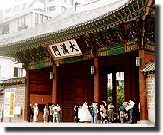
This palace was originally built as a villa for
Prince Wolsan-daegun, an elder brother of King Songjong. A century
later, as all the royal palaces in Seoul had been burned during
the Japanese invasion of 1592, King Sonjo took up a temporary residence
here when he returned to Seoul in 1593.
The palace became known
as the "West Palace." The next ruler, Kwanghaegun, held
his coronation here in 1608 and renamed this temporary palace "Kyong-un-gung"
in 1611.
|
He then moved to the rebuilt Ch'angdok-kung
Palace in 1615, leaving his step-mother Queen Inmok-taebi
here.
When Kwanghaegun was deposed by King Injo
in 1623
, the new king held his coronation in this
palace. However, he then moved to the Ch'angdokkung
Palace and the palace remained a subsidiary for 270
years.
In 1897, after his 13-month sojourn in the Russian
Legation, King Kojong returned here and used this palace
as his primary palace. |
In July, 1907,after he was forced by the Japanese to abdicate to his
son, King Sunjong,the palace was given its present name of Toksugung
or "The Palace of Virtuous Long Life", in honor of the
retired king. The king continued to live here after the new king
had moved the seat of government to Ch'angdokkung.
Ex-King Kojong
died in Hamnyongjon Hall of Toksugung on January 22, 1919, touching off the historic
nationwide anti-Japanese Independence Movement of March 1, 1919.
Inside the entrance gate (Tatourmun Gate), Chunghwajon Hall, Chukchodang
Hall, Sogodang Hall, and Hamnyongjon Hall greet the visitor. Within
the compound stand the Hungch'onsa Bell and a statue of King Sejong.
Sokchojon Hall is an example of old western-style architecture,
and it is now used as the Court Relics Museum.
Operating hours :
09:00-18:00, 09:00-16:30 in winter (closed on Mondays)
Cultural properties
Tatourmun Gate, Chunghwajon Hall, Sokchojon Hall,
Hungch'onsa Bell and over 100 other items
Nearby tourist spots
- Chongdong Church (0.1 km, Historic Site No.
256)
- King Kojong Monument (0.4 km, Historic Site
No. 171)
- Former Russian legation (0.2 km, Historic
Site No. 253)
- Sejong Cultural Center (1 km)
- National Museum (1.3 km)
- Kyongbokkung Palace (1.5 km)
Admission
(Unit=Won)
Division |
Adults |
Students (Age 19-24) |
Remark |
Individuals |
700 |
300 |
Group : over 30 people |
Group rates |
550 |
250 |
Age under 19 : free |
Transportation
10 minute walk from City Hall Subway Station
on Subway Line 1 or 2
Restaurants
- Songjuk Chukchip������������������������������������82-2-265-5129
- Yangp'yong Sutpul Twaeji Kalbi��������82-2-279-1777,
3261
- Hangukchip������������������������������������������������82-2-778-6259
- Somunhoegwan��������������������������������������������82-2-755-0897,
4645
- Yukmijip����������������������������������������������������82-2-773-4402
- Komsotchip������������������������������������������������82-2-756-4094
- Ojangdong Hungnamjip����������������������������82-2-266-0735
- Namp'o Myonok������������������������������������
����82-2-777-2269
- Komgukshijip ������������������������������������
����82-2-756-3249, 3250
Exhibition Hall of Court Relics, Tel: 02-752-0735
|