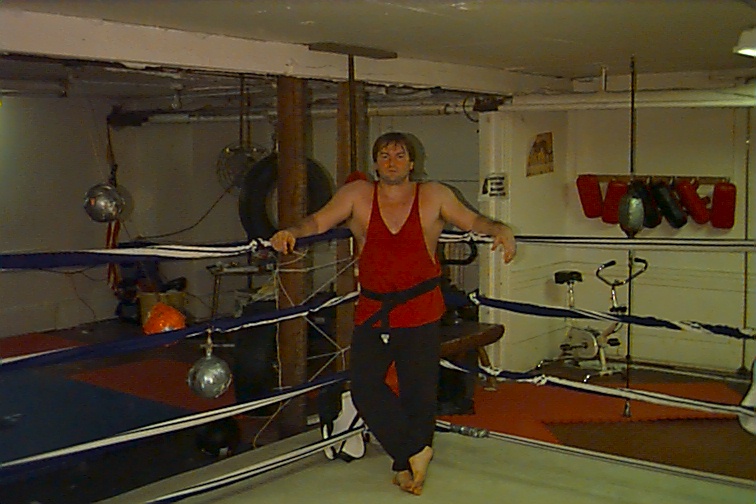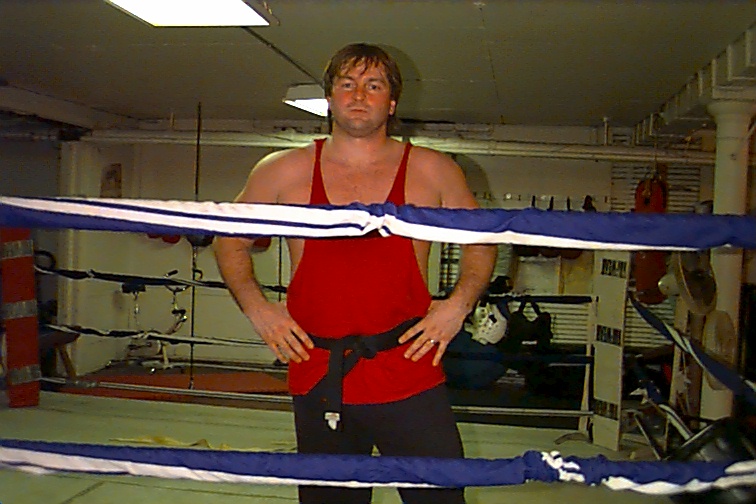
Michael E. Reilly
SherKhan
4th Degree Black Belt
USJA, USMA, UJSA
14 Years experience Player
8 Years Coaching Experience
Age 34
Weight 200
E-mail Coach Reilly
|
|
Michael E. Reilly SherKhan 4th Degree Black Belt USJA, USMA, UJSA 14 Years experience Player 8 Years Coaching Experience Age 34 Weight 200 E-mail Coach Reilly |
I started grappling as a kid. Inspired by Nick Bockwinkle, Jesse Ventura and Mad
Dog Vashon. I would wrestle with anyone who gave me half a chance. I did some
formalized wrestling in high school and dabbled in several martial arts. Then I
discovered Judo. Actually my first real coach called it Jacket Wrestling rather then
Judo. He and the local Judo community did not see eye to eye on most issues;
but he was among the best technical teachers I have ever seen. His name was John
Holms and I trained with him for several years at the University of Minnesota. Coach Holms
was an excellent coach and he taught me a slew of techniques that are unknown to even some
of the best Judokians. Along with teaching outstanding competition Judo skills; Coach
Holms also taught a lot of pragmatic, street savvy self defense orientated skills.
After the University of Minnesota I expanded my skills to include more Jujitsu and started
my first club at Hamline University. I then moved to Chicago and coached the small U of C
judo club. In Chicago I also studied Tijitsu and Karate. Once back in Minnesota I started
working with Adam Rachuy again. Adam and I met at the U of M club and he has been one of
the most influential forces on my growth as a grappler. Our styles and approaches differ,
but those difference have strengthened both our individual grappling and coaching skills.
Adam and I worked together over the last several years as coaches and training partners in
various places. In the last few years my focus has changed to more cross training and
Catch Wrestling - or grappling without bounds. This year, 1998 we created Bison
Grappling and starting hosting our own Jujitsu tournaments.
Training Philosophy
I believe in what works. I have endeavored to maintain an eclectic style that incorporates
the best of Judo, Jujitsu, Sombo, Catch Wrestling and any thing else that works for
me. I put little stock in Katas and avoid unrealistic drills, motions or techniques such
as Uchi-Komi. I feel that training needs to be dynamic and reality based. I learn the most
when sparring. While techniques can be learned in drills; the intra techniques can only be
learned on the mat while sparring. By developing flexibility in my style I feel I can
adapt to my opponent and take him out of his game. If he's a thrower, I'll fight him on
the mat. A ground fighter I'll look for a throw that gives me a clear advantage. If he's
aggressive I'll play for the counter and with a counter fighter I'll use a slew of fake
attacks to by pass his defenses and use his commitment to the counter as a weapon against
him. Most of all I feel to be successful you must commit. Commitment to training, to
technique, to the sport. This means that when you try a throw you go all the way. No
hedging. It also means that grappling has to have a priority in your life. If you blow off
practice because you don't want to miss 'Friends' your never going to make it. You also
have to commit to other avenues of training. Strength, endurance, speed are all parts to
the puzzle. That means exercising, watching your diet and getting enough rest.
Coaching Philosophy
I love this sport. There are other sports I enjoy; but nothing comes close to how I
feel about grappling. I met my wife through grappling, My best man is also my coaching
partner. I plan all my other activities around my grappling. I teach simply for the love
of it. I have never made a dime from teaching; yet I consider it my most profitable
endeavor. My goal as a coach is to empower my students, to help them improve their skills
and to give them some of what this sport have given me. Grappling should be fun,
challenging and exciting. No matter if students are learning for competition, self defense
or exercise I try to help them reach their goals. I structure training to get students
moving right away.
The first night of class I teach students several throws, a couple of submissions and a
ground control techniques. From there we go to body awareness, Kinestitics, grappling
principles and start piling on the technique. From day one I have students on the mat
sparring. Not with each other mind you; but with myself and other instructors, where we
allow for success. This way students right from the very beginning experience success. You
will note I don't include falling in the early part of a students training career. Falling
is an important skill; but it is one that is learned as well being Uke in safe throwing
drills as it is hurling your self over in an unrealistic fashion. Eventually all students
learn falling; but it is never stressed as much as other techniques. Some might see this
as unsafe, but to the contrary I feel it is safer then having students hurl themselves, in
uncontrolled rolls that net dubious results. Safety is my number one concern for my
students. While I expect there to be pain, bumps, bruises and maybe even a little blood;
injury is unacceptable.
Most of all, as a coach I want to help students find their own way. This is an art form,
and like any art it lacks meaning, depth and usefulness until the individual make it
his/her own. Everyone will do things just a little bit different. Like a master painter I
can teach students how to use the brush, mix the colors and frame the subject; but to
become an artist they must make the art their own. Students who simply replicate what they
have seen never develop their own approach, thus while their techniques maybe perfect it
will always be lacking. I do not expect students to copy me. My technique has been honed
to match my build, strength, rhythm. Your mind and body have their own way of
communicating to each other and no two people are the same in this respect. One hundred
people might all do a hip throw the same way. Feet, hands, hip all in the same position.
Yet the intra technique, the timing, the entrance, the reason that technique was chosen
over any other will all be different. My goal is to help students get to the point when a
technique becomes their own; when their own style guides their fighting strategy; when
they become an artist.