|
Taekwondo is a Korean martial art which can trace its origins and evolution back about 2,000 years in Korean history back to the first and second centuries. In its modern form, it is practised in about 120 countries world wide as a martial art, self defence system and competitive sport. Taekwondo also offers self development, physical fitness activity, physical and technical skills development, participation with others in shared experience and personal accomplishment.
Meaning of "Taekwondo"
The term "Taekwondo" can be literally translated:
- "Tae" means to kick with the foot
- "Kwon" means to punch or strike with the hand
- "Do" means the art or the way
Basic Taekwondo Training
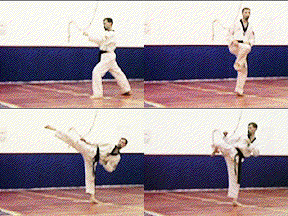
Basic Taekwondo training consists of first learning the blocking, kicking and punching techniques which form Taekwondo's basic elements. The student also learns how to use these techniques in response to an attack in prearranged attack/block/counterattack moves. Another significant element is the practice of patterns, in which a prearranged series of twenty to forty movements of different blocks, kicks and strikes is performed in imaginary combat against a number of different assailants. Self defence techniques are also taught to respond to real life, "street" situations.
Taekwondo and Life Balance
Taekwondo stresses a balanced approach to life consisting of three main elements:
- Taekwondo training
- family and social responsibility
- responsibility toward one's education or work
Taekwondo develops a person in harmony and balance. One can develop physically ("Tae" and "Kwon" ) as well as mentally and morally ("Do" ) from the practice of Taekwondo. Mentally, perseverance, self discipline, self confidence and self control are the principle benefits. Summarised, Taekwondo's benefits are:
- Physically, Taekwondo develops coordination, motor skills, agility, flexibility, muscular strength, endurance, balance, posture, cardiovascular fitness, aerobic fitness and anaerobic fitness. Due to its physical nature, Taekwondo training promotes a healthy lifestyle including proper physical training, proper nutrition, proper rest and the maintenance of a balance in life.
- Morally, Taekwondo's tenets are courtesy, integrity, perseverance, self control, loyalty and the indomitable spirit. Taekwondo promotes good character and a non-violent attitude by teaching courtesy, humility, integrity, respect for others, self reliance, courage and self control under stress. In response to conflict, Taekwondo teaches calmness, avoidance and neutralisation. It features a non-confrontational and controlled approach to aggression through the teaching of self control, self confidence and violence-as-a-last-resort response to conflict. Students must respect fellow students and obey instructors. Taekwondo demands patience, perseverance and a striving for perfection.
- Psychologically, Taekwondo reduces tension and anxiety by providing a socially acceptable means of physical self expression, controlling aggression and venting hostility and frustration in a healthy, beneficial manner. It requires self respect, complete self control and respect for others, whether training partner or adversary. It also provides a means of personal achievement and advancement through mastery of its curriculum, testing and progression through its belt levels. Dedication to attaining a goal and successful goal attainment improve one's self image and sense of self worth.
- Aesthetically, Taekwondo involves skills and techniques to be mastered, with some latitude for personal style and self expression. It develops a set of core techniques, which the Taekwondo student can master and also emphasise those most natural to and effective for each individual. Rhythm, timing, balance, proper form and proper breathing are all essential to correct technical execution. Mentally, Taekwondo practitioners have to master focussed concentration and detachment from external distractions. There is beauty and grace in the practice of the Taekwondo movements and techniques, and great satisfaction in mastering and controlling one's mind and body in the execution of demanding physical exercise.
The Personal Experience
Taekwondo training is also an educational and a personally broadening experience through the curriculum of Taekwondo. Students learn much about themselves, their abilities and how to go beyond what they thought were their physical and mental limitations to new levels of excellence. Students come into contact with people of different origins, of different ages and from different socioeconomic, ethnic, cultural and racial backgrounds, which is an important learning experience in the changing and multicultural mosaic of most nations. They learn to train together and relate to each other through the medium of Taekwondo.
Students learn the basic philosophy of Taekwondo, an overview of Korean history and are exposed to elements of the Korean culture and language.
|