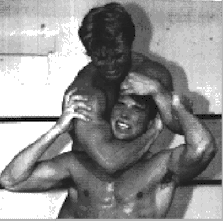
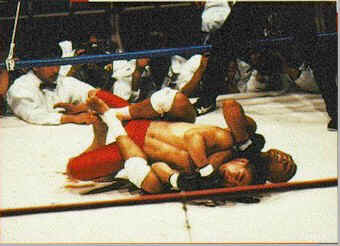
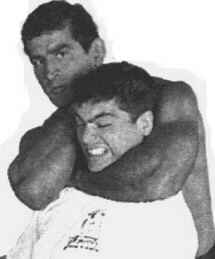
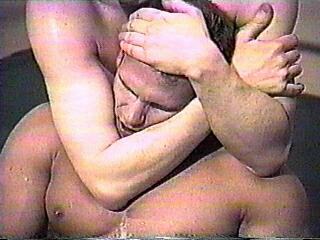
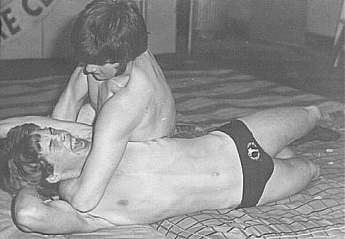
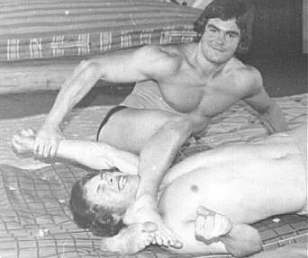
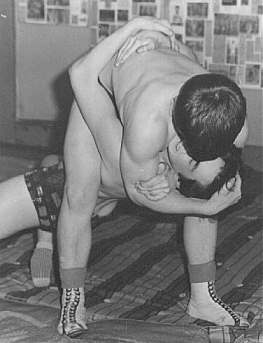
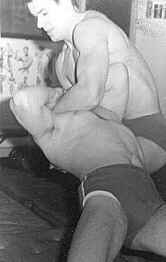
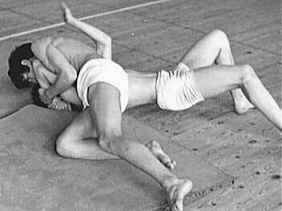
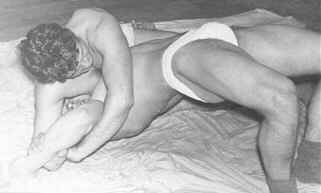
Strangle holds are different from
choke holds in that they do not apply direct and primary pressure against the windpipe,
but rather apply pressure TOWARD the carotid arterties. Unconsciousness is not the result
of "cutting the blood supply from the brain" by pinching the carotid arteries as
many incorrectly believe. The mechanism of strangle holds is to apply pressure to both
sides of the neck near the carotid sinus. By exciting the sinus nerve quickly, the vagus
nerve center in the brain becomes stimulted thereby exciting the vagus nerve. All of this
causes a slowing of the heart that creates a rapid fall in blood pressure, which in turn,
causes fainting. (By the way, blood supply to the brain cannot be closed off by carotid
artery compression since the vertebral arteries continue to supply blood to the brain).
Although strangle holds are not violent and do not cause physical
injury, they are dangerous. Normally, one will wake up within several seconds after
lapsing in unconsciousness. However, there are rare instances where proper strangle holds
result in a ceasation of breathing. Most traditional jujutsu ryu's train resuscitation
methods for this event.
Because of these risks, most jurisdictions consider strangle/chokes
deadly force. This is something to consider in applying your self-defense. If you apply
one of these techniques, you may find yourself charged with a felony.
Terence
|
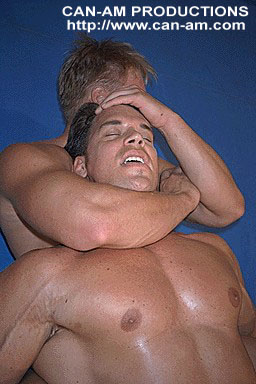
When trying to apply this choke to advanced guys, use the
opposite hand you usually choke with first! For example, if you usually slide your right
arm underneat, instead, slide your left arm underneath. When he tries to block this, THEN
you slide your right arm underneath and continue the choke. This is a little setup/trick
to get this on the advanced guys. Beginners you can just go for it.
|
Choke holds are only really
dangerous when you don't know how to do them. If all your choke experience comes from
watching an episode of Highlander, then stay away from it.
The last two issues of Inside Kung Fu magazine has a great set of
articles on the choke by Rorion Gracie, but here's my condensed version, gleaned from both
reading and jiu jitsu experience.
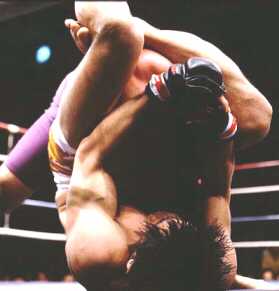
I can attest to the safety of a properly executed choke. I have
passed out from chokes probably about six times, and woke up within 20 seconds each time.
It's not painful, though it's scary going under the first time -- after all, no blood in
the brain is a good enough signal to me to stimulate a panic attack. But, waking up from
the experience is actually somewhat pleasant, reminiscent of using Nitrous Oxide at the
dentists office...
|
NEVER place the bar of your arm on someone's windpipe. Not only is
it dangerous, as it can cause permanent injury or death from crushing cartilage on the
windpipe, but it's a lousy choke. If you put the bone of your forearm againse someone's
windpipe, you're trying to choke them by cutting off air. That will take anywhere from 30
seconds to several minutes to accomplish, giving a desperate opponent plenty of time to
ruin you. If anything, this method of choking is far easier to escape from, because of the
time required to choke, plus the fact that it's not nearly as "tight" and secure
as a proper choke hold. A good choke applies pressure on the carotid
artery, NOT the jugular vein. Stopping the flow of the jugular would be of very limited
practical value. Stopping the carotid ends blood flow to the brain, causing the opponent
to pass out, often within six seconds. This isn't something that can be particularly
defended against, either. Even the strongest neck muscles would have a hard time resisting
the soft pressure of a well-leveraged choke.
To achieve a proper "naked" choke (one of dozens of choke forms), wrap
your strong arm around the victim's neck. As mentioned in an earlier post, place the crook
of your elbow exactly in front of his windpipe. Place the hand of your strong arm on your
biceps, or, if possible, your shoulder. Then place your other arm behind the victim's
neck, with your hand against the opponent's head for stability in case he tries a
backwards head butt (not to be confused with butt head). Place your head in the gap left
by your arms, and keep your eyes protected, because if he hasn't totally freaked out, he
WILL try to rip out an eye or two.
If you can, place a knee against his back. Then, while driving the knee in,
place gradual pressure on the neck by contracting your arm as in a biceps curl while
pressing the weak arm forward into his neck. Note I say gradual. This is not a safety
matter, because if you secured the choke correctly, the victim is perfectly safe. You want
to squeeze gradually because if you squeeze hard, you might exhaust your arm strength.
Rely on leverage, apply gradual pressure, and it's lights out for your friend.
|
| Well...there is some mis-information regarding
"chokeholds", so here is a basic synopsis. There are two basic choke types
(though many variations to apply them). 1. Tracheal Choke: In which pressure is applied to
the trachea (wind pipe) and the subject passes out because he/she/it cannot breathe. The
potential danger with this is great. The windpipe can collapse, the "Adam's
Apple" can crush under the pressure exerted by the user, and if applied to long,
death will occur. 2. Carotid Restraint: the user applies pressure to the Carotid arties
which in turn stimulates the Carotid Sinus nerve. Because of this stimulation, the Vagus
nerve "engages" and the body reacts by slowing down the heart. This slowing
causes blood pressure to drop, and the subject will become unconscious. NOTE: that it is
not true that the Carotid artery becomes "pinched" shut and blood ceases to flow
into the brain. Even if the blood was stopped at the carotids, blood would still reach the
brain via the Vertebral arteries. The danger of the Carotid Restraint are many: death,
stroke, heart attack, seizure, vomiting, etc....Feel free to email me with any
questions... |
 |
| Please excuse me if I got your position here backward. Are you
seriously ssuggesting that the PRIMARY mechanism of unconciousness in judo chokes is
stimulation of the vagus nerve?! Anyone who has ever watched someone
"choked" out knows that people turn red and purple when they are strangled. If
you have ever been choked out, you know that the feeling is that your head is going to
explode, not at all like a low blood pressure faint. If you notice carefully, the chokee's
pulse rate is usually racing from exertion.
Most judo chokes work by applying pressure around the entire cirecumference of
the neck as in a sliding lapel choke or by applying fairly direct pressure to the carotid
sinuses naked choke. In any case, the veins lie exterior to the arteries and because of
simple mechanics, they are compressed more than the arteries. In terms of unconciousness,
the lapel chokes are faster because they hit everything all the way around the neck (and
you can get fantastic leverage.)
Thus the primary mechanism of unconciousness is stagnatiion of the blood in the
brain caused by failure of venous return through the compressed veins. Obviously the
compression of the arteries helps, because it reduces flow into the brain as well which
increases stagnation. If vagus nerve stimulation worked faster, it would contribute too.
Stimulation of the vagus nerve is certainly an issue and in judo an unwelcome
one because bruising and swelling can cause stimulation to persist after the choke is
removed. Substantial swelling can actually impinge on the nerve causing tachycardia (rapid
heart beats, 400/min) and heart failure. This can occur minutes later.
As long as we are on the subject, strangulation is only part of the judo choke
holds. The pressure on the nerves on the neck and in the carotid sinus is quite painful in
itself and is useful for causing pain and panic instantly rather than waiting seconds for
the choke to take effect. In reality, these pressure points are what usualy drive the
opponent to give up or drive him into a position where the strangle can be locked down and
completed. The pressure points are key to strangling very muscular men who can otherwise
tense their sternomastoids to the point were they can protect the underlying veins. A
fairly pointed jab with a knuckle can sometimes quickly end that tension. Once lost even
for an instant, it is difficult to reestablish. (Small poeple just have to make up
by being nasty.)
At the same time, when we are talking about such jabs and nerve attacks, care
must be taken not to injure the vagus nerve and considerable restraint should be used on
friendlies. This sort of strangle is a major medical event, and though the momentary lack
of blood supply to the brain is unlikely to cause major harm, their increased pressure in
the head certainly is somewhat dangerous, the vagus stimulations is an issue, and the neck
contains lots of fragile structures.
I am surprised that the BJJ types here don't have more first hand experience
with chokes. I note that the Judo Guy, Mr Ohlenkamp, knew exactly what it felt like.
|