Tips for Netminders: Making Saves
There are a number of different saves that goaltenders
employ in the net. Often, different saves are ideal for
different skill levels and different situations. As you
perfect your skills, you fill find that you use some
techniques more than others, or meld them into new
techniques. This page describes some basic saves and
situations that arise. Before we get into actual save
positions, we thought we would mention information useful
to both scorer and goaltender. The following statistics
can give you some ideas about what your opponents are
aiming for. Keep these in mind when you are practicing.
Where Players Score From:
There are four areas that players score from the most
often. They are in the slot, ranging from right in front
of the goal to at a "bad angle". The first spot
is about 10-25 feet out from the goal in the middle of
the zone. The second spot is at a slight angle from the
middle of the zone. The third spot is "off
angle" near the face-off spots and the fourth spot
is at a "bad angle" beyond the face off spots.
The Area of the Net Most Goals are Scored:
70% of goales are scored on the stick side. 20% of goals
are scored on the glove side. 10% of goals are scored
between the feet, rebounds, deflections, etc.
Height of Goals Scored:
Over 66% of all goals scored are below the goalie's
knees. This is because these shots are easier to
tip/deflect, they are hard work for the goalie and they
create the most rebounds. 20% of goals are scored
shoulder high or above. %10 of goals are scored between
the knee and the shoulder.
Now onto different types of saves...
Butterfly:
The butterfly save is good for beginners, because it is
relatively simple in its motion, and fairly easy to get
up from. When attempting a butterfly save, assume your
stance. Then, open your feet wider and set yourself
lower. When the puck comes at you, drop both knees to the
ice. Keep your hands and shoulders up and your stick on
the ice. Meet the puck in front, and cover it if
possible. If the shot misses the goal, pull one knee up
and then the other, or jump straight back into your
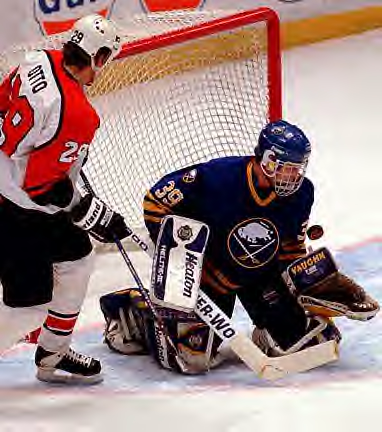
stance. Here is a photo of Dominik Hasek in the butterfly position.
Skate Save (or Stick Save - depending on which you block
the puck with):
This save allows for good rebound control. It starts with
a good stance. Keep your eye on the puck, and watch for
the release. Turn your hips and drop your rear end. Drop
one pad to the ice and extend your skate in a semi
circular motion, keeping the blade on the ice. In your
final position, your toe should point to the corner. You
can also block with your stick in a sweeping motion. Here
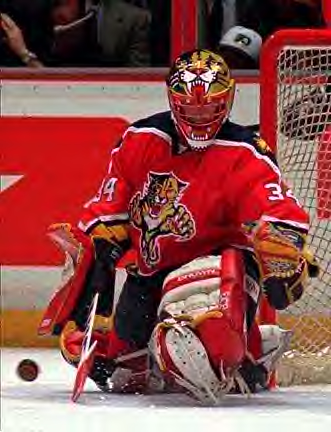
is an excellent example of John Vanbiesbrouk employing the skate/stick save.
Two Pad Slide (Also Referred as "Stacking the
Pads"):
This save requires a good set at one of the posts. Keep
your weight on your inside leg and leave the post as the
puck is passed. Push towards the shooter's stick and go
down quickly on your side. Kick your feet and stack your
pads. Block the net with your catch glove or blocker
(depending which direction your are moving in). There is
another save, commonly done by Ron Hextall, which starts
out with a good stance. Turn your hips and lay one pad
down at the ice - at an angle, with your skate out. Keep
your glove out in front, with your arm tight to your
body. Your skate should be ready to be thrown out in a
semi-circle. Your blocker arm should also be in tight.
The move is same in the other direction.
When You are Screened:
Being screened stinks, but it is something every goalie
has to deal with. It is always going to be hard to make a
save when you are being screened, but here's some tips to
help. Read the pass to the player you are being screened
from. Move quickly as close to the screener as possible
(unless there is a man at the corner of the net... in
which case, you would want to stay back and keep him from
tipping it in). Set up for the butterfly save and listen
for the shot. Keep your stick on the ice and glove up and
open. React to the shot as needed.
In Case of Deflections:
Deflections are an unpredictable result of hockey, but a
goalie has to try and make the best of it. You cannot
always assume that the puck will move from the shooter to
you. Always keep alert for anything that might cause a
deflection. If the ice is congested, establish a stance
as quickly as you can. Try and know where the possible
deflections are. Always remember to face and play the
shooter. Wait for the shot, and then push towards the
deflector's stick. Execute the butterfly or stick/skate
save. As you become more experienced, you will be able to
read possible deflections more accurately and more
quickly. Just remember to not panic and practice reading
the angles.
On Breakaways:
Breakaways are many goalies' worst nightmares. Even the
best goaltender cannot stop most breakaway shots. Just be
alert and try your best. Try and stay accutely aware of
the play and see it coming early. Dash out to the hash
marks and try and gauge the speed of the puck carrier.
Start skating back hard when the shooter is 20 to 25 ft
out from th net. Try to match his speed with your
backward motion. Keep your eye on the puck, not the
shooter or his stick. Wait for him to commit himself to a
direction. When he dekes, push laterally, and react to
the shot with an appropriate save.
Well, we hope these tips have been helpful in giving you
perspective on some different saves and situations to use
them in. We are by no means professional goaltenders,
however, so if you have anything to add, or see any
mistakes in this writing, please feel free to e-mail us.
And keep up the good goaltending!
Home_________ Skaters ___________Links
© Copyright 1998 The Hockey Phreak and Elephy Designs. All rights reserved.
|