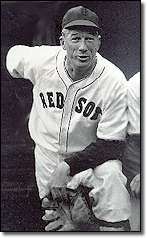
Robert Moses "Lefty" Grove
He came to the Red Sox with a resumé that was as impressive as the
fastball his left arm uncorked. A member of the Philadelphia Athletics
from 1925-1933 (he didn't make the big leagues until he was 25), Grove
led the American League in strikeouts for seven consecutive years (1925-1931).
Nine times he led AL pitchers with his stingy ERA in his 17-year career.
Only two other pitchers led the league in ERA as many as five times.
Known for his ferocious temper (which included kicking buckets, screaming
at teammates and re-arranging locker rooms), Grove came to the Red Sox
for $125,000 with lefthanded pitcher "Rube" Walker and second baseman Max
Bishop when Connie Mack sought financial relief with his Philadelphia A's.
It was quite a steal for Boston to pick up a pitcher who posted 20 wins
or better from 1927 through 1933, including 31 wins in 1931. His winning
percentage led the league five times and four times he led in wins. In
that same magical year of 1931, he tied "Smoky" Joe
Wood's and Walter
"Big Train" Johnson's record of 16 consecutive wins. A misjudged fly
ball by a substitute fielder accounted for the winning run crossing the
plate and the end of the streak.
Due to arm problems, Grove's first year with the Sox with new owner
Tom Yawkey was a struggle -- so much so that
Connie Mack offered Tom Yawkey a refund. Yawkey kindly declined the offer
as Grove pitched to an 8-8 record, the first time he failed to reach 20
wins since 1926. Despite the setback, Grove was back to form in 1935, posting
a 20-12 mark and a league-leading 2.70 ERA.
With his overpowering fastball and tempermental days behind him, Grove
became a smarter pitcher as his career progressed. He went 17-12 in 1936
for Boston, 17-9 in 1937, 14-4 in 1938 and 15-4 in 1939. In four of his
eight years with the Red Sox he led the league in ERA.
On July 25, 1941, at 41-years old, "Lefty" Grove put the finishing touches
on his spectacular career. Pitching through nine innings and 90-degree
heat, Grove notched his 300th win in a 10-6 win over Cleveland and became
the fifth all-time winningest pitcher in baseball history.
He was elected to the Hall of Fame in 1947.