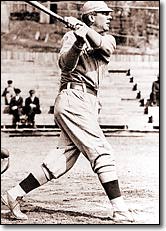
Tris Speaker
"Spoke" was born in a center fielder's mold, which he broke soon after
he retired in 1928. Nobody manning center field has been able to recreate
it since.
Tristram "Tris" Speaker had all of the tools which he used to be the
greatest of all time to field his position (with all due respect to Mantle
and DiMaggio). Blessed with blazing speed and a cannon of an arm, Speaker
played so shallow in center he frequently acted as an extra infielder.
On several occasions he turned unassisted double plays. "'Spoke' was something
extra special," said the great Babe Ruth. "Only those who played with or
against him really appreciated what a great player he was."
"In my Red Sox pitching days, I would hear the crack of the bat and
say, 'There goes the game.' But Tris would turn his back to the plate,
race for it out to the fences and at the last moment make a diving catch.
Not once, but a thousand times."
"I figured that 98 percent of all safe hits to the outfield drop in
front of the outfielders," Speaker said after his playing days. "Only two
percent go over their heads or between them. That's why I played close
in."
Teamed with Harry Hooper in right and Duffy Lewis in left, Speaker was
one third of what many consider to be the greatest defensive outfield of
all time.
His greatest moment came in the 1912 World Series against the New York
Giants. Down 2-1 in the 10th inning of the final game with one man on,
Speaker lofted a foul ball between home and first. It would have been an
easy out for first baseman Fred Merkle but Giants' pitcher Christy Mathewson
called for catcher Chief Myers to make the play. Merkle made a last-minute
attempt, got a glove under it, but couldn't hang on. The play became known
as "Merkle's Muff," as Speaker used his new life to hit a game-tying single
and the Sox later went on to win the game and the Series.
"Spoke's" numbers speak volumes of his talent: his 448 lifetime assists
still stand as a record, his .344 lifetime batting average was notched
over a 22-year playing career and nobody has even come close to threatening
his 793 career doubles. Speaker set major league records in 1909 and 1912
by gunning down 35 baserunners.
What isn't in the record books, however, are the number of runners who
didn't dare run against him.