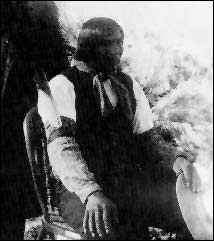
Wovoka
Jack Wilson
(c.1856-1932)
Known as the messiah to his followers, Wovoka was
the Paiute mystic whose religious pronouncements spread the Ghost Dance
among many tribes across the American West. Wovoka was born in Western
Nevada, in what is now Esmeralda County, in about 1856. Little is known
about his early life, but at about age fourteen his father died, leaving
Wovoka to be raised by the family of David Wilson, a nearby white
rancher. Wovoka soon took the name Jack Wilson, by which he was broadly
known among both neighboring whites and Indians, and worked on Wilson's
ranch well into adulthood. He learned to speak English and apparently
had a fair amount of contact with Christianity.
At around age thirty, Wovoka began to weave
together various cultural strains into the Ghost Dance religion. He had
a rich tradition of religious mysticism upon which to draw. Around 1870,
a northern Paiute named Tävibo had prophesied that while all whites
would be swallowed up by the earth, all dead Indians would emerge to
enjoy a world free of their conquerors. He urged his followers to dance
in circles, already a tradition in the Great Basin area, while singing
religious songs. Tävibo's movement spread to parts of Nevada,
California and Oregon.
Whether or not Tävibo was Wovoka's father, as
many at the time assumed, in the late 1880's Wovoka began to make
similar prophecies. His pronouncements
heralded the dawning of a new age, in which whites would vanish, leaving
Indians to live in a land of material abundance, spiritual renewal and
immortal life. Like many millenarian visions, Wovoka's prophecies
stressed the link between righteous behavior and imminent salvation.
Salvation was not to be passively awaited but welcomed by a regime of
ritual dancing and upright moral conduct. Despite the later association
of the Ghost Dance with the Wounded Knee Massacre and unrest on the
Lakota reservations, Wovoka charged his followers to "not hurt
anybody or do harm to anyone. You must not fight. Do right always... Do
not refuse to work for the whites and do not make any trouble with
them."
While the Ghost Dance is sometimes seen today as
an expression of Indian militancy and the desire to preserve traditional
ways, Wovoka's pronouncements ironically bore the heavy mark of popular
Christianity. His invocation of a "Supreme Being,"
immortality, pacifism and explicit mentions of Jesus (often referred to
with such phrases as "the messiah who came once to live on earth
with the white man but was killed by them") all speak of an
infusion of Christian beliefs into Paiute mysticism.
The Ghost Dance spread throughout much of the
West, especially among the more recently defeated Indians of the Great
Plains. Local bands would adopt the core of the message to their own
circumstances, writing their their own songs and dancing their own
dances. In 1889 the Lakota sent a delegation to visit Wovoka. This group
brought the Ghost Dance back to their reservations, where believers made
sacred shirts -- said to be bullet-proof -- especially for the Dance.
The slaughter of Big
Foot's band at Wounded
Knee Creek in 1890
was cruel proof that whites were not about to simply vanish, that the
millennium was not at hand. Wovoka quickly lost his notoriety and lived
as Jack Wilson until sometime in 1932. He left the Ghost Dance as
evidence of a growing pan-Indian identity which drew upon elements of
both white and Indian traditions.
Back |