KFOR MYASS!!!
Especially
for KFOR's actions in Kosovo...
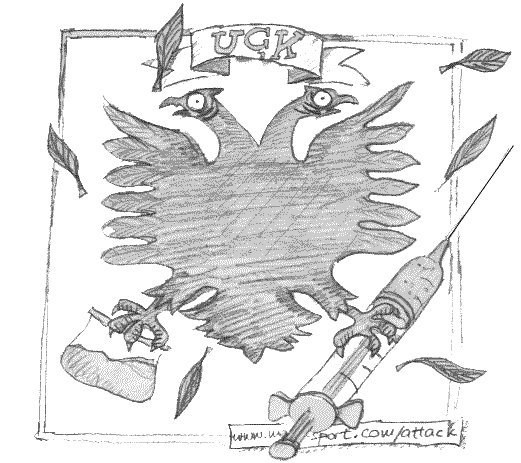
The KLA wants all of Kosovo, most of Macedonia, some
of Montenegro,
even part of Greece and Bulgaria. Then they
'll march on Tirana, Albania
to complete the 'reunification.' And if we know
that, no one can tell us
that NATO doesn't.
UNBELIEVABLE?
Kosovo
War: KLA finances war with heroin sales
Germans
Detain 25 KLA Rebels who jailed, tortured and killed Kosovars
KLA
CHIEFS ACCUSED OF KILLING OFF THEIR RIVALS
KLA
agrees to become a "civilian force"
KLA
signs transformation into UN-approved civilian force
KLA,
KFOR sign accord
Kosovo
force a step towards province's "liberation": Thaci
Heroin
Heroes!
KFOR
aware of Albanian extremists crossing Kosovo border
War
fears as Albanian fighters seize Serb land
Kosovo
Albanian fighters put on show of force
Kosovo
Rebels Mass Arms-Yugoslav Army Chief
Albanians
Hurt French, Serbs, and Albanians in Kosovo Clash
KFOR
Gives Kosovo's "Glittering Prize" to KLA Drug Dealers
"Most
Valuable Piece of Real Estate in Balkans" Now Under KLA Direction
Rugova
supports Kosovo's independence, NATO membership
Belgrade
Says Mortars Fired at Area Near Kosovo
Robertson praises infamous
terrorist
Albanian
extremists warn about "new wars and further atrocities"
Kosovo
peacekeepers find secret training camp, big weapons cache
KLA investigated over war crimes
Kosova Albanian soldiers accused of warcrimes
KFOR
denies that the discovered warehouses were left by YA and MUP: Weapons
in Klecka belonged to the KLA
Kosovo
Albanians Stage First Anti-KFOR Demo, Demand Arms Back
A
UN official left Kosmet under threat; Peacekeepers runaway from terrorists!
UNMIK
proposes law on municipalities in Kosovo: Serbs for, Albanians against.
Shiptars oppose the opening of local Serb offices
KOSOVO
ALBANIAN OPPOSITION, PRESS OPPOSE SERB NATIONAL COUNCIL, UNMIK AGREEMENT
Thaci
Presents Kosovo's UN Government with a List of Demands
Kosovo
party resumes normal ties with U.N.
Peacekeepers
Find Drugs in Kosovo Village During Weapons Search
3
Serb Men Shot in Kosovo Attack - Dita will continue publishing names of
"criminals"
Violence
feared as KLA fund dries up
Serbian
Farmer Vanished Near Ethnically Mixed Kosovo Town
More
hidden weapons were discovered!
Local
Albanian Official Injured in Kosovo Shooting
More
Kosovo Albanian Officials Wounded in Shooting
Moderate
Kosovo Party Hit Again by Violent Attack
Wife
of Kosovo Political Leader Killed in Blast at Her Home
Violence
hits Kosovo politicians
Missing
Albanian politician found burnt to death
NATO
in Kosovo: in bed with a scorpion
Senator
Lieberman - Apologist for the fascist KLA
UN
POLICE DISCOVER MASS GRAVE OF 160 KIDNAPPED SERBS
160
Serbs reportedly found in Kosovo grave; Western press is silent
Two
Emirati peacekeepers were injured in a revenge attack by Albanians
KLA
faces trials for war crimes on Serbs - Inquiry turns on Albanians
Former
Guerrilla Leader Thaci Launches Kosovo Election Campaign
Kosovo
is not a part of Serbia anymore!
KLA-KPC
Chief Killed, Mutilated In Gang-Ridden NATO Protectorate
Kosovo
War: KLA finances war with heroin sales
http://www.canadianserbs.com/war_stories/kosovo/facts_kosovo_drugkla.htm.
Washington Times
May 3, 1999
By Jerry Seper
The Kosovo Liberation Army, which the Clinton
administration has embraced and some members of
Congress want to arm as part of the NATO bombing
campaign, is a terrorist organization that has
financed much of its war effort with profits from the
sale of heroin.
Recently obtained intelligence documents show that
drug agents in five countries, including the United
States, believe the KLA has aligned itself with an
extensive organized crime network centered in Albania
that smuggles heroin and some cocaine to buyers
throughout Western Europe and, to a lesser extent, the
United States.
The documents tie members of the Albanian Mafia to a
drug smuggling cartel based in Kosovo's provincial
capital, Pristina. The cartel is manned by ethic
Albanians who are members of the Kosovo National
Front, whose armed wing is the KLA. The documents show
it is one of the most powerful heroin smuggling
organizations in the world, with much of its profits
being diverted to the KLA to buy weapons.
The clandestine movement of drugs over a collection of
land and sea routes from Turkey through Bulgaria,
Greece and Yugoslavia to Western Europe and elsewhere
is so frequent and massive that intelligence officials
have dubbed the circuit the "Balkan Route."
Mr. Clinton has committed air power and is considering
the use of ground troops to support the Kosovo rebels
against Yugoslav President Slobodan Milosevic. Last
week, Sen. Mitch McConnell, Kentucky Republican, and
Sen. Joseph I. Lieberman, Connecticut Democrat, called
on the United States to arm the KLA so ethnic
Albanians in Kosovo could defend themselves against
the Serbs.
Mr. McConnell and Mr. Lieberman introduced a bill that
would provide $25 million to equip 10,000 men or 10
battalions with small arms and anti-tank weapons for
up to 18 months.
In 1998, the U.S. State Department listed the KLA --
formally known as the Ushtria Clirimtare e Kosoves, or
UCK -- as an international terrorist organization,
saying it had bankrolled its operations with proceeds
from the international heroin trade and from loans
from known terrorists like Osama bin Laden. "They were
terrorists in 1998 and now, because of politics,
they're freedom fighters," said one top drug official
who asked not to be identified.
The U.S. Drug Enforcement Administration, in a recent
report, said the heroin is smuggled along the Balkan
Route in cars, trucks and boats initially to Austria,
Germany and Italy, where it is routed to eager buyers
in France, Germany, Italy, the Netherlands, Portugal,
Spain, Switzerland and Great Britain. Some of the
white powder, the DEA report said, finds its way to
the United States.
The DEA report, prepared for the National Narcotics
Intelligence Consumer's Committee (NNICC), said a
majority of the heroin seized in Europe is transported
over the Balkan Route. It said drug smuggling
organizations composed of Kosovo's ethnic Albanians
were considered "second only to Turkish gangs as the
predominant heroin smugglers along the Balkan Route."
The NNICC is a coalition of federal agencies involved
in the war on drugs.
"Kosovo traffickers were noted for their use of
violence and for their involvement in international
weapons trafficking," the DEA report said.
A separate DEA document, written last month by U.S.
drug agents in Austria, said that while the war in the
former Yugoslavia had reduced the drug flow to Western
Europe along the Balkan Route, new land routes have
opened across Romania, Hungary and the Czech Republic.
The report said, however, the diversion appeared to be
only temporary.
The DEA estimated that between four and six metric
tons of heroin leaves each month from Turkey bound for
Western Europe, the bulk of it traveling over the
Balkan Route.
A second high-ranking U.S. drug official, who also
requested anonymity, said government and police
corruption in Kosovo, along with widespread poverty
throughout the region, had contributed to an increase
in heroin trafficking by the KLA and other ethnic
Albanians. The official said drug smuggling is "out of
control" and little is being done by neighboring
states to get a handle on it.
"This is the definition of the wild, wild West," said
the official. "The bombing has slowed it down, but has
not brought it to a halt. And, eventually, it will
pick up where it left off."
The heroin trade along the Balkan Route has been of
concern to several countries:
The Greek representative of Interpol reported in 1998
that Kosovo's ethnic Albanians were "the primary
sources of supply for cocaine and heroin in that
country."
Intelligence officials in France said in a recent
report the KLA was among several organizations in
southern Europe that had built a vast drug-smuggling
network. France's Geopolitical Observatory of Drugs
said in the report that the KLA was a key player in
the rapidly expanding drugs-for-arms business and
helped transport $2 billion worth of drugs annually
into Western Europe.
German drug agents have estimated that $1.5 billion in
drug profits is laundered annually by Kosovo
smugglers, through as many as 200 private banks or
currency-exchange offices. They noted in a recent
report that ethnic Albanians had established one of
the most prominent drug smuggling organizations in
Europe.
Jane's Intelligence Review estimated in March that
drug sales could have netted the KLA profits in the
"high tens of millions of dollars." The highly
regarded British-based journal noted at the time that
the KLA had rearmed itself for a spring offensive with
the aid of drug money, along with donations from
Albanians in Western Europe and the United States.
Several leading intelligence officials said the KLA
has, in part, financed its purchase of AK-47s,
semiautomatic rifles, shotguns, handguns, grenade
launchers, ammunition, artillery shells, explosives,
detonators and anti-personnel mines through drug
profits -- cash laundered through banks in Italy,
Germany and Switzerland. They also said KLA rebels
have paid for weapons using the heroin itself as
currency.
The profits, according to the officials, also have
been used to purchase anti-aircraft and anti-armor
rockets, along with electronic surveillance equipment.
Germans
Detain 25 KLA Rebels who jailed, tortured and killed Kosovars
By MELISSA EDDY Associated Press Writer
Friday June 18 1:46 PM ET
PRIZREN, Yugoslavia (AP) - German soldiers detained 25 ethnic
Albanian rebels today after finding one elderly man
dead and more than 15 others hurt in a police station that had been
under control of the Kosovo Liberation Army since early this week.
Most of the victims seemed to be ethnic Albanians
or Gypsies between the ages of 50 and 60, said Lt. Col. Dietmar
Jeserich, a spokesman for
the German army serving in the Kosovo peace force in the region.
During the Kosovo conflict that started February 1998 and ended in a
peace deal last week, the
KLA had assassinated not only Serbs but also ethnic Albanians and
Gyspies believed loyal to the
Belgrade regime of Slobodan Milosevic.
One man in his 70s was found dead, chained to a chair. He appeared to
have died shortly before
the German soldiers arrived, Jeserich said.
Most of the injured had bloody wounds and bruises, many on their faces.
One man had huge purple
welts across his back. Two or three others had what appeared to be
stab
wounds in their legs.
Many were found chained to radiators, Jeserich said.
The wounded received first aid at the scene, then were transferred to
a
nearby military hospital.
About 25 KLA members were detained and marched away from the police
station under German
guard. It was unclear where they were taken.
One man, who gave his name as Gani Berisha, said the KLA had beaten
him,
although he insisted
he had done nothing wrong. Other victims said they had been accused
of
stealing and of burning houses.
German troops found a stash of weapons, including grenades, machine
guns, mortars and shells.
They also found heavy wooden sticks and spikes with nails that they
said
appeared to be ``instruments of torture.''
KLA
CHIEFS ACCUSED OF KILLING OFF THEIR RIVALS
by Chris Hedges (Rick Rozoff's
comments in brackets)
New York Times
June 24, 1999
The senior commanders of the Kosovo Liberation
Army, which has signed an agreement
with NATO to disarm, carried out assassinations, arrests and purges
within their ranks to thwart
potential rivals, say current anf former commanders in the rebel army
and some Western
diplomats.
The campaign, in which as many as a half-dozen
top rebel commanders were shot dead,
was directed by Hashim Thaci and two of his lieutenants, Azam Syla
and Xhavit Haliti, these
officials said.Thaci denied through a spokesman that he was responsible
for any killings.
Although the United States has long been wary of the KLA, the rebel
group has become the
main ethnic Albanian power in Kosovo.
Rebel commanders supplied NATO with target information during the bombing
campaign. Now,
after the war, the United States and other NATO powers have effectively
made partners of Thaci
and the KLA in the rebuilding [?!] of Kosovo. The agreement NATO signed
with Thaci, for
example, envisions turning the KLA into a civilian police force and
leaves open the possibility
that the KLA could become a provisional army modeled on the National
Guard in the United
States. [Remember Kent State? South Central Los Angeles after the first
Rodney King
verdict?]
While none of the KLA officials interviewed
witnessed Thaci or his aides execute anyone,
they recounted episodes in which Thaci's rivals were killed shortly
after Thaci or one of his
aides had threatened them with death.
"When the war started, everyone wanted to
be chief," said Rifat Haxhijaj, 30, a former
lieutenant in the Yugoslav army who left the rebel movement last September
and now lives in
Switzerland. "For the leadership, this was never just a war against
Serbs [note, all Serbs] - it
was also a struggle for power."
Thaci's representative in Switzerland, Jashae
Salihu, denied accounts of assassinations.
"These kind [sic] of reports are untrue," he said. "Neither Thaci nor
anyone else from the KLA
is involved in this kind of activity. [Oh, no, never] Our goal has
been to establish a free Kosovo
[Free of Serbs, Roma, Turks, Goranis and Albanian "collaborators,"
that is] and nothing more."
The accusations of assassinations and purges were
made in interviews with about a dozen
former and current Kosovo Liberation Army officials, two of whom said
they had witnessed
executions of Thaci's rivals. [Didn't the writer say just the opposite
a few paragraphs ago? Well,
it is from the New York Times, after all.] Similar charges also were
leveled by a former senior
diplomat for the Albanian government, a former police official who
worked with the rebel
[read:terrorist] group and several Western diplomats. [Wonder who they
would be....]
But the State Department yesterday challenged some
[!] aspects of these accounts. "We
simply don't have information to substantiate allegations that there
was a
KLA-leadership-directed program of assassinations or executions," said
State Department
spokesman James Rubin. [Of course. Is he one of the Western "diplomats"?
Translated from
the all but unintelligible bureaucratese: Rubin, who "confirmed" the
same Thaci's claim of
100,000 Albanian men rounded up in the Pristina sports stadium in early
April - when no one
was there - can't "substantiate" his hired killer's hits. Odd....]
Rubin said he could not exclude the possibility
that the rebel leaders were somehow tied to
the killings. ["Somehow"? As in ordering and implementing them?] But
he said Wednesday that
the department officials had checked a wide range of sources in the
previous 24 hours and
could not confirm the accusations. [How about checking with Thaci himself?
Or with his CIA
and MI6 handlers? Rubin wouldn't even have to made a long-distance
call.]
A senior State Department official and a Western diplomat
in the Balkans, citing intelligence
reports and extensive contacts with the KLA officials inside and outside
Kosovo [Read: long
experience arming, financing, training and commanding them], said they
were aware of
executions of midlevel officers suspected of collaborating with the
Serbs [Let's get this straight:
Rubin "checked" and "could not confirm" the killings, but an official
from his own Department
confirmed just that to a Times reporter?], but said they had no evidence
to link those killings
with Thaci. [Maybe Rubin did call Thaci, on a private hotline, and
Thaci obligingly denied the
accusations - so as not to embarrass the State Department, of course.
Plausible deniablity and
all that.]
Former and current KLA officials also charge
that a campaign of assassinations was carried
out in close cooperation with the Albanian government, which often
placed agents from the
Albanian secret police at the disposal of the rebel commanders. [Recall,
the KLA is, if you
believe the U.S. State Department, an "autonomous" Kosovar organization
whose "goal is to
establish a free Kosovo and nothing more." Not, for example, a Greater
Albania, ethnically
cleansed of all other national and religious groups. And of course
the U.S. State Department
has no "contacts" within the Albanian government and secret police
they could "check" this
story out with, right?]
Rubin said the State Department did not have any
information to suggest that the KLA
leadership directed an execution program in conjunction with the Albanian
security services.
[Pinnochio, your nose is getting longer. Try calling the Times
reporter; he seems to have the
information you somehow can't find, James.]
Two former rebel leaders and a former Albanian police
official, interviewed in Tirana, said
that Haliti, who is officially Thaci's ambassador to Albania, was working
in Kosovo with 10
secret police agents from Albania to form an internal security network
that would be used to
silence dissenters in Kosovo. ["Free and independent" Kosovo?]
Thaci, 30, has named a government, with himself
as prime minister ["Free, democratic"
government, no doubt - just ask James Rubin], and denounced Ibrahim
Rugova, who for nearly
a decade was the self-styled president [Self-appointment is evidently
a "democratic" tradition
among the "freedom fighters"] of Kosovo and ran a successful campaign
of non-violent protest
after the Serbs stripped Kosovo of its autonomy in 1980. [Aha! That
explains the U.S./NATO
assertions immediately after the bombing began that Rugova had been
killed by the
Yugoslavs: One of Thaci's assassins failed in his mission. I wonder
where he's buried.]
KFOR
says KLA agrees to become "civilian force"
PRISTINA, Yugoslavia, Sept 8 (AFP)
- The Kosovo Liberation Army (KLA) has
reached agreement in principle with
the NATO-led force KFOR to turn itself into a
civilian force after its forthcoming
disarmament deadline, a senior KFOR officer
said Wednesday.
The text of an agreement with the
KLA is to be submitted to the United Nations by
the UN's mission chief in Kosovo,
Bernard Kouchner, who is currently in New York,
KFOR's French second-in-command
General Jean-Claude Thomann said.
"There should be a force of 3,000
active personnel, with 2,000 reservists. Its
emphasis will be humanitarian, with
the mission of taking on the task of the
reconstruction of Kosovo," he said.
According to the general, the model
for the new force will be France's Civil
Protection Service, a 1,200-strong
body responsible for urgent intervention in
large-scale accidents or natural
disasters -- most recently during last month's
earthquake in Turkey.
The text of the agreement says that
the KLA can keep 200 revolvers for the
self-protection of its senior officers,
the general said.
This falls far short of the demands
of many KLA commanders, who want the
organisation to remain a significant
armed force, despite its undertaking to KFOR
to hand over all its weapons by
September 19.
"In the short to medium term, there's
no question of a (Kosovo Albanian) army,"
said General Thomann. After September
19, those who had not handed over their
weapons would be considered "armed
rebel gangs."
The general said the cost of implementing
the agreement would be between 72
and 82 million euros (75 to 85 million
dollars), spread over three to five years. He
asked for the help of the international
community in paying for it.
"If we don't find the money to put
the deal into effect on September 19, we'll have
our backs up against the wall,"
he said.
KLA
signs transformation into UN-approved civilian force
PRISTINA, Yugoslavia, Sept 20 (AFP)
- The Kosovo Liberation Army
(KLA), signed an agreement late
Monday with the NATO-led
peacekeeping force KFOR transforming
the ex-rebel group into a
purely civilian security force,
KFOR and UN officials here said.
The new force, known
as the "Kosovo Protection Corps", will be
headed by the KLA's former military
chief, Agim Ceku, the UN
administrator for Kosovo, Bernard
Kouchner, said after the signing.
The KLA's political
leader, Hashim Thaci, announced during the
extended talks leading up to the
agreement that he is now the head
of a new, but as-yet-unnamed party
which will campaign for Kosovo's
independence.
The signing of the
agreement marks the end of a three-month
phased process of disarming and
demilitarising the KLA, which was
formed in 1992 to combat Belgrade's
repression of ethnic Albanians
in the Serbian province.
The document was signed
by Ceku, Thaci, the KFOR commander,
British Lieutenant General Mike
Jackson, the NATO supreme commander
in Europe, US General Wesley Clark,
and Kouchner.
"We have signed an
historic document," Clark said as the four
men formed a circle to shake hands
to applause.
Jackson said the negociations
were "difficult" but added "We
have now to congratulate general
Ceku" -- something Kouchner did
immediately.
Thaci, for his part,
seemed distant. Observers said the youthful
leader had been entertaining hopes
of heading up the civilian force
to add muscle to his ambitions of
being president of an independent
Kosovo.
The genial finish to
the day was in marked contrast to the
tensions felt before the signing.
An undertaking signed
on June 21 by Thaci and Jackson which set
out the timetable for the process
stipulated a deadline of September
20 for the KLA's demise.
But KFOR and UN officials
were forced to extend that time limit
by 48 hours when the KLA opposed
restrictions imposed on the
creation of the civilian security
force which will succeed it.
In particular, the
KLA wanted the force -- which is to count
3,000 regulars and 2,000 reservists
-- to be the nucleus of a
"national" army for an independent
Kosovo.
The former rebels demanded
that the force have an arsenal of up
to 2,000 handguns, brandish Albania's
two-headed eagle appropriated
by the KLA as its insignia and have
the word "army" in its name in
Albanian.
But KFOR and the UN
negotiators, insisting on the UN resolution
recognising that Kosovo remains
a sovereign part of Serbia, knocked
down those demands, saying that
the new force would only be a sort
of national guard to be used for
operations such as disaster relief
efforts.
Under its UN mandate,
KFOR is the sole armed force permitted in
Kosovo, and the peacekeeping force
said that the civilian force
would be permitted only 200 pistols
and that it could not use the
Albanian emblem nor present itself
as an army.
That disagreement --
and friction between Ceku and Thaci, UN
sources said -- bogged down the
negotiations and forced General
Clark to fly in to Pristina Monday
to add his weight to the talks.
It was not immediately
clear what the details of the
transformation agreement entailed,
but observers said KFOR was
likely to keep a careful watch out
for renegade elements of the KLA
who might not accept the deal.
There is also concern
that one of the key phases of the KLA's
demilitarisation -- its disarming
-- might not have been completely
fulfilled, despite assurances from
Ceku.
The ex-rebel military
chief said 10,000 weapons had been handed
over to KFOR since the June 21 undertaking,
but the fact that many
of the arms appeared to be old or
unusable and that the KLA claimed
it still had 10,700 fighters under
its command raised fears of
hidden weapons caches.
KLA,
KFOR sign accord
PRISTINA, Yugoslavia, Sept. 20 (UPI) -- After 26 hours of marathon
negotiations led by NATO commander
Gen. Wesley Clark, the Kosovo
Liberation Army agreed to disband
and transform itself into a lightly
armed, 5,000-member civil guard
called the Kosovo Protection Force.
Leaders of the KFOR international peacekeeping force and the KLA
signed the agreement late Monday
to demilitarize the ethnic Albanian
separatist force and transforming
it into a 5,000-member civilian corps.
Bernard Kouchner, the top United Nations administrator in Kosovo,
presented the KLA's Gen. Agim Ceku
with a letter appointing him
commander of the provisional force.
A KFOR statement issued in Pristina on Monday night said members of
the corps ``responsible for guarding
and protection duties'' would be
allowed to retain 200 weapons. A
limited number of small arms will also
be available for personal protection,
the statement said.
The agreement was to be signed Sunday at midnight, but after the
deadline passed, British Lt. Gen.
Sir Mike Jackson, the military leader
of KFOR, extended it until midnight
Tuesday.
Talks snagged on issues including the size of the corps, the number
of weapons it would be allowed to
carry, and whether it would form the
nucleus of a regular defense force
-- as the KLA wanted -- or be charged
only with carrying out humanitarian
and relief work, as NATO insisted.
The accord was signed by Kouchner, Jackson, Ceku and the KLA's
political leader, Hashim Thaci.
Clark, who arrived in Pristina early in the day to press the Albanian
side to accept the deal, also attended
the ceremony.
Earlier Monday, KFOR officials expressed satisfaction with the scope
of KLA disarmament, saying it had
met the requirements spelled out in
the demilitarization agreement.
The weapons handed in to KFOR so far include 9,000 infantry weapons,
800 machineguns, 300 anti-tank weapons
and 178 mortars. Also surrendered
were 27,000 hand grenades, 1,200
mines and a ton of explosives, KFOR
said.
Last June, KLA leaders agreed to a 90-day process in which the group
was to remove its uniforms and hand
in weapons. Under the plan, most of
the personnel would then return
to civilian life, while a few would be
retained for a civil corps.
Immediately after the war, NATO leaders made clear they didn't intend
to completely disarm members of
the KLA, which is composed primarily of
rural men. KFOR demanded the return
of only heavy military arms.
Going into Sunday's talks, the KLA had wanted the name of the corps
to be translatable as the Kosovo
Army Corps, said a Pentagon source
close to the debate. The name Kosovo
Protection Corps appears to be a
compromise between that and NATO's
proposed name, the Kosovo Corps.
Thaci had wanted 400 members of the corps to be armed, but in the end
agreed to 200.
The corp's access to stored weapons was also an issue, with the KLA
wanting the authority to issue weapons
and establish ``rules of
engagement'' -- that is, when and
how corps members can employ the
weapons.
No details were immediately available on how the weapons control
issue was resolved.
During a break in his talks with Clark on Monday, Thaci announced he
would form a new political party
of Kosovo Albanians to promote
democracy and an independent Kosovo.
Thaci said he was holding discussions with other political leaders so
as to create the broadest possible
base for the party.
Kosovo
force a step towards province's "liberation": Thaci
PRISTINA, Yugoslavia, Oct 16 (AFP) - Kosovo's new protection
force is another next step leading to the province's independence
from Yugoslavia, the former political chief of Kosovar Albanian
rebels said Saturday.
"You represent the future, the security, peace, democratization
and the total liberation of Kosovo," Hashim Thaci said in an
impromptu speech at the first "graduation" ceremony for the force.
Thaci, who was not expected at the ceremony, was invited
to the
podium by Nuredine Ibishi, an ex-guerrilla who heads this first
class.
The crowd of predominantly ethnic Albanian recruits, who
stood
up when he entered the room, roundly applauded Thaci's comments.
Thaci greeted each new recruit after they picked up their
diplomas.
UN Kosovo administrator Bernard Kouchner had urged the
new
police, who will formally begin their duties in two weeks, to give
"a democratic Kosovo a chance" earlier in the ceremony.
"You are the symbol of the break with intolerance that
has
dominated Kosovo for too long," he said.
The force, which is supposed to consist of all of the
province's
ethnic groups but is predominantly ethnic Albanian, "is a
fundamental step towards a multi-ethnic Kosovo," Kouchner said.
The first graduating class comprises 173 new police officers
--
including eight Serbs, three Bosnians, three Roms and three Turks.
There are 39 women.
The corps is to number about 6,500 police officers at
its
strongest.
Thaci, who presides the provisional government formed
in
February 1998, has campaigned hard for the Serbian province's
independence from Belgrade.
He has made comments in the past suggesting he sees this
force,
whose existence was part of a plan to demilitarize ethnic Albanian
rebels, as an embryo for a future army.
Heroin
Heroes
Mother Jones Magazine
The United States propped up the
KLA in the Kosovo conflict. With
Milosevic gone, and no one in control,
the former freedom fighters are
now transforming the province into
a major conduit for global drug
trafficking.
by Peter Klebnikov
January/February 2000
When the bombs stopped falling over
Yugoslavia last June, a flood of
humanity swept through the Balkans
as thousands of Kosovar Albanians
returned home from refugee camps.
But over the craggy mountains
separating Yugoslavia and Albania,
a far less innocent traffic returned.
A fleet of Mercedes sedans without
license plates lined the streets of
Kosovo's capital, Pristina, and
young men with hooded eyes and bulky
suits checked into the top floors
of showcase hotels such as the Rogner
in Tirana, the Albanian capital.
It was time for criminal elements with
close ties to America's newest ally
to reopen the traditional Balkan
Road -- one of the biggest conduits
for global heroin trafficking. Law
enforcement officials in Europe
have suspected for years that ties
existed between Kosovar rebels and
Balkan drug smugglers. But in the six
months since Washington enthroned
the Kosovo Liberation Army in that
Yugoslav province, KLA-associated
drug traffickers have cemented their
influence and used their new status
to increase heroin trafficking and
forge links with other nationalist
rebel groups and drug cartels. The
benefits of the drug trade are evident
around Pristina -- more so than
Western aid. "The new buildings,
the better roads, and the sophisticated
weapons -- many of these have been
bought by drugs," says Michel
Koutouzis, the Balkans region expert
for the Global Drugs Monitor (OGD),
a Paris-based think tank. The repercussions
of this drug connection are
only now emerging, and many Kosovo
observers fear that the province
could be evolving into a virtual
narco-state under the noses of 49,000
peacekeeping troops.
For hundreds of years, Kosovar Albanian
smugglers have been among the
world's most accomplished dealers
in contraband, aided by a propitious
geography of isolated ports and
mountainous villages. Virtually every
stage of the Balkan heroin business,
from refining to end-point
distribution, is directed by a loosely
knit hierarchy known as "The 15
Families," who answer to the regional
clans that run every aspect of
Albanian life.
The Kosovar Albanian traffickers
are so successful, says a senior U.S.
State Department official, "because
Albanians are organized in very
close-knit groups, linked by their
ethnicity and extended family
connections."
The clans, in addition to their
drug operations, maintained an armed
brigade that gradually evolved into
the KLA. In the early 1990s, as the
Kosovar uprising in Yugoslavia grew,
ethnic Albanian rebels there faced
increased financial needs. The 15
Families responded by boosting drug
trafficking and channeling money
and weapons to the rebels in their
clans. As traffickers started taking
bigger risks, drug seizures by
police across Europe skyrocketed
from a kilo or two in the early 1980s
to multimillion-dollar hauls, culminating
in the spectacular 1996 arrest
at Gradina, Yugoslavia, of two truckers
running a load of more than half
a ton of heroin worth $50 million.
German Federal Police now say that
Kosovar Albanians import 80 percent
of Europe's heroin. So dominant
is the Kosovar presence in trafficking
that many European users refer to
illicit drugs in general as "Albanka,"
or Albanian lady.
The Kosovar traffickers ship heroin
exclusively from Asia's Golden
Crescent. It's an apparently inexhaustible
source. At one end of the
crescent lies Afghanistan, which
in 1999 surpassed Burma as the world's
largest producer of opium poppies.
From there, the heroin base passes
through Iran to Turkey, where it
is refined, and then into the hands of
the 15 Families, which operate out
of the lawless border towns linking
Macedonia, Albania, and Serbia.
Not surprisingly, the KLA has also
flourished there. According to the
State Department, four to six tons of
heroin move through Turkey every
month. "Not very much is stopped," says
one official. "We get just a fraction
of the total." Initially, the
Kosovar traffickers used the direct
Balkan route, carrying goods
overland by truck from Turkey and
Yugoslavia into Europe. With the
Bosnian war, the direct route was
shut down and two splinter routes
developed to bypass Yugoslavia.
The ascent of the Kosovar families
to the top of the trafficking
hierarchy coincided with the sudden
appearance of the KLA as a fighting
force in 1997. As Serbia unleashed
its campaign of persecution against
ethnic Albanians, the diaspora mobilized.
Hundreds of thousands of
expatriate Kosovars around the world
funneled money to the insurrection.
Nobody sent more than the Kosovar
traffickers -- some of the wealthiest
people of Kosovar extraction in
Europe. According to news reports,
Kosovar Albanian traffickers launder
$1.5 billion in profits from drug
and arms smuggling each year through
a shadowy network of some 200
private banks and currency exchange
offices. A congressional briefing
paper obtained by Mother Jones indicates:
"We would be remiss to dismiss
allegations that between 30 and
50 percent of the KLA's money comes from
drugs."
As the war in Kosovo heated up,
the drug traffickers began supplying the
KLA with weapons procured from Eastern
European and Italian crime groups
in exchange for heroin. The 15 Families
also lent their private armies
to fight alongside the KLA. Clad
in new Swiss uniforms and equipped with
modern weaponry, these troops stood
out among the ragtag irregulars of
the KLA. In all, this was a formidable
aid package. It's therefore not
surprising, say European law enforcement
officials, that the faction
that ultimately seized power in
Kosovo -- the KLA under Hashim Thaci --
was the group that maintained the
closest links to traffickers. "As the
biggest contributors, the drug traffickers
may have gotten the most
influence in running the country,"
says Koutouzis. The congressional
brief explains how groups like the
KLA become involved with drug barons.
"Such groups had it easier during
the Cold War when they could seek out
patron states," it notes. "But today,
with the decline in state
sponsorship of insurgent groups,
private funding is critical to keep the
revolution alive."
The KLA's dependence on the drug
lords is difficult to prove, but the
evidence is impossible to overlook:
In 1998, German Federal Police froze
two bank accounts of the "United
Kosovo" organization in a DŸsseldorf
bank after they discovered
deposits totaling several hundred
thousand dollars from a convicted
Kosovar drug trafficker. According
to at least one published report, the
accounts were controlled by Bujar
Bukoshi, prime minister of the Kosovo
government in exile.
In early 1999, an Italian court
in Brindisi convicted an Albanian heroin
trafficker named Amarildo Vrioni,
who admitted obtaining weapons for the
KLA from the Mafia in exchange for
drugs.
Last February 23, Czech police arrested
Princ Dobroshi, the head of a
Kosovar drug gang. While searching
his apartment, they discovered
evidence that he had placed orders
for light infantry weapons and rocket
systems. No one questioned what
a small-time dealer would be doing with
rockets. Only later did Czech police
reveal he was shipping them to the
KLA. The Czechs extradited Dobroshi
to Norway, where he had escaped from
prison in 1997 while serving a 14-year
sentence for heroin trafficking.
In Kosovo, it's hard to separate
a legal organizational structure from
an illegal one. "A trafficker can
sell blue jeans one day and heroin the
next," says Koutouzis. "The same
supply network is used. There are no
ethical distinctions. Heroin is
just another way of making money." It
was the disparate structure of the
KLA, Koutouzis says, that facilitated
the drug-smuggling explosion. "It
permitted a democratization of drug
trafficking, where small-time people
get involved, and everyone
contributes a part of his profit
to his clan leader in the KLA," he
explains. "The more illegal the
activity, the more money the clan gets
from the traffickers. So it's in
the interest of the clan to promote
drug trafficking."
According to Marko Nicovic, the
former chief of police in Belgrade, now
an investigator who works closely
with Interpol, the international
police agency, 400 to 500 Kosovars
move shipments in the 20-kilo range,
while about 5,000 Kosovar Albanians
are small-timers, handling shipments
of less than two kilos. At one point
in 1996, he says, more than 800
ethnic Albanians were in jail in
Germany on narcotics charges. In many
places, Kosovar traffickers gained
a foothold through raw violence.
According to a 1999 German Federal
Police report, "The ethnic Albanian
gangsÉhave been involved in drugs,
weapons traffickingÉblackmail,
and murder.ÉThey are increasingly
prone to violence."
Tony White of the United Nations
Drug Control Program agrees with this
assessment. "They are more willing
to use violence than any other
group," he says. "They have confronted
the established order throughout
Europe and pushed out the Lebanese,
Pakistani, and Italian cartels." Few
gangs are willing to tangle with
the Kosovars. Those that do often pay
the ultimate price. In January 1999,
Kosovar Albanians killed nine
people in Milan, Italy, during a
two-week bloodbath between rival heroin
groups.
Daut Kadriovski, the reputed boss
of one of the 15 Families, embodies
the tenacity of the top Kosovar
drug traffickers. A Yugoslav Interior
Ministry report identifies him as
one of Europe's biggest heroin
dealers, and Nicovic calls him a
"major financial resource for the KLA."
Through his family links, Nicovic
says, Kadriovski smuggled more than
100 kilos of heroin into New York
and Philadelphia. He lived comfortably
in Istanbul and specialized in creative
trafficking solutions, once
dispatching a shipment of heroin
in the hollowed-out accordion cases of
a popular traveling Albanian folk
music group. German authorities
eventually arrested him in 1985
with four kilos of heroin. They
confiscated his yachts, cars, and
villas, and sent him to prison.
Kadriovski's reign appeared to be
over.
But Kadriovski greased his way with
narco-dollars. He escaped from
prison by bribing guards, and in
1993 he headed for the United States,
where it's believed he continues
to operate. According to Nicovic,
Kadriovski reportedly funneled money
to the KLA from New York through a
leading Kosovar businessman and
declared KLA contributor. "Kadriovski
feels more secure with his KLA friends
in power," Nicovic says.
The U.S. representatives of four
other heroin families are suspected by
Interpol of having sent money for
the uprising, according to Nicovic.
These men typically maintain links
with local distributors, he says, and
move heroin through a network of
small import-export companies in New
York and Philadelphia.
Now free of the war and the repressive
Yugoslav police machine, drug
traffickers have reopened the old
Balkan Road. With the KLA in power --
and in the spotlight -- the top
trafficking families have begun to seek
relative respectability without
decreasing their heroin shipments. "The
Kosovars are trying to position
themselves in higher levels of
trafficking," says the U.N.'s Tony
White. "They want to get away from
the violence of the streets and
attract less attention. Criminals like
to move up like any other business,
and the Kosovars are becoming
business leaders. They have become
equal partners with the Turks."
Italian national police discovered
this new Kosovar outreach last year
when they undertook "Operation Pristina."
The carabinieri uncovered a
chain of connections that originated
in Kosovo and stretched through
nine European countries, extending
into Central Asia, South America, and
the United States.
"People from Pristina worked all
over Europe and the world," says
JŸrgen Storbeck, director of Europol,
the cooperative police force of
the European Union. "They used sophisticated
methods, taking advantage
of places where police work was
not so successful, like Eastern Europe."
Eventually, 40 people were arrested
and 170 kilos of heroin were seized
in an operation that involved seven
European police departments. As
their business reaches a saturation
point in Europe, Kosovar traffickers
are looking more to the West. It's
a smart business move. The United
States has seen a marked shift from
cocaine to heroin use. According to
recent DEA statistics, Afghan heroin
accounted for almost 20 percent of
the smack seized in this country
-- nearly double the percentage taken
four years earlier. Much of it is
distributed by Kosovar Albanians.
The Clinton administration has launched
a vigorous crackdown on
Colombian heroin. As the campaign
intensifies, some White House
officials fear Kosovar heroin could
replace the Colombian supply. "Even
if we were to eliminate all the
heroin production in Colombia, by no
means do we think there would be
no more heroin coming into the United
States," says Bob Agresti of the
White House Office of National Drug
Control Policy. "Look at the numbers.
Colombia accounts for only six
percent of the world's heroin. Southwest
Asia produces 75 percent."
Perhaps most alarmingly, Kosovar
drug dealers associated with the KLA
have begun to form partnerships
with Colombian traffickers -- the
world's most notorious drug lords.
"We have an all-new situation now,"
says Europol's Storbeck. "Colombians
like to use Kosovar groups for
distribution of cocaine. The Albanians
are getting stronger and
stronger, and there is a certain
job sharing now. They are used by Turks
for smuggling into the European
Union and by Colombians for distribution
of cocaine."
Washington clearly hopes the KLA
will disentangle itself from its
drug-running friends now that it's
in power, but this may not be easy.
"The KLA owes a lot of debts to
the traffickers and holy warriors," says
Koutouzis. "They are being pressured
to assist other insurrections."
Already, the OGD has reports of
KLA weapons being routed to the newest
Muslim holy war in Chechnya.
The congressional brief addresses
the KLA's future: "One of the problems
you have with organizations that
engage in drug trafficking is that they
become addicted to the trade and
the income it brings," the report
notes. "Later on in life, even if
they want to stop trafficking in
drugs, it's not always possible."
Marko Nicovic, the former Belgrade
police chief, puts it a bit more
succinctly: "If Kosovo gets full
autonomy, they may well double the
production of heroin," he says.
"Kosovo will become a smuggler's
paradise, its doors open to every
global criminal." The U.S. Foreign
Assistance Act of 1961 prohibits
aid to any entity that has colluded
with narcotics traffickers. Similarly,
the Balkan peace agreement
brokered in June prohibits the KLA
from engaging in criminal activity.
And so the Clinton administration
tries to steer clear of questions
suggesting the KLA has joined a
rogues' gallery of narco-leaders. KLA
drug-running is the last thing the
administration wants to tackle with
the success of its "moral war" already
open to question.
Late last spring, Senator Charles
Grassley (R-Iowa) sent a letter to
President Clinton requesting an
assessment of KLA drug trafficking. The
president responded quickly, telling
Grassley in a June 15 letter that
he had demanded an intelligence
assessment from the CIA and the DEA on
Kosovar drug trafficking. "Neither
agency," the president wrote, "has
any intelligence that indicates
the KLA has either been engaged in other
criminal activity or has direct
links to any organized crime groups."
Clinton did acknowledge that crime
groups "have contributed at least
limited funds and possibly small
arms to the KLA." He promised to
"monitor" narcotics distribution
there in the future. "There was no
action," said a congressional source
close to Grassley. "It was a
nonanswer."
White House officials deny a whitewashing
of KLA activities. "We do care
about [KLA drug trafficking]," says
Agresti. "It's just that we've got
our hands full trying to bring peace
there." The DEA is equally reticent
to address the issue. According
to Michel Koutouzis, the DEA's website
once contained a section detailing
Kosovar trafficking, but a week
before the U.S.-led bombings began,
the section disappeared. "The DEA
doesn't want to talk publicly [about
the KLA]," says OGD director Alain
Labrousse. "It's embarrassing to
them." High-ranking U.S. officials are
dismayed that the KLA was installed
in power without public discussion
or a thorough check of its background.
"I don't think we're doing
anything there to stem the drugs,"
says a senior State Department
official. "It's out of control.
It should be a high priority. We've
warned about it."
Even if it tried to stop Kosovar
heroin, the U.S. would be hard-pressed
to do so. "Nobody's in control in
Kosovo," adds the State Department
official. "They don't even have
a police force." Regardless of what it
says, there's little indication
that the administration wants to do
anything with the intelligence available
about its newest ally. "There
is no doubt that the KLA is a major
trafficking organization," said a
congressional expert who monitors
the drug trade and requested
anonymity. "But we have a relationship
with the KLA, and the
administration doesn't want to damage
[its] reputation. We are partners.
The attitude is: The drugs are not
coming here, so let others deal with
it."
That phrase is troublingly familiar.
It raises the question: Is our
embrace of the KLA the latest in
an ignoble tradition of aiding drug
traffickers for political reasons?
Similar recipients of U.S. largesse
have included the Nicaraguan Contras,
former Panamanian strongman Manuel
Noriega, the Afghan Taliban, and
Burma's Khun Sa. Early in 1999, as the
war against Serbia raged, Congress
voted to fund the KLA's drive for
independence. In the days ahead,
our embrace of the KLA may come to
haunt us. Elections scheduled for
this spring in Kosovo have been
delayed; but no matter when they
occur, observers say, their outcome is
already certain. The time-honored
clans will win. And the men in
oversized suits -- the kind who
sing allegiance to democracy and global
capitalism while conducting business
in the back of an unlicensed
Mercedes -- will be running the
show.
KFOR
AWARE OF ALBANIAN EXTREMISTS CROSSING KOSOVO BORDER
Pristina, March 2nd -
KFOR spokesman, Philip Hening, stated in Pristina
that the Intelligence Service of the
international peacekeeping force in Kosovo had
obtained information that Albanian extremists from
Kosovo were involved in the terrorist actions in
Presevo,Medvedja and Bujanovac.
At the press conference, Hening said that this
service is persistently working on the
identification of Albanian
extremists in Kosovo who are involved in terrorism in
these districts, which are located in the vicinity of
the administrative border to Kosovo. After he
was asked whether any grouping of the Yugoslav Army
in Medvedja, Presevo and Bujanovac were noticed,
Hening stated that, until now, the international
force and certain services of this force did not
notice any actions or activities of the YA.
War
fears as Albanian fighters seize Serb land
The Telegraph
(UK)
ISSUE 1743
Friday 3 March 2000
By Gillian
Sandford in Dobrosin
ARMED
ethnic Albanians are occupying border regions
in the south
of Serbia and terrorising their
inhabitants,
raising fears that Nato will be dragged
into another
Balkan conflict.
The men are
believed to be members of a radical
offshoot of
the Kosovo Liberation Army which fought
Serbs in the
province last year. At least one
"liberated"
area of southern Yugoslavia is just yards
away from
Nato outposts in Kosovo. Although the Serbs
have so far
refrained from major operations against
armed Albanians,
there is a rising tide of killings,
bombings and
terror.
Diplomats in
the Yugoslav capital, Belgrade, said the
situation
was extremely dangerous. Nato has accused
the regime
of President Slobodan Milosevic of building
up troop levels
on the border with Kosovo, in breach
of the peace
deal signed last June to end the Kosovo
war, although
there is little sign of this on the
ground.
All the same,
there remains a risk that troops or
heavily armed
police may launch hot-pursuit raids into
the Nato-imposed
three-mile demilitarised zone in
southern Yugoslavia.
Yugoslavia's southern border
districts
are 80 per cent Albanian. Local men have
armed themselves
in Kosovo and slipped back over the
border to
create what some call eastern Kosovo.
In the "liberated"
village of Dobrosin, there is a
strange silence.
The village is empty of children and
almost empty
of women. Sitting on the Serbian side of
the border
between Kosovo and Serbia proper, Dobrosin
used to have
a population of 1,200. Now more than 80
per cent have
fled. Most Albanians from the village
claim they
were driven out by Serbs, but it is a month
since any
Serb policemen dared to enter Dobrosin.
The truth,
although Albanians dare not say it, is that
the villagers
are not fleeing Serbs, they are leaving
their homes
because of fellow Albanians. Dobrosin is
now controlled
by a radical offshoot of the Kosovo
Liberation
Army - the so-called Liberation Army of
Presevo, Medvedje
and Bujanovac, the three
predominantly
Albanian municipalities of southern
Serbia that
border Kosovo.
The guerrillas
drive through the muddy tracks in
expensive
cars at breakneck speed brandishing
Kalashnikov
assault rifles. The agenda of the fighters
is, they boast,
to "liberate" the territory that
belongs to
Serbia, even though it is peopled by
Albanians
who have lived peacefully alongside Serbs
for years.
The mayor of
Dobrosin has fled, like most of his
people. Six
miles away, the Serb town of Bujanovac
houses the
local government and hospitals for the
municipality
covering Dobrosin. The direct route from
Bujanovac
to Dobrosin is no longer safe, even for
Albanians.
Foreigners are even less welcome. Earlier
this week
a United Nations official was shot in both
legs while
driving towards Dobrosin.
Virtually all
communication between the village and
the nearest
town has now ceased. Meanwhile, the
violence in
the Bujanovac municipality is fuelling
suspicion
and enmity. A Serb policeman and a guerrilla
were killed
in a gun battle at another border village
at the weekend
when the heating plant in Bujanovac was
blown up.
The Serbian
mayor of the town, Stojanca Arsic, blames
Nato for the
situation, saying that KFOR has failed to
disarm the
rebels and stop their border violations.
Dobrosin poses
a serious dilemma for the Serb
authorities.
Although the Serbian deputy Information
Minister,
Mijodrag Popovic, says Serbia will stick to
the terms
of its agreement with KFOR and not send
troops into
the the buffer zone, the fact is that, in
the words
of Serbia's Blic newspaper "terrorists are
operating
on Serbian soil".
Nato's response
shows it, too, is worried. American
peacekeeping
troops are rapidly building a base on the
other side
of the border near Dobrosin and gun turrets
now face towards
the village.
Nato knows
that Dobrosin has the potential to drag it
into further
war.
Kosovo
Albanian fighters put on show of force
PREKAZ, Yugoslavia, March
5 (AFP) -
A memorial service for a slain ethnic
Albanian warlord Sunday became a
show of force for the ex-Kosovo
Liberation Army (KLA) as 20,000 people
stood in the snow to hear heated
speeches. The ceremony took place in
Prekaz, in the heart of the KLA
stronghold of central Drenica, where
Adem Jashari and 50 others -- mostly
women, children and elderly men --
were gunned down by Serbs exactly
two years ago.
More than 1,000 members of the KLA's
civilian successor, the Kosovo
Protection Corps (KPC), filed into
town both in formation and
individually.
While officially a demilitarised
disaster-relief organisation, the KPC
paraded in military-style fatigues
and berets, with many members
carrying side arms.
After a march-past to review his
"troops" and the raising the Albanian
two-headed eagle flag, KPC commander
General Agim Ceku saluted his
"general staff, the Kosovo guard,
the companies of the six zones, the
military academy ... and squadron
number 70 of the air force." "By being
united, we soldiers of the KLA,
who joined the ranks of the KPC, will
make of the KPC the force that Kosovo
really needs," said Ceku in a
speech punctuated by celebratory
salvoes of Kalashnikov gunfire from
youths in KLA berets.
The KLA's former political leader
Hashim Thaci also made a fiery speech
pledging to "liberate" the divided
town of Kosovska Mitrovica. "The
legendary commander Adem Jashari
wanted a single Kosovo, free and
independent. We will bring that
about. Mitrovica, like all the other
parts of Kosovo, will be liberated.
Kosovo will be ruled by Kosovars,"
Thaci said.
Mitrovica has been split between
Serbian and ethnic Albanian communities
since last June, when NATO bombed
Yugoslav forces out of Kosovo and
installed the international peacekeeping
force KFOR. In his address,
Thaci recalled the situation in
southwest Serbia, home to some 75,000
ethnic Albanians and scene of gunfights
this week between an Albanian
rebel group and Serb police.
Thaci, now a leading member of a
joint Kosovo administration sponsored
by the United Nations, accused Belgrade
of "pursuing a policy of ethnic
cleansing and genocide against the
Albanian population" in Presevo,
Medvedja and Bujanovac, the main
towns of southwest Serbia. "We are
following events there with great
concern," he said, adding that he was
"studying the issue with the international
community and in particular
with those good friends of the Albanians,
the Americans," who patrol the
Kosovo side of the boundary.
"The ethnic Albanians of these regions
cannot afford to make mistakes in
trying to stop Belgrade's campaign.
Let Belgrade make its own mistakes
and they will be severely punished
for it," he said. KFOR peacekeepers
have denounced the presence of "ethnic
Albanian extremists" in the
five-kilometre (three-mile) wide
border zone, demilitarised under an
accord between NATO and Belgrade
which ended the Atlantic alliance's air
campiagn.
The self-styled "Liberation Army
for Presevo, Medvedja and Bujanovac
(UCPMB)" has vowed to protect local
ethnic Albanians from a Serbian
police force they accuse of killing
two Albanian brothers in January.
The UCPMB fought Serb police around
its base in the village of Dobrosin,
a few hundred metres (yards) from
US checkpoints late Friday, KFOR said.
Thaci ended his speech by proclaiming
"Long Live the KLA!" a declaration
greeted by prolonged salvoes of
automatic rifle fire.
Albanians
Hurt French, Serbs, and Albanians in Kosovo Clash
WIRE:03/07/2000 09:31:00 ET
KOSOVSKA MITROVICA, Yugoslavia (Reuters)
- At least seven French
KFOR soldiers, 20 Serbs and three Albanians were
injured Tuesday in
the predominantly Serb part of the divided Kosovo
town of Mitrovica.
A Reuters reporter at the scene said he saw at
least six French
soldiers and one captain injured when Albanians
threw two explosive
devices at soldiers who had surrounded an Albanian
house from which
there had been shooting.
Some of the soldiers were evacuated to a nearby
French military
hospital.
Philippe Paco, a spokesman for the United Nations
Mission in Kosovo,
said he had heard that the incident started with
a quarrel between
Albanian and Serb youths.
"One Albanian fired a hunting rifle on a young
man and wounded him
and immediately after that Albanians from a
courtyard fired two hand
grenades," Paco said.
A doctor at the hospital in northern Mitrovica,
Marko Jaksic, said 20
Serbs had been injured.
"Twenty injured Serbs have been received in the
hospital for
treatment and two of them are seriously wounded,"
said Jaksic, head
of the surgical ward of the Mitrovica hospital.
KFOR spokesman Lieutenant Christian Lindmeier
said by telephone from
the Kosovo capital Pristina that he could confirm
that 10 Serbs and
three Albanians had been wounded and "several"
French soldiers had
received grenade injuries.
He said the French were not badly hurt.
The northern Mitrovica district where the firing
broke out was
heavily fortified by KFOR last week when it managed
to return some
Albanians to their homes there after a two-day
standoff with angry
Serbs.
KFOR and the United Nations, anxious to demonstrate
their backing for
a multi-ethnic Kosovo, put on a huge show of
force to get the
Albanians back home through a gauntlet of Serbs,
who said having
Albanians in their part of town was a threat
to their safety.
The Albanians had fled to the purely Albanian
southern part of the
town, which is divided by the River Ibar, last
month after ethnic
violence drove them from their homes.
The shooting later died down. French KFOR spokesman
Colonel Patrick
Chanliau said French soldiers were still surrounding
the house where
the shooting had started. He also said two cars
were burning and that
a child was among the injured.
Troops and U.N. police had reinforced the bridges
dividing the town
where Serbs and Albanians had gathered on their
respective sides of
the river. The atmosphere remained extremely
tense but was quiet
after the shooting finished.
Kosovo
Rebels Mass Arms-Yugoslav Army Chief
http://www.centraleurope.com/news.php3?id=141327
BELGRADE, Mar 9, 2000 -- (Reuters)
Yugoslavia's army
chief said on Wednesday that Kosovo
Albanian
"terrorists" were massing weapons
on the Kosovo-Serbia
border to spread conflict to Serbia
and provoke
international intervention.
General Nebojsa Pavkovic said that
together with their
supporters in the towns of Bujanovac,
Presevo and
Medvedja, just inside government-controlled
Serbia,
the "terrorists" wanted to provoke
a reaction by the
Serbian security forces.
"Their plan is for this to create
conditions for
international intervention, allegedly
to protect
Albanian rights and freedoms," Pavkovic
was quoted by
Tanjug news agency as saying in
an interview with
Thursday's edition of the weekly
Vojska.
"With this aim, and under KFOR protection,
they are
massing large quantities of weapons
near Kosovo's
administrative border with Serbia,
and building
facilities for attacks and protection,"
Pavkovic said.
Pavkovic said the Albanians were
organising military
training on surprise attacks, ambushes
and diversions.
Leaders of the now-disbanded ethnic
Albanian Kosovo
Liberation Army have denied links
with a shadowy armed
group that has emerged in Albanian
villages inside
government-controlled Serbia.
Local Albanians and Serbs both fear
a re-run of the
Kosovo conflict in the area after
a series of clashes
between Serb police and the rebels,
who say they are
only protecting their villages from
alleged police
brutality.
Pavkovic added there were a number
of illegal
organisations working to expel Serbs
from Kosovo
through murders, abductions and
other crimes and that
they also planned to conduct terrorist
actions outside
Kosovo.
Deputy Serbian Prime Minister Dragan
Todorovic, a
member of the ultra-nationalist
Radical Party, said
armed Albanians in Kosovo and nearby
villages in
government-controlled Serbia were
spreading panic and
also accused the West of backing
them.
"The Serbian government expects ethnic
Albanian
terrorists to intensify their terrorist
activities at
the break of Spring, with the help
of KFOR and UNMIK,
especially in Bujanovac, Presevo
and Medvedja,"
Todorovic said.
"They are doing this to destabilise
us in their
attempts to create a so-called Greater
Albania,"
Todorovic added.
Belgrade accuses Kosovo's separatist
leaders of
seeking to unite the province with
neighbouring
Albania.
The NATO-led KFOR peacekeeping force
and
the United
Nations Mission in Kosovo (UNMIK)
have expressed
concern over the clashes inside
Serbia and stepped up
controls on the border.
KFOR
Gives Kosovo's "Glittering Prize" to KLA Drug Dealers
"Most
Valuable Piece of Real Estate in Balkans" Now Under KLA Direction
by: Mary Mostert, Analyst, Original
Sources,
http://www.originalsources.com/OS3-00MQC/3-28-2000.1.html
March 29, 2000
On February 24th my analysis was
subtitled: "The
Battle of Mitrovica is Not About
Visiting Cousins -
its About the Trepca Mine." (See:
http://www.originalsources.com/OS2-00MQC/2-24-2000.1.html)
Somewhere between 25,000 and 50,000
ethnic Albanians
had marched for miles through the
snow to attempt to
get across the bridge in to Mitrovica,
which was being
guarded by French peacekeepers.
The marchers told
gullible Western journalists that
"all they wanted"
was to "be able to visit their cousins
on the other
side of the river."
Over the weekend the real issue of
Kosovo finally
emerged in a press release from
KFOR headquarters in
Pristina, Kosovo which was entitled:
Mining Industry -
A Great Asset For Kosovo, written
by Maj. Kristian
Kahrs.
The e-mail to me and other members
of the media said:
"Dear friends of KFOR Online We can
now offer an
article from the Stari Trg Mine
just east of
Mitrovica. KFOR Polish soldiers
gave 500 uniforms and
safety equipment to the mine, and
the mine has a great
potential. According to mine director
Mr. Burhan
Kavaja, they can exploit 16 million
metric tons of
zinc, lead and silver, and there
are enough metals to
have work for 20 years. Read more
on KFOR Online,
http://kforonline.com."
Only one month ago I asked in my
analysis of the
conflict at the Mitrovica bridge
"How come none of
these reports are mentioning another
minor little fact
concerning Mitrovica - the Trepca
Mine? The mine is
owned by the Serbs and a Greek mining
firm,
Mytilinaios SA who signed a contract
with Serbian
agency of foreign trade in 1998
to invest $519 Billion
in the mine."
Now, all the sudden, KFOR is claiming
some kind of
"humanitarian" giveaway program
to "help" the mine?
What's going on? In February I quoted
from an article
written by Chris Hedges in the New
York Times in July
1998 entitled: "Kosovo War's Glittering
Prize Rests
Underground" in which he pointed
out that the real
issue in Kosovo was control of the
mine. In that
article Hedges quotes "Burhan Kavaja,
an Albanian, who
was the former director of the Stari
Tng mine, who was
dismissed and imprisoned after the
first strike.
...This conflict will only end now
with our
independence."
And just who is it that KFOR is giving
the free
miner's helmets to? Is it the director
put in place by
the owner of both the mine, the
Belgrade government,
Novak Bjelic, who Hedges interviewed?
It wasn't. It
was no other than the Albanian,
Burhan Kavaja, the
former director of the Stari Tng
Mine who led the
illegal efforts to seize control
of the mine by force.
Hedges wrote, "The ethnic Albanian
miners, who made up
75 percent of the 23,000 employees,
shut down the
mines and organized a 30-mile-long
protest march to
Pristina. They carried photos of
the late communist
leader, Josip Broz Tito, and Yugoslav
flags adorned
with the communist red star." What
the miners wanted
was not only independence, but control
of the most
valuable piece of real estate in
Kosovo - the Trepca
Mines - the only thing in the area
that Adolf Hitler
wanted.
"When the Nazis seized this corner
of the Balkans in
1941, they handed over the hovels
in Pristina, the
provincial capital, to the Italian
fascists," Hedges
observed. "But they kept the British-built
Trepca
mines for the Reich, shipping out
wagonloads of
minerals for weapons and producing
the batteries that
powered the U-boats. Submarine batteries,
along with
ammunition, are still produced in
the Trepca mines.
The mining history reaches back
to the Romans, who
hacked out silver from the quarries."
Before their destruction under KFOR
"protection"
Kosovo was covered with ancient
Serbia Orthodox Church
monasteries and religious sites.
Some of those now
destroyed Churches were built in
the 13th and 14th
centuries. Kosovo is the cradle
of the Serb culture.
Even throughout 500 years of Ottoman
Turk occupation,
the Serbs were a majority in Kosovo.
The "real worth of Kosovo", Hedges
said, are the mines
- especially the which contains
the minerals needed to
wage war - even back in the time
of the Romans. "The
fighting between the rebels of the
Kosovo Liberation
Army, with their intoxicating visions
of an
independent state, and the 50,000
Serbian soldiers and
special policemen. ...There is over
30 percent lead
and zinc in the ore," said Novak
Bjelic, the mine's
beefy director. "The war in Kosovo
is about the mines,
nothing else. This is Serbia's Kuwait
-- the heart of
Kosovo. We export to France, Switzerland,
Greece,
Sweden, the Czech Republic, Russia
and Belgium. "We
export to a firm in New York, but
I would prefer not
to name it. And in addition to all
this Kosovo has 17
billion tons of coal reserves. Naturally,
the
Albanians want all this for themselves."
The Trepca mining complex "the most
valuable piece of
real estate in the Balkans," is
worth billions of
dollars. "The Stari Tng mine, with
its warehouses, is
ringed with smelting plants, 17
metal treatment sites,
freight yards, railroad lines, a
power plant and the
country's largest battery plant.
"In the last three years we have
mined 2,538,124 tons
of lead and zinc crude ore," Novak
Bjelic, 58, the
Serb director of the mine in July
1998 told Hedges,
"and produced 286,502 tons of concentrated
lead and
zinc and 139,789 tons of pure lead,
zinc, cadmium,
silver and gold."
The battle for control of that silver
and gold, lead,
zinc, and cadminum, began in the
late 1980s with a
series of hunger strikes in which
the Albanian miners
occupied the mines. The mine protests
led to general
strikes throughout Kosovo, making
Trepca the nerve
center of the resistance movement.
Serbian special
policemen eventually seized the
mine, carrying
weakened miners out on stretchers.
The Albanians'
drive to seize the mines, declare
independence to
create a "greater Albania" of course
would switch the
proceeds of the mines from the government
of
Yugoslavia to the Albanians under
the KLA, which
controls much of the heroin trade
in Europe. Milosevic
declared a state of emergency and
the ethnic Albanian
miners were replaced with Poles,
Czechs and Serbs. In
1998 there were 15,000 mine workers,
about 15% of whom
were of Albanian origin.
Less than a year after Hedges wrote
that, US Bombers
began to wreak havoc on both Kosovo
and Belgrade,
supposedly to "stop" a "genocide"
of Albanians. The
bombing raids, under the direction
of Bill Clinton,
drove out half the Albanian population
and sixty
percent of the Serb population of
Kosovo.
After the bombing stopped, thousands
of forensic
experts from several countries searched
for the "mass
graves" the KLA kept telling the
world contained "up
to 100,000" Albanians slaughtered
by the Serbs. Only
about 2108 bodies were found, some
of them Serbs,
others prisoners in a prison bombed
by NATO and NO
proof of ANY genocide.
Throughout the world the word is
getting out. We were
lied to. The KLA, which was listed
as a terrorist
group by the U.S. State Department
in 1998 and known
to Interpol as the major supplier
of illegal drugs and
prostitutes in Europe, is now in
control of Kosovo,
anarchy reigns, just as it does
in Northern Albanian
under the clan warlords, and KFOR
has reinstalled the
Albanian manager of the Stari Tng
mine who tried to
deliver the mine to the KLA in 1998.
Contacts in Yugoslavia told me, via
e-mail, when
Clinton ordered the bombing, that
the bombing was
really all about control of Kosovo
mineral assets. I
didn't print that in 1999. I couldn't
believe at that
time that America would be a party
to such a thing.
The KFOR e-mail and their report
on the Stari Tng mine
on the Internet is irrefutable proof
that the Serbs
were right.
Will Belgrade stand by and do nothing
as the Serbs of
Mitrovica are driven out so the
Albanians can have
total control over mineral resources
the Serbs need to
survive? Thirty-four percent of
the coal used to heat
Belgrade comes from the same region
of Kosovo. Will
they stand by, with their intact
army, and do nothing
as a seizure of assets comparable,
in the words of the
Serb director of the mine, to Iraq's
seizure of
Kuwait's life blood - their oil
wells, takes place?
Will the Russians and the Chinese,
who are friends of
the Serbs, allow those assets to
be controlled by the
KLA drug dealers as the region deteriorates
into
anarchy?
And, will the candidates for the
U.S. Presidency
continue to pretend that nothing
is happening as
America implements such a glaring
piece of
imperialism? Will the next U.S.
leader and the
American people really continue
to be content with
spending billions of American dollars
to shore up the
KLA and its drive to create a Greater
Albania and
secure its near monopoly of heroin
sales in Europe?
Time will tell.
To comment: [email protected]
Rugova
supports Kosovo's independence, NATO membership
By STEFAN RACIN
BELGRADE, Yugoslavia, April 17 (UPI) -- Ibrahim Rugova, leader
of the Democratic League of Kosovo,
warned the international community
in
an interview that a new war will
break out if it tries to join the
province to Yugoslavia again.
Rugova, who was elected Kosovo president at an election in the
early 1990s that was not recognized
by the international community, said
that U.N. Security Council Resolution
1244 did not rule out independence
for Kosovo. The resolution was passed
at the end of Yugoslavia's war
with
NATO last June to establish control
over Serbia's southern province by
the United Nations and by a NATO-led
international peacekeeping force.
"All of us, the entire population of Kosovo, will stand at the
barricades" and the Kosovo population
is "at the moment interested only
in independence," he said.
Albanians now account for 35 percent of Macedonia's
population, and their number in
Montenegro is on the rise, Rugova said,
adding: "We are a divided nation.
There are political circles which
demand that all Albanians live in
a single state. A confederation with
Albania is a matter of time."
He said that Kosovo should have its own army so it could be
"protected in case of a Serbian
attack" and that it wanted to be a
member
of NATO.
Rugova said efforts were being made to discourage militants of
the disbanded Kosovo Liberation
Army now operating in the southern
Serbian regions of Presevo, Bujanovac
and Medvedja where Albanians also
live from provocations in order
to avoid "offering Belgrade an excuse
for
armed actions."
Belgrade radio B2-92 quoted Serbian sources on Monday as
saying that "armed terrorists of
the so-called OCPBM had fired five
projectiles at a police post on
the road between Lucane and Dobrosin.
The projectiles were fired on Saturday evening from the
direction of Dobrosin in the 5-km-wide
buffer zone between Kosovo and
Serbia, where the OCPBM is believed
to have its headquarters. The
sources
added that firing was subsequently
heard in the area but could not say
whether there were casualties on
either side in the incident.
The radio later said KFOR had confirmed that the attack took
place.
Two Belgrade-based U.N. officials who were touring the area
were shot at near the same police
post, 4 km from Lucane, early last
February.
Belgrade
Says Mortars Fired at Area Near Kosovo
http://www.centraleurope.com/yugoslaviatoday/news.php3?id=162714
BELGRADE, May 25, 2000 -- (Reuters) Belgrade accused
what it called ethnic Albanian terrorists of mounting
a mortar attack on a Serb police checkpoint on
Wednesday in the volatile southern part of Serbia,
along the administrative border with Kosovo.
"Albanian terrorists of the so-called Kosovo
Liberation Army (KLA) attacked at 12:15 p.m. (1015
GMT) today members of the Serbian Interior Ministry
while performing their regular duties close to the
village of Konculj, near Bujanovac," Serbian state
television said.
The report said 60 millimeter mortars and automatic
weapons were used in the attack, which came from the
direction of the ethnic Albanian village of Dobrosin.
It said one mortar bomb fell in the yard of Nimani
Rusdi, causing minor damage, but that there were no
casualties.
The television said that just before the attack, U.S.
Apache helicopters and drones flew over the region of
Konculj on Yugoslav territory.
The report said Serb police in the Konculj area were
attacked three times on Tuesday by ethnic Albanian
"terrorists".
An armed group called the Presevo, Medvedja and
Bujanovac Liberation Army, named after the three
municipalities in the area, is said to be based in
Dobrosin and believed to have been involved in several
clashes with local Serb security forces.
The predominantly ethnic Albanian area east of Kosovo
has seen an upsurge in violence since Yugoslav forces
pulled out of Kosovo following last year's 11-week
NATO bombing over Yugoslavia's repression of the
province's ethnic Albanians.
Other Belgrade media have reported incidents in the
area over the past few days.
The independent news agency Beta said two mortar
grenades were fired by unidentified assailants late on
Tuesday near a police checkpoint in Konculj in the
five km (three mile) demilitarized zone along the
Kosovo boundary.
The independent daily Blic said nine mortars were
fired at the Serb police checkpoint in the same area
on Saturday, also from the direction of Dobrosin.
Robertson
praises infamous terrorist
www.serbia-info.com/news
May 31, 2000
Pristina, May 31 - NATO Secretary General George Robertson praised in
Pristina today one of the most infamous ethnic Albanian terrorists,
Agim
Cheku, commander of the so-called "Kosovo Protection Corps," which
is
only another name for the terrorist "KLA," and moreover offered to
help
would-be efforts to promote peace and reconciliation in the southern
Serbian province.
Robertson took a step further, he become one of the few foreign visitors
roaming around Kosovo-Metohija to claim that "progress" has been made
in
the past year since the establishment in the Province of two U.N.
missions - civil (UNMIK) and security one (KFOR).
NATO Secretary General apparently has only one goal - support for
terrorists - because what kind of support can he speak about two days
after an ethnic Albanian terrorist, nearby U.S. KFOR troops, killed
three Serbs, including a four-year-old child, raising the number of
killed Serbs since the arrival of KFOR to 900.
Robertson ignores the fact that in the past year from Kosovo-Metohija
have been expelled 360,000 Serbs and other non-Albanians, that in
Pristina live today only 270 Serbs, as compared to 44,000 a year ago,
that ethnic Albanian terrorists have burned down or plundered over
40,000 Serbian houses...
Only Robertson sees progress there. Nevertheless, he claims that in
Kosovo-Metohija things are getting better and better and apparently
in
that improvement he sees also the role of Agim Cheku, Hashim Thaqui
and
others.
Albanian
extremists warn about "new wars and further atrocities"
(wonder who will perpetrate them?)
(Webmaster's note: Some authentic propaganda: "An estimated 20,000 Kosovar
women were raped
by Serbs."
"War criminals have not been arrested." Yeah, sure, they still hang
around in KosovO killing non-Albanians.
AND the most important: "Kosova is still not free. To deny the
aspirations of Kosovars is to ensure new wars and further
atrocities." I am sure no one doubts about that! There are already
enough atrocities made by these poor "freedom fighters". But I'm sure
if
you ask their politicians they will say they meant they are afraid
that
these "evil Serbs" will continue their ...genocide against Albanians.
Scroll down to see who participate in this Goebbels-like propaganda
"force").
--------------------------------------------------------------------
Kosova Crisis Center (KCC) News Network: http://www.alb-net.com
---------------------------------------------------------------------
Kosova Task Force, USA
News Update
June 15, 2000
As the first anniversary of Serb withdrawal approaches
(June 20), journalists in leading newspapers are suffering
from a serious bout of collective amnesia. Critics in
alliance with the Serb lobby are questioning whether NATO
intervention on humanitarian grounds was justified. Instead
of acknowledging NATO¹s role in the heroic resistance waged
by the people of Kosova against genocide, the focus is on
whether the number of Serb tanks hit were worth the costs of
intervention.
The following facts need to be remembered and brought forward
to the media's attention.
1 Kosova is still not free. Serbia continues to
have
political sovereignty over Kosova despite the overwhelming
vote for independence by Kosovars in 1991. To deny the
aspirations of Kosovars is to ensure new wars and further
atrocities.
2 The UN Security Council assigned UNMIK the impossible
task of creating a multi-ethnic Kosova subject to Belgrade.
Any talk of reconciliation and creation of a multiethnic society
is futile so long as there is no acknowledgment of the wrongs done,
and if not amends then at least a sense that some measure of
justice is being done.
3 NATO went to war against Belgrade not to create some
multiethnic and democratic nirvana but to prevent an escalation
of Serb attacks against Kosovo's civilian population.
4 Albanian relief from Serb tyranny cannot depend simply
on
the presence of international forces providing border security.
A political settlement with ethnic Albanians as full partners
is needed.
5 The upcoming municipal elections are no more than a UN
plan to assuage Kosovars and a bid for time in the hope that
some sort of compromise short of Koosovar independence will emerge.
6 French peacekeepers in Kosova have been repeatedly accused
of
cooperating with Serb paramilitaries controlling access to northern
Mitrovica. French forces sympathetic to Belgrade have allowed a
defacto partition of the mineral-rich region of Mitrovica by the Serbs.
7 War criminals have not been arrested. KFOR and UNMIK civilian
police force have deliberately failed to pursue indicted war
criminals. Kosova still has no court that can deliver impartial
judgments regarding war crimes.
8 About 1200 Albanians are still being illegally held
in
Serbian prisons, subjected to mock trials that make a parody of
justice. Last month, 143 of these prisoners were sentenced
to a
total of 1632 years in prison. Another 5000 Kosovars are reported
missing. The weak international response has fostered a profound
cynicism among Kosovars regarding the prospects for realizing
other Western promises such as self-governance or real peace.
9 An estimated 20,000 Kosovar women were raped by Serbs.
None of
these criminals have been arrested. Few services are available for
these women to deal with their personal traumas. Local humanitarian
groups, including the Red Cross, have estimated that 100 rape-babies
were born in January alone.
--
==========================================
Justice For All
730 W. Lake St., Suite 156
Chicago, IL 60661, USA
Phone: 312-829-0087 Fax: 312-829-0089
Email: [email protected]
Internet: http://www.justiceforall.org
Visit our website for news and information
==========================================
The following organizations constitute the Kosova Task Force, USA:
Albanian Islamic Cultural Center, American Muslim Council,
Balkan Muslim Association, Council of Islamic Organizations of Chicago,
Council of Islamic Organizations of Michigan, Council on American
Islamic Relations (CAIR), Islamic Circle of North America ( ),
Islamic Council of New England, Islamic Medical Association, Islamic
Shura Council of Southern California, Islamic Society of Greater
Houston, Islamic Society of North America (ISNA), Majlis Shura New
York,
The Ministry of Imam W.D. Muhammad, Muslim Students Association of US
and Canada, The National Community.
afp- Kosovo
peacekeepers find secret training camp, big weapons cache
(Webmaster's
note: That's how the "new wars and further atrocities" would be perpetrated)
KLECKA, Yugoslavia, June 17 (AFP) - Peacekeeping forces have
uncovered a massive arms cache near a secret training camp in
Kosovo, their biggest haul since they were deployed in the province
a year ago, officials said Saturday.
British Brigadier Richard Shirreff said the cache, some
six
kilometres (four miles) from the central Drenica Valley, had been
opened within the last two weeks and arms may have been removed.
"They wouldn't have been digging it up if they weren't
going to
use it," said Shirreff, who commands the British-led forces of KFOR
in the Yugoslav province's central sector.
He said it was possible the weapons had been destined
for the
Presevo Valley in southeast Serbia, where ethnic Albanian rebels
have been fighting Serb security forces in the predominantly
Albanian-inhabited area.
"This represents a major weapons haul. It almost certainly
entirely ethnic Albanian, mostly former Kosovo Liberation Army (KLA)
materials," said Shirreff.
"It could be used by any extremist organisation who wanted
to do
some serious damage and certainly put back any degree of peace and
stability here in Kosovo," he added.
Another British officer said the four bunkers and military
assault course near the village of Klecka had contained paperwork
indicating it was a former KLA hide.
"Anyone saying this was the Yugoslav army and the locals
never
noticed is talking rubbish," he said in response to assertions by
ethnic Albanian journalists that it could have been built by Serb
forces.
The bunkers, dug into a hillside and sealed with steel
doors,
were discovered late Friday by some of the 400 KFOR troops taking
part in a huge sweep of the Drenica Valley, the main fiefdom of the
now disbanded KLA.
British Defence Secretary Geoffrey Hoon said: "This has
already
been a particularly successful and significant operation.
"These types of weapons pose a threat to security in Kosovo,
and
taking them out of circulation should be in everyone's interest."
The discovery came after a recent upsurge in anti-Serb
violence
that on Thursday saw two Serbs killed by an anti-tank mine near
Pristina, bringing the Serbian death toll to 10 in three weeks.
"It is the biggest weapons haul by a long way," said Lieutenant
Tom Rees of the British Royal Engineers, adding that there could be
more bunkers hidden in the area.
KFOR troops had emptied less than half of the first bunker
by
midday Saturday but had already brought out four heavy machine guns,
eight 105 mm anti-tank guns, 15 heavy mortars, 150 anti-tank
rockets, several thousand grenades, as well as anti-tank mines and
plastic explosives.
The arms were all of Russian, Chinese, East European and
US
origin.
KFOR reinforcements were being deployed to provide extra
security after locals had disabled at least one vehicle by throwing
spikes into the road to stop them moving in, one officer said.
The find was less than a kilometre from the wartime command
centre of General Agim Ceku, who led the KLA in its fight against
Belgrade. One KFOR spokesman said Ceku still uses the place as a
summer residence.
Shirreff said he would be asking the former KLA leadership
about
the presence of such a huge stash nine months after the KLA was
officially disbanded and transformed into a civil disaster relief
group, with Ceku still as its head.
He said if they had known about it and said nothing it
would
show a "degree of non-compliance."
Another high-ranking KFOR officer said: "I think former
KLA
leaders will be pretty upset by this."
KLA investigated over war crimes
Wednesday, 21 June, 2000, 10:58 GMT 11:58 UK
The Kosovo Liberation Army (KLA) guerrilla
group is being investigated
over alleged war crimes committed during
last year's conflict in the
province.
The United Nations' International Criminal
Tribunal for the Former
Yugoslavia is examining five cases where
members of the KLA are believed
to have been involved in murders of
the province's minority Serb
population.
The tribunal has been working on numerous
cases of atrocities committed by
Serb security forces during last year's
conflict. Over 2000 bodies have
been recovered from mass graves.
This, however, is the first time the
court has revealed investigations
into murders believed to have been committed
by the KLA. Search BBC
Kosovo
Albanian soldiers accused of warcrimes
Wednesday, 21 June, 2000, 10:52 GMT 11:52 UK
The chief prosecutor of the international
war crimes tribunal for former
Yugoslavia, Carla del Ponte says the
court is investigating members of the
Kosovo Liberation Army.
Speaking in the Kosovo capital, Pristina
she said the investigation
involved the alleged murders of ethnic
Serbs during last year's conflict
in the province.
The tribunal has been working on numerous
cases of atrocities committed by
Serb security forces but this is the
first time the court has revealed
investigations into murders believed
to have been committed by the KLA.
A BBC correspondent in Kosovo says many
former KLA members now hold
official positions and the indictments
could have serious repercussions
for the UN's administration in Kosovo.
Exact details of the crimes are not
expected to be released until the court
issues indictments.
The tribunal says the investigation
has been hampered by an inability to
gain access to Serb victims and witnesses,
many of whom are living in
Serbia.
From the newsroom of the BBC World Service
Search BBC News Online
KFOR
denies that the discovered warehouses were left by YA and MUP: Weapons
in Klecka belonged to the KLA
Blic, Belgrade, Yugoslavia
June 24, 2000
PRISTINA (Beta) -KFOR has confirmed that the weapons which members of
the
international forces discovered last week in the Drenica region village
of Klecka
belonged to the officially disbanded KLA.
KFOR spokesperson major Scott Slaten advised yesterday that KFOR intelligence
experts have significant evidence with the help of which the discovered
arms can be
tied to the members of the KLA who were active in these parts during
the war in
Kosovo.
According to Slaten, the evidence dispproves the inaccurate rumors which
are
circulating that the discovered weapons and ammunition was left by
members of the
Yugoslav security forces upon withdrawal. He added that an investigation
was still
in progress to determine who was responsible for the warehousing of
this war
material.
Yesterday morning three hand grenades were thrown at and gunfire opened
on a Romany
house not far from Pec. No one was injured in that attack, advised
the KFOR
spokesperson. The unknown assailants stepped out of their car, threw
three hand
grenades and fired several shots at the Romany house. The case was
reported to UN
police by an Albanian.
A hand grenade expoded two nights ago not far from a Serb house near
Stimlje. There
was no one injured during this attack and this house was the target
of previous
attacks as well, said Slaten.
He said that KFOR explosives experts found five craters made by mortar
grenades not
far from the monastery of High Decani which had been launched on Wednesday
night not
far from the monastery. He said that KFOR was continuing its investigation
but that
it was slowed because of the possibility that there were more grenades
in that
region.
Two men of Albanian nationality were arrested two days ago in Djakovica
for
attempted child kidnapping.
Two nights ago not far from the border between FR Yugoslavia and Albania
in south
Kosovo and near Tekija two large fires broke out which were localized
during the
night and in the morning.
The KFOR spokesperson advised that yesterday morning approximately 150
Serbs
gathered near the village of Preoce on the spot where two Serbs were
killed in a
landmine explosion last week. The gathering was peaceful.
Translated by S. Lazovic (June 24, 2000)
Kosovo
Albanians Stage First Anti-KFOR Demo, Demand Arms Back
PRISTINA,
Jun 28, 2000 -- (Agence France Presse)
Kosovo Albanians staged their
first demonstration against the
KFOR international peacekeeping
force to protest the destruction of
a huge arms stash belonging
to former rebels, KFOR officials
said Wednesday.
The crowd
of up to 1,000 ethnic Albanians used
trucks to block the
road into the village of Lapusnik, near the central
town of Glogovac, late Tuesday
and waved banners saying "These
weapons belong to the Albanian
people" and "KFOR out of Kosovo," said
KFOR spokesman Rune Haarstad.
They also called for
the release of farmer Shaban
Shala, 25, on whose land the
massive stash of arms and munitions was
found two weeks ago.
Haarstad said it was
the first time ethnic Albanians, who welcomed the NATO-led force
with open arms when they replaced
Yugoslav troops last June,
have demonstrated against KFOR.
Brigadier Richard Shirreff,
commander of Kosovo's
British-led central sector, said
some protest was to be expected
after his troops confiscated the
weapons near the central Drenica
Valley, heartland of the former
separatist Kosovo Liberation
Army (KLA).
He said gun ownership
was a part of the local
culture, but added that the
demonstration was almost certainly
organized.
"You don't block
a road with four heavy goods
vehicles and get 1,000 people
out just like that," said
Shirreff.
KFOR troops found
two bunkers filled with some 70
tonnes of weapons and explosives
-- including anti-tank rockets,
mortars, machine guns and
tens of thousands of grenades -- earlier
this month near the village of Klecka,
some six kilometers (four
miles) from the Drenica Valley.
They also
found documents such as issue and
receipt vouchers which identified
the stash as KLA property,
Shirreff said.
He said it was
possible that ex-KLA leader General
Agim Ceku, whose wartime headquarters
were less than a kilometer
from the bunkers, had not known
about the stash.
He said Ceku had
taken over KLA command very late
in the war and had only led the
rebels for the last few months of
their conflict with federal
Yugoslavia.
Ceku, now head of the
KLA's civilian successor, the
Kosovo Protection
Corps, has strenuously
denied any link between the
KLA and the arms find. ((c)
2000 Agence France
Presse)
A
UN official left Kosmet under threat; Peacekeepers runaway from terrorists!
June 29, 2000
Toronto, June 29th (Tanjug) - Canadian prison official who was
engaged by UN to help building the prison system in the province,
escaped from
Kosovo after former members of "KLA" threatened him,
Canadian journal "Globe and Mail" writes citing the sources in the United
Nations.
According to the UN sources which the journal cites, former "KLA"
members started threatening him after he had refused to employ dozens of
their members as prison guards.
UNMIK
proposes law on municipalities in Kosovo: Serbs for, Albanians against.
Shiptars oppose the opening of local Serb offices
Glas Javnosti, Belgrade, Yugoslavia
July 1, 2000
By LJ. S.
BELGRADE - The draft of the temporary law on municipalities which was
discussed two
days ago at the session of the Temporary Administrative Council of
Kosovo (PAVK) has
run into the disapproval among Shiptar representatives. They oppose
the opening of
local Serb office and in this they see a kind of cantonization of Kosovo
which is,
based on the current situation, impossible and impracticable. On the
other hand, the
Serbs see a step toward the improvement of the conditions in which
they live in the
opening of local offices for national communities.
The expert group of the Serbian National Council (SNV) of Kosovo and
Metohija is
already considering this draft which is in fact a copy of the agreement
from
Rambouillet. If the text is adopted as is, its implementation will
be qualified by
participation in elections which the Serbs oppose. Namely, the Serbs
have decided to
boycott the upcoming local elections in October because they believe
that necessary
conditions for their organization do not exist in view of the fact
that
approximately 350,000 have been expelled from Kosovo and Metohija while
at the same
time there is a large number of Albanians from Albania and Macedonia
in the south
Serbian province.
The Serbian side wants the agreement on coexistence to be incorporated
into this
text and a decision added regarding the establishment of a national
committee in
which every community will have the right of veto, said Father Sava
Janjic following
the session of the PAVK in whose work he participated. If the incorporation
of the
agreement on coexistence is incorporated, the Serbs will be able to
more actively
participate in the administration of territories in which they live
which is
assessed as a positive move in the establishment of a better quality
of life.
* * * * *
Whatever Kouchner says
The proposed draft law does not show anything new which was not already
presented at
Rambouillet. According to this document, among other things, the national
communities have the right to appeal a decision. However, they do not
have the right
of veto nor can they influence the law's implementation. In other words,
whatever
Koucher says, goes.
Translated by S. Lazovic (July 2, 2000)
KOSOVO
ALBANIAN OPPOSITION, PRESS OPPOSE SERB NATIONAL COUNCIL, UNMIK AGREEMENT
(Beta, 3. 7. 2000.)
Democratic Party of Kosovo president Hashim Thaci said on July 1 that
he
opposed an agreement signed last week by UNMIK chief Bernard Kouchner
and Serb National Council of Kosovo and Metohija president Bishop
Artemije.
During a meeting with local party chapter leaders, Thaci said the
agreement had been signed because of "pressure and a boycott by
destructive elements in the Serb ethnic community in Kosovo."
The United Democratic Movement of Kosovo headed by Rehxep Qosja warned
that the "establishment of a Serb bureau is a legalization of the
division of Kosovo."
The agreement envisages the forming of special military and police units
to guard Serbs in Kosovo, the appointment of international and Serb
judges in municipal councils and a future court for war crimes in
Kosovo, the establishment of a minimum of 20 local offices in which
Serbs will work side-by-side with UNMIK officials in the district.
The Kosovo Albanian press criticized the agreement which was signed
by
Kouchner and Bishop Artemije on June 29.
The Zeri daily said that one of the principle reasons for Thaci's
refusal to attend a Kosovo Transitional Administration Council session
on June 30, which was attended by Serb representatives, was his
discontent with Kouchner's stance on what he called "political factors."
The Koha Ditore daily published a statement by the Alliance for Kosovo's
Future, a coalition which gathers six parties, which said that the
agreement would endanger the peace process in Kosovo.
The Dita daily said that the agreement almost granted a special status
to Serb enclaves in Kosovo, despite statements by leading international
officials that they opposed the division of Kosovo and the establishment
of cantons.
Thaci
Presents Kosovo's UN Government with a List of Demands
[I'll bet Thaci has his 'own plan' for Kosovo: Expulsion and genocide.
And his current lover's spat with Bernard Kouchner is no doubt a
stage-managed charade.)
PRISTINA, Jul 6, 2000 -- (Agence France Presse) Hashim Thaci, former
political leader of the Kosovo Liberation Army, issued a list of demands
Wednesday which he said must be met before his party could return to
the
province's UN-led joint administration.
Talking at a news conference at the headquarters of the Democratic
Party
of Kosovo (PDK), Thaci said Kosovo's UN administrator Bernard Kouchner
had gone behind his back in striking a deal with Serbian representatives
but this was not the only reason for his party's decision to boycott
the
administration.
"The signing of this accord is only the latest in a series of problems
we have had with the United Nations," he said. "We have other issues
to
address."
The PDK and other ethnic Albanian politicians have warned that the
letter of understanding signed by Kouchner and the leader of the Serbian
National Council (SNV) Bishop Artemije Radosavljevic was the first
step
towards the "cantonisation" of Kosovo.
The letter provides for local administrative centres and unarmed
neighbourhood watch patrols to improve living conditions and security
in
Serbian areas of Kosovo. It was a precondition of the SNV ending its
own
boycott of the administration.
Thaci attacked the document and demanded that the United Nations mission
(UNMIK) and Kosovo's multinational peacekeeping force (KFOR) do more
to
prevent the "violation" of Kosovar territory.
"Kosovo has its own territory, and this territory has been violated
and
continues to be violated. KFOR and UNMIK have been slow to resolve
these
problems," he said, giving as an example the northern Kosovo town of
Kosovska Mitrovica.
KFOR and UNMIK should end the division of Mitrovica into Serbian and
ethnic Albanian sectors as a sign of their determination to maintain
the
territorial integrity of Kosovo, Thaci said.
The PDK had come up with its own plan for the reunification of
Mitrovica, Thaci said, but it had been ignored by UNMIK and it had
become a forbidden topic at meetings of the administration.
In addition to the territorial question Thaci demanded a settlement
be
reached to pay pensions to injured KLA veterans, the families of
guerrillas killed in action and to the elderly.
He also called for more local Kosovars to be recruited into the Kosovo
Police Service (KPS), which polices the province alongside UNMIK's
multinational police force.
Under the deal signed with the UN to disarm and abolish the KLA half
of
the KPS's officers were to be former guerrillas, he said, but this
had
not been the case.
Aside from the list of seven demands to be presented to UNMIK, Thaci
also called for increased security on Kosovo's borders with Montenegro
and Serbia to prevent contraband and "political instability" and for
action against Serbian spies and paramilitaries who he claimed were
destabilizing the province.
The PDK would continue to refuse to take part in meetings of the Interim
Administrative Council, the executive body of Kosovo's administration,
until progress had been made on these issues, Thaci said.
Nadia Younes, UNMIK's chief spokeswoman, earlier told reporters that
Kouchner would meet Thaci on Friday to discuss the boycott but that
the
letter of understanding signed with the SNV would not be renegotiated.
((c) 2000 Agence France Presse)
Kosovo
party resumes normal ties with U.N.
[Comments by A Serb: "Disgusting
- Yes! But what more are we to expect. Although the article
provides no more details, Thaci left b/c Kouchner wasn't doing enough
to
cleanse the Serbs or provide for "poor" KLA fascists and their families.
We
don't know what's in the pact but you can rest assured that it doesn't
include anything positive for the Serbs. Nice that two non-Yugoslav
citizens
like Thaci and Kouchner have so much power, yes, the good ol' days
of
colonialism are back..."]
PRISTINA, Yugoslavia, July 17 (Reuters) - One of Kosovo's main ethnic
Albanian political parties said on Monday it would resume normal relations
with the province's United Nations administration, broken off more
than two
weeks ago.
AFP Peacekeepers
Find Drugs in Kosovo Village During Weapons Search
PRISTINA, Jul 20, 2000 -- (Agence France Presse) KFOR peacekeeping
troops
uncovered a haul of drugs along with assault rifles and hundreds
of
rounds of ammunition after searching a Kosovo Albanian village,
a British army
spokeswoman said Wednesday.
In searches Monday and Tuesday of the village of Gornje Dobrevo,
seven
kilometers (four miles) southwest of Pristina, a team of around
400 troops from the
KFOR multinational force found four harvests of cannabis and
four boxes of
"narcotics," Captain Kath Hurley said.
In houses across the village, the troops found several assault
rifles, a
machine gun, ammunition, gas masks, batons and handcuffs, Hurley
said.
Three uniforms were found alongside the weapons, she said, but
could not
specify the unit to which the uniforms belonged.
A possible minefield was also identified near the village which
Hurley
said would be investigated further by explosives experts.
The Serbian media regularly portrays Kosovo Albanian separatist
rebels
as belonging to a "narco-mafia," supporting their struggle against
the Yugoslav
regime in Belgrade through criminal activities. (As
if this is not true!)
The search in Gornje Dobrevo, which was carried out by Finnish,
British
and Swedish troops, was part of an ongoing program to disarm
Kosovo's
population. Serbian villages have also been targeted for searches,
Hurley said.
US troops serving in southeast Kosovo also found weapons Tuesday,
Sergeant Pat McGuire said. A foot patrol of US peacekeepers
discovered a grenade, a machine
gun and a large quantity of ammunition in a building in Gnjilane,
he
said. No one was arrested.
3
Serb Men Shot in Kosovo Attack - Dita will continue publishing names of
"criminals"
The Associated Press
By ROBERT H. REID
PRISTINA, Yugoslavia (AP) - Gunmen shot and wounded three Serb
men during a
late-night attack in the sector of Kosovo under control of American
peacekeepers, the U.S. military reported Saturday.
The three Serbs were shot about 10:30 p.m. Friday near a cemetery
in
Kosovska Kamenica, an ethnically mixed town jointly patrolled by Russian
and
American troops, a U.S. statement said.
The three were evacuated to the U.S. military hospital at Camp
Bondsteel
where they were reported in serious but stable condition with multiple
gunshot wounds.
Several ethnic Albanians were questioned as witnesses but were
released,
according to NATO spokesman Maj. Scott Slaten. No further details were
released.
Attacks by ethnic Albanians against Serbs have continued despite
the
presence of NATO-led troops and U.N. police, who took control of the
Serb
province in June 1999 from Yugoslav forces withdrawing after the 78-day
NATO
bombing of Yugoslavia.
On Saturday, about 150 Serbs held a memorial service to mark the
deaths of
14 villagers slain in a wheat field a year ago, among the bloodiest
ethnic
attacks since NATO moved into Kosovo.
The victims of the massacre were found by a British patrol July
23, 1999
after automatic weapons fire was heard near the town of Gracko, some
10 miles
south of the capital, Pristina. Thirteen people were found lying in
a circle
next to their harvester while another man was slumped over his tractor
150
yards away.
Serbs blamed ethnic Albanian militants for the attack and accused
peacekeepers of failing to heed their pleas for protection during the
harvest
season. The massacre also dashed early hopes that the peacekeeping
mission
would be able to impose ethnic tolerance in the strife-torn province.
Saturday's service was closely watched by Finnish and Norwegian
peacekeepers, the private Beta news agency said. Serbs attending expressed
bitterness that NATO and U.N. authorities in the province had failed
to find
those responsible for the attack, the report said.
Meanwhile, the publisher of an Albanian-language newspaper said
he would
refuse to pay a fine for violating regulations on publishing personal
information on alleged war criminals.
Belul Beqaj declared that his newspaper, Dita, would ignore an
order to pay
a fine of $11,900 by Tuesday and suggested the paper would not change
its
policy of publishing names of those they believe were involved in war
crimes.
As long as those people are free, Beqaj said, ``the freedom and
stability of
Kosovo will be endangered.''
The Organization for Security and Cooperation in Europe fined
Dita for
repeatedly violating a U.N. regulation against accusing individuals
who have
not been charged with a crime of being war criminals or publishing
other
information that could make them targets of retribution.
AP-NY-07-22-00 1726EDT
Copyright 2000 The Associated Press.
Violence
feared as KLA fund dries up
The Times(London) Monday July 24 2000
WORLD NEWS: EUROPE
BY MICHAEL EVANS, DEFENCE EDITOR
A PROJECT aimed at preventing former Kosovo
Liberation Army members
from returning to violence faces collapse.
The United Nations Mission in Kosovo has found
that after this
month it has no money for the Kosovo Protection
Corps, the body set
up last year to give the disarmed KLA a role.
There are fears in
Nato that disillusioned ethnic Albanians will
return to guerrilla
activities against the Serbs. Many weapons
that should have been
handed over are believed to have been buried.
While KLA leaders hoped the corps would develop
into a recognised
defence force, its purpose was to involve
the former fighters in
public works such as firefighting and engineering
projects.
Although the US and Germany provided most
of the funds for wages,
it lacked equipment: many former guerrillas
ended up clearing
rubbish. They were becoming angry about this
role, but the pay
helped to deter them from taking up arms again.
Now, according to
sources in Pristina, the money has run out.
From January the UN is to pay the wages. Until
then the survival of
the corps - and potentially the peace agreement-
lies with foreign
governments.
Serbian
Farmer Vanished Near Ethnically Mixed Kosovo Town
PRISTINA, Jul 30, 2000 -- (Agence France Presse) Peacekeepers are
searching for an elderly Serbian farmer who disappeared while working
in
fields in southwestern Kosovo, a spokesman for the KFOR multinational
force said Saturday.
The man went missing Friday between 9:30 p.m. (1930 GMT) and 10:00
p.m.
near the ethnically mixed Kosovo town of Orahovac, said German
Lieutenant Colonel Peter Wosniak.
A search was immediately launched, and KFOR helicopters were used to
scan the area, but KFOR peacekeepers found no trace of the missing
man.
According to the Yugoslav state news agency Tanjug, the man is
75-year-old Trifun Velikic, whose family reported to KFOR he had been
kidnapped by ethnic Albanian extremists.
In June when a 60-year-old shepherd was kidnapped from near the
Serbian-majority town of Strpce, locals protesting the failure of KFOR
to quickly find him rioted and ransacked a UN administrative building.
The shepherd was later found brutally murdered.
Serbs have often found themselves the targets of extremists since the
end of Kosovo's 1998-1999 civil war in June last year and the arrival
of
KFOR peacekeepers.
On Saturday, KFOR commander General Juan Ortuno called on all the
peoples of Kosovo to live together in peace.
"We, NATO, did not enter Kosovo to endorse ethnic violence and the
continued intimidation of ethnic minorities," he said.
"KFOR will do everything necessary to protect ethnic minorities in
Kosovo. But we can only do so much. The future is in the hands of the
people of Kosovo. They must show they are willing and able to live
together."
No incidents had been reported late Saturday in Orahovac following
the
alleged kidnapping, Wosniak said. ((c) 2000 Agence France Presse)
More
hidden weapons were discovered!
UROSEVAC, August 1, 2000 (http://www.kforonline.com )
Multi-National Brigade East forces, spearheaded
by the Greek
501st Mechanized Infantry Battalion, and assisted by KFOR U.S. and
KFOR Italian units, seized a significant cache of weapons early
Saturday morning.significant cache of weapons early Saturday morning.
The weapons were seized in an area west of
Ferizaj / Urosevac as
part of KFOR's ongoing mission of seizing unregistered weapons and
preventing violence. The cache included over 80 mines, 100 pounds of
TNT, sniper rifles, machine guns, and paraphernalia to
remote-detonate bombs -clear indications of a terrorist capability.
The cache had been discovered previously through ground and aerial
reconnaissance. The area was put under surveillance while the seizure
mission was planned.
Local
Albanian Official Injured in Kosovo Shooting
http://www.centraleurope.com/yugoslaviatoday/news.php3?id=185495§ion=Kosovo
PRISTINA, Aug 3, 2000 -- (Reuters) An ethnic Albanian
politician was shot and wounded in northeastern Kosovo
on Tuesday, the province's UN administration said on
Wednesday.
UN spokeswoman Susan Manuel said Agim Veliu, a local
leader of the moderate Democratic League of Kosovo
(LDK) party in Podujevo, was taken to hospital in
Pristina after being shot in the back and arm.
His condition was not life-threatening and he was
later released from hospital.
The NATO-led KFOR peacekeeping force said the
assailants were reported to have been driving in a
grey or black BMW car when they shot at Veliu, who is
also deputy director of the municipal assembly.
Opinion polls point to victory for the LDK in October
municipal elections which have been billed by the West
as the first free and fair vote in the province's
history.
Many international officials see the LDK as more
moderate and closer to Western values than parties
which have emerged from the Kosovo Liberation Army
(KLA) that fought Serb rule in Kosovo, prompting NATO
intervention last year.
But if the LDK does well, Western officials fear a
backlash from former guerrillas who now wield power in
many areas.
Kosovo
Albanian Officials Wounded in Shooting
[Tsk, tsk, Those nasty little KLA killers. What will they think of next?
Say, didn't we train and arm them to act just like that?...Shhh.]
Thursday August 3 10:35 AM ET
By Shaban Buza
PRISTINA (Reuters) - Two ethnic Albanian politicians from the same
moderate party who were due to stand for election in Kosovo this fall
were shot and wounded in separate attacks, media and international
officials in the province said Thursday.
The two officials were both local branch leaders of the Democratic
League of Kosovo (LDK), led by Ibrahim Rugova. They were expected to
do
well in municipal elections due in October.
The vote, 16 months after NATO-led peacekeepers and the U.N.
administration assumed de facto control of the Yugoslav province, has
been billed by the West as the first free and fair vote in Kosovo's
history.
``We observed in the last few days several actions against LDK
leadership in various places, said Eric Chevallier, special
adviser to the head of the U.N. mission in Kosovo, Frenchman Bernard
Kouchner.
Chevallier told reporters he could not say whether the attacks were
linked, but that a recently formed international body grouping U.N.
police and other officials would look into the incidents and any others
in the run-up to the vote.
In the latest attack, the daily Koha Ditore said Sejdi Koci, leader
of
the LDK branch in the town of Srbica, was shot in the throat and arm
Wednesday evening.
Koci, also a member of Srbica's municipal council, was taken to a
hospital in Pristina. The daily said he had lost a lot of blood but
was
still conscious when he was taken there.
A spokesman of the NATO-led peacekeeping force in Kosovo said French
KFOR soldiers had arrested four suspects in connection with the attack,
without giving details. He said the victim's condition was reportedly
not life-threatening.
Wednesday, the province's U.N. administration said Agim Veliu, an LDK
leader in Podujevo in northeastern Kosovo, was hospitalized after being
shot in the back and arm on Tuesday evening. He was released from
hospital after treatment.
Another LDK activist, lawyer Shaban Manaj in the town of Istok, was
kidnapped by unknown persons 10 days ago. His fate remains unknown.
Opinion polls have pointed to election victory for the LDK in the
October vote.
Many international officials see the party as more moderate and closer
to Western values than parties that emerged from the Kosovo Liberation
Army (KLA), which fought Serb rule in Kosovo, prompting NATO
intervention last year.
But if the LDK does well, Western officials have said they fear a
backlash from former guerrillas who now wield power in many areas.
Moderate
Kosovo Party Hit Again by Violent Attack
http://www.centraleurope.com/yugoslaviatoday/news.php3?id=186728§ion=Kosovo
[At this rate Hashim Thaci will be guaranteed an election victory -
he'll soon be the only ethnic
Albanian of voting age left alive in Kosovo. Doesn't seem as though
his Western sponsors - Albright,
Kouchner, Schroeder, Blair, et. al. - are terribly upset by this 'majority
of one' scenario,
though....Speaking of the leader of the soon to bemdefunct - or deceased
- opposition party, Ibrahim
Rugova, he appears to be doing comparatively well for someone who,
as State Department shill Jamie Rubin
assured the world some sixteen months ago, was 'murdered' by Yugoslav
government officials. But when Jamie's dinner companion Hashim The Snake
gets done with him, Rugova will be dead for good.]
PRISTINA, Aug 8, 2000 -- (Agence France Presse) A
member of the ethnic-Albanian moderate Kosovo
Democratic League (LDK) narrowly escaped injury when
he was attacked by gunmen, a UN police spokesman said
Monday.
In the latest in a wave of attacks in the
UN-administered province, Mehmet Gerkinaj, an LDK
chief near the northwestern town of Srbica, was
attacked outside his home late Sunday by unidentified
gunmen, spokesman Andriej Stepien told AFP.
The supporter of moderate leader Ibrahim Rugova
escaped the attack with no injuries, police said and
an enquiry has begun.
A wave of political violence appears to be sweeping
Kosovo in the run-up to October municipal elections,
and LDK members have been its most frequent victims.
On Saturday another senior member of the LDK --
Kosovo's leading ethnic Albanian political party --
was found dead 10 days after his family reported him
kidnapped.
On Wednesday last week, unidentified gunmen shot and
injured Sejdi Koci, the leader of the LDK in Srbica,
also in northwest Kosovo.
This attack followed a similar shooting the day before
which left Agim Veliu, LDK leader in Podujevo,
northeast Kosovo, slightly injured.
In reaction to the wave of violence, Kosovo's UN
administration announced Thursday it was creating a
cell of UN officials, police investigators,
peacekeeping troops and OSCE election monitors to
examine the problem of political violence.
The KFOR multinational peacekeeping force also
announced last week that it hoped to send an
additional 2,000 troops to Kosovo to oversee security
in the run-up to the poll.
October's elections will be the first fully democratic
poll ever held in Kosovo. Voters will choose local
administrations in the province's 30 municipality.
Polls conducted by the OSCE in the province earlier
this year suggested that the LDK will come out well
ahead in voting, with their nearest rivals likely to
be the Democratic Party of Kosovo (PDK) of Hashim
Thaci, the former political leader of the guerrilla
Kosovo Liberation Army. ((c) 2000 Agence France
Presse)
Wife
of Kosovo Political Leader Killed in Blast at Her Home
PRISTINA, Aug 11, 2000 -- (Agence France Presse) The
wife of a prominent member of the moderate Kosovo
Democratic League was killed in an explosion at her
home in southern Kosovo, the UN mission in Kosovo
(UNMIK) said Thursday.
An UNMIK spokesman said the cause of the blast was not
immediately known, and the UN police had launched an
investigation.
Avni Salihu, head of the LDK in the southern Kosovo
town of Dragas, and his son were hurt in the blast,
which occurred at 7:40 p.m. (1740 GMT) Wednesday, the
spokesman said, without providing details about their
injuries.
Attacks against politicians in Kosovo, mostly members
of the LDK, led by ethnic Albanian Ibrahim Rugova,
have been on the rise since last month, ahead of
municipal elections set for October.
Last week, the LDK leader in the northwestern town of
Istok, Shaban Manaj, was found dead after being
kidnapped by unknown assailants, two other party
officials were shot and wounded, and another escaped a
shooting attempt.
In response to the upswing in violence, UNMIK has set
up a body to monitor ethnic violence in the Yugoslav
province. ((c) 2000 Agence France Presse)
Violence
hits Kosovo politicians
Special report: Kosovo
Nicholas Woods, Pristina
Friday August 11, 2000
The Guardian
The UN authorities in Kosovo are investigating a
series of sometimes fatal attacks on members of the
province's biggest political party, the Democratic
League of Kosovo (LDK), in the run-up to local
elections in October.
They have set up an investigative committee with the
power to impose fines and ban politicians from
standing for election for six years.
The latest victim is Ganimete Salihu, 54, who died in
an explosion in her home in town of Dragash on
Wednesday. Her husband Avni Salihu, head of the town's
department of sport and culture, was injured.
A week ago the charred remains of an LDK politician
and prominent lawyer, Shaban Manaj, were found in a
northern village where he had been reported kidnapped
a fortnight earlier. Two other party members were shot
and injured in separate incidents at the beginning of
the month. Opinion polls show that the LDK is likely
to win the elections, organised by the UN. Its main
rival is the Democratic Party of Kosovo, led by Hashim
Thaci, formerly the political leader of the Kosovo
Liberation Army.
Senior LDK members say they are not being adequately
protected by the UN. According to a report by the
peacekeeping force, K-For, party members want to be
allowed to carry weapons. Permission has been denied.
The UN has not decided whether the attacks are
political. A spokeswoman said: "Clearly it is a very
delicate situation, and that is why we have set up
this new committee to establish whether there is a
pattern to these attacks, or whether the same people
are behind them."
CONTENTS
FRAMES/NO FRAMES
Still under
construction by KFORmyass.com
If you have
any articles concerning KFOR's action send to: [email protected]