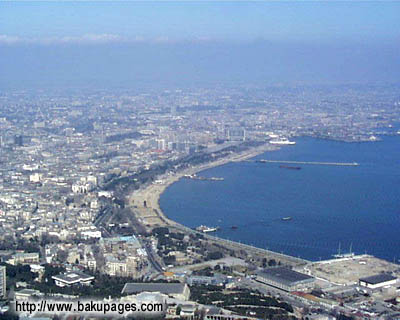
Baku is situated on the Apsheron Peninsula, which just about 40 miles out into the Caspian Sea, at the point where the slopes of the Great Caucasus Range descend to the sea.
The low shoreline with its historic coastal rad is protected here by the mountains. Hills, about 1,150-1,300 ft. high from a natural amphitheater with a convenient harbour - an ideal location for a city. They also provide good limestone for building. Combine all this with the fabulous local mineral resources of which Jules Verne once wrote that to obtain instant heating and lighting all you need to do is to make a hole in the ground and natural gas will gush out - and it will be understood why form earliest times man decided to settle at this spot.
Million of years back the land here was under the sea. Later on movements in the earth's crust led to the formation of dry land. The land-licked Caspian is in fact the largest lake in the world, and over the centuries has had seventy different names. The present level of the Caspian, which in the course of its history has advanced on dry land and receded several times, is 90 ft. below that of the World Ocean and it is still constantly changing. At Baku latitude the sea does not freeze over and Baku port is open all the year round.
Baku has a moderately warm and dry subtropical climate, with a hot summer and short mild winter. Frosts occur once in 10-15 years. The average temperature is 3-4 degrees Celsius above zero in January, 25-39 degrees Celsius in July. On the same latitude as Greece and Italy, the Apsheron peninsula is warmer and drier. Incidentally, its average yearly temperature of 14.4 degrees Celsius coincides with that of the Earth. It has the greatest number (284) of fine days in the year of all places in the Caucasus, and the least amount of rainfall (180 mm in the south, 322 mm in the north).
Due to the hot, dry, windy climate there is comparatively little vegetation on the peninsula. The Eldar pine, requiring little moisture, is the species of tree that grows best here. The only river, the Sumgait, dries up in summer. Hence, the necessity for irrigation which has been increasingly developed in recent years.
Baku today is a city of gardens and parks. Each citizen is required to plant a certain number of trees. As a result there is now 20 sq.m. of greenery per head, a ratio higher than in London, Rome or Bucharest.
The first thing a traveler notices upon arrival in Baku is its unique smell: a peculiar mixture of dry mountain air tempered with oil and gas, "wonderful and unforgettable", as visiting Russian writers have more than once described it.
Present-days Baku with suburbs, their complex of oil-wells and refineries, industrial, agricultural zones and holiday belts, extends over the whole peninsula, as well as to the numerous offshore islands, both natural and artificial, where the oilmen live and work. It includes, for example, the steel platform township, known as Oil Rocks, 60 miles out to sea. Greater Baku this occupies an area of 220,000 hectares (as compared to the 22 hectares of the historical center of the town).
Administratively Baku is divided into eleven districts in which there live over 1.6 million people. The average city family consists of 4-5 persons. Women, who live longer, slightly outnumber the men. With 45 people aged over a hundred per 100,000 of population, Azerbaijan and neighboring Georgia hold the world record for longevity.
Several factors may account for this: the mountain climate, genes, the rare medicinal herbs, the steady rhythm of life, healthy toil in the fresh air plus a lot of walking over the hills, and a balanced diet. Another contributing factor may be that the old, as a rule , tend to live with their children, grand-children and great grand-children, enjoying their love after retirement age.
Despite the disadvantages of life in an urban environment, genetic and psychological factors presumably play a role here plus the fact that Baku has become a much cleaner place to live in thanks to a lot of greenery planted in recent years and anti-pollution measures.

|

|
|---|