The history books tell us
that when Count Jofre el Pilós governed most of the Catalonian territories, there lived in a cave in the Massif
of Sant LlorenÇ, near the town of Terrassa, a monstrous dragon known as La Vibria.
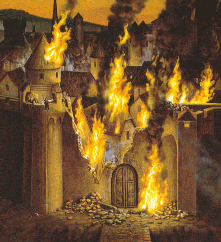 When he was still young, the dragon was put in the
cave by the Moors, who wanted to avenge themselves on the Christians for expelling them from the region.
The animal grew until he became a powerful beast, who, on his nocturnal forays into the surrounding countryside,
devoured flocks and shepherds, devastated the farms and terrorized the local people. The town of Terrassa
offered a substantial reward to whoever could free them from this terrible menace. Many knights, monks and
soldiers tried to kill the Vibria, but as he was a cunning dragon who was very well versed in magic, nobody
succeeded in subduing him. When he was still young, the dragon was put in the
cave by the Moors, who wanted to avenge themselves on the Christians for expelling them from the region.
The animal grew until he became a powerful beast, who, on his nocturnal forays into the surrounding countryside,
devoured flocks and shepherds, devastated the farms and terrorized the local people. The town of Terrassa
offered a substantial reward to whoever could free them from this terrible menace. Many knights, monks and
soldiers tried to kill the Vibria, but as he was a cunning dragon who was very well versed in magic, nobody
succeeded in subduing him.
Finally, Count Jofre, tired of the monster's excesses and of his
subjects' complaints, decided to confront him. Fully armed, and riding his powerful black steed, the Count set
out for the dragon's cave. The place was deserted, and only a black rook was perched on a branch.
But the brave Jofre was not taken in by the Vibria's tricks and he called him by his name: 'Vibria!'
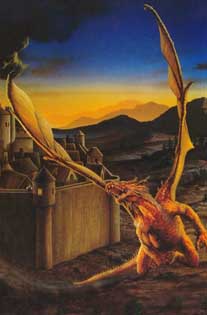 The dragon immediately abandoned his bird disguise and turned into a
horrendous winged beast who seized the Count with his sharp talons and tried to lift him off the ground and dash
him against the rocks. Without flinching, Jofre lashed out bravely against the dragon's scaly neck, and, when
the beast opened his enormous jaws, he plunged his sword down his gullet, wounding him fatally. However,
the dragon still managed to fly off, but he fell headlong into the mountainside, which has been known ever since by
the name of Puig de la Creu {the Peak of the Cross}. The dragon immediately abandoned his bird disguise and turned into a
horrendous winged beast who seized the Count with his sharp talons and tried to lift him off the ground and dash
him against the rocks. Without flinching, Jofre lashed out bravely against the dragon's scaly neck, and, when
the beast opened his enormous jaws, he plunged his sword down his gullet, wounding him fatally. However,
the dragon still managed to fly off, but he fell headlong into the mountainside, which has been known ever since by
the name of Puig de la Creu {the Peak of the Cross}.
The Count founded a convent of monks near the cave, and on
the summit of the mountain he had a monastery built, so that never again would a dragon make his home among the
rocks where the Vibria had lived.
Count Jofre's battle against the
Vibria is recorded for posterity on the sculpted door of Sant Iu, in Barcelona Cathedral, where it can still be seen
today.
|