Cathal
Hall
Weapons
Room
A brief history of the time period weapons!
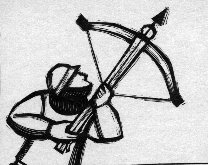
| Crossbow - A short steel
mechanical bow
that shoots heavy bolts (small arrows). It takes a long time to load using a cranking mechanism. An archer can shoot dozens of arrows while a crossbow reloads. Banned by the church, most knights considered it a dishonorable weapon, but some soldiers used it anyway. William Tell was a legendary crossbowman who had to shoot an apple from his son's head as a punishment for not being loyal to the Austrian court. |
![]() |
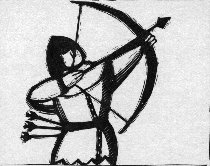
| Longbow - A large bow under great tension
that was difficult to master, but could fire deadly arrows up to 100 yards. The English used it to defeat the French at the battle of Crecy (1346) despite being outnumbered 4 to 1. In order to take care of a longbow, an archer would unstring the bow to release the tension from the frame, and to keep the string from getting wet. |
![]() |
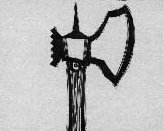
|
about two to three feet of a wood handle. Often tipped with a spike to keep an attacker at bay. |
![]() |
|
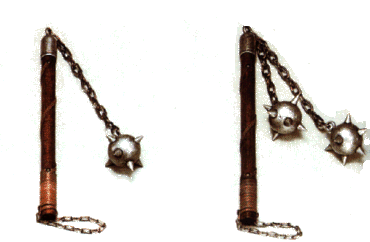
Mace - A blunt or spiked heavy ball attached directly to a handle. Used to smash the enemy, it came in both footman's (long-handled) and horseman's (short-handled) versions. |
![]() |
| Sword - the most common hand-to-hand
fighting weapon of knight was a tempered blade of steel that ranged from two and a half to four feet in length. Blessed by the priest, the sword was usually a knight's favorite weapon. He spoke of it almost as affectionately as if it had been a brother in arms. "My own good sword," he called it. He even gave it a name. Charlemagne's sword was Joyosa; Roland's was Durindana; Arthur's was Excalibur. The Cid's favorite sword, Tizona, was buried with him. The sword was more than a weapon, for blade and hilt formed the sacred sign of the cross, and many a good knight and true has kissed it fervently and murmured his last prayer as he lay dying on the field of battle. The most common sword was the broadsword. This two-edged weapon was 30" to 42" in length, but only weighed 3 to 4 pounds. Thus a knight could wield it all day in battle by it's lightness, but give crushing blows with it's rarely sharpened edge. A larger sword was the bastard sword. This versitile 44" to 50" weapon was made to be used two-handed, but had a short enough handle to be used one-handed by a knight on horseback. In contrast, the claymore, a Scottish sword also known as the two-handed or great sword, was 50" to 72" long (that's up to six feet!). 18" to 21" of the sword was made of the handle alone. |
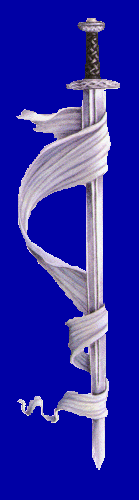
This is the Sword I used, now drapped with a Healers Marking |
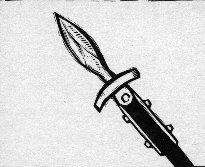
| Lance - A jousting weapon; a modified spear
that is 8 feet long with a 6-inch blade shaped like a leaf. |
![]() |
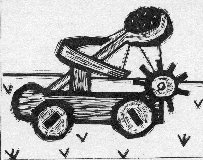
| Catapult - A launching machine for
flinging objects over castle walls. A massive cup or net is held under great tension by a strong rope or chain. The tension is mechanically released and the cup flings its contents of rocks, trash, cows, or Greek fire. |
![]() |
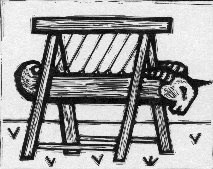
| Battering ram - Formally known as a
bosson, this was a huge log with an iron end used to break down castle doors and walls |
![]() |
These are some examples of the time period weapons.
Return to Great Hall