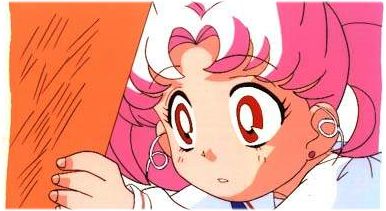
How they did it? In some years during 1990's Sailor Moon became suddenly the most popular and commercially successful anime TV series ever. What happened? How a story of Messiah, Holy Grail and a Kingdom of thousand years emerged from Japan, of all places?
Origins of shoujo
The genre of Japanese girls' comics, shoujo manga, was founded by none else
but Osamu Tezuka himself, the furiously active artist who practically alone
founded all the traditions of Japanese comics after the World War II. Since
the times of Tezuka (Ribon no kishi, 1953) some characteristical standards were
applied in every shoujo manga; the girls were young, typically in the age of
14, they had big round eyes, and in the moment of crisis mystical magic powers
emerged.
In TV animation scene the bedrock production was Little Witch Sally in 1966,
adapted from Mitsuteru Yokoyama's manga. There a cute little magical girl rode
her broomstick through the sky, and solved the everyday problems of mortal people,
even though she didn't manage to control her magical abilities completely, which
gave an appropriate comical effect.
As the years passed by, the stories of cute girls in their obligatory sailor
suit school uniforms became an institution. And as an institution, the shoujo
manga is indeed beyond criticism. Never mind how silly the situations or stories
of all kind of magical girls look at the first glance - they follow the rules
of genre. This is what shoujo manga is. The western wiever of the show have
to accept it.
Origins of senshi
In the early years of 1990's a young female manga artist Naoko Takeuchi began
her career by creating a shoujo manga called "Sailor V". That creation appeared
to be yet another magical girl -story, where the most typical 14-years-old heroine
fought against evil in the name of love and justice. This early attempt wasn't
very sensational. Only few people could guess that this bulk work could inspire
just some years later a magnifient universe with myriads of characters and a
lengthy epic saga called "Sailor Moon". This peculiar story about a "crybaby
girl who meets a talking cat" (well, that's what it seemed to be) made its premiere
on the pages of Nakayoshi girls' comics magazine in the year 1992.
After that, the world was never the same again. More than 50 manga books and
200 TV episodes later Sailor Moon had practically done everything that can be
ever done in shoujo manga/anime.
Not that Sailor Moon had been exceptionally original work. In Sailor Moon the
obligatory magical girl transformations, for example, with "cool" poses, wildly
designed soldier costumes, weird attacks, and always repeated lines of "In the
name of moon, I'll punish you" are at the dangerous limit of hilarity. Is this
thing going to parody itself? Yes it is. In the fifth and final season of anime,
Sailor Stars, transformations and even the battles are continuously parodied
and ridiculed in a way that brings to mind an idea that Sailor Moon might be
actually the best and funniest shoujo manga parody of all time.
Origins of money
However, Sailor Moon became the absolutely most stunning commercial success
ever in the history of shoujo anime. What in the world happened? How come this
Japanese show, full of cultural references of and situations beyond the compherension
of non-Japanese public, finally was seen in such remote places as USA, Australia,
Germany, Sweden, Poland and even Russia? Clever marketing? Or... are there something
meaningful behind the shoujo anime facade after all?
To say it very shortly: Sailor Moon is the ULTIMATE shoujo manga/anime. It adapts
all the elements and standards of shoujo, and accelerates them to the highest
and most dangerous interstellar course ever seen. The collision against the
cruel reality and disbelief is present all the time during every anime season,
every manga book, but at the critical moment Sailor Moon always manages to play
the strings of public's hearts. The tremendously emotional and universal stories
of Sailor Moon are not uniquely Japanese. At the last moment it is always the
human life that is in the centre. This is good old soap opera strategy, the
trick that makes "The Bold And Beautiful" the most popular TV show in two so
different worlds as in Finland and Egypt. The major difference between Sailor
Moon and your favourite soap opera is that even with all that exaggerated imagination
Sailor Moon is far more serious - and a way more beautiful.
Origins of censorship
Even in spite of all the controversiality of the show. The appearance of girl-love
couple of Haruka and Michiru, who enter in the third TV season, cause stir and
trouble among the executives of TV networks, who in the worst case label Haruka
as a man in their translations. That's a weird solution, let me say, because
in transformation scenes we clearly see something different than male anatomy.
In the first Sailor Moon movie we are shown the relationship of young Mamoru
and Fiore, where is no doubt that those boys are more than just buddies. In
Super S season Mamoru's daughter develops a mild Electra complex, which is ridiculed
in the episode where Sailor Moon and Chibusa change bodies. In the final season
appear the Sailor Starlights, who look like male students in their everyday
life, but in transformation they become female sailor soldiers dressed in black
leather underwear. If they are not androgynes, then they are transvestites at
least. Details like this have caused some silent questions about the creator
herself, but perhaps that's not our business. Of course, a series like that,
with all its fame and success and many beautiful girl characters, has been (ab)used
in numerous strictly unlicensed hentai doujinshi (porn adaptation) comics.
This is not to say that Sailor Moon would be a bizarre show. Definetely not.
The course of Sailor Moon from a crybaby schoolgirl to a Messiah of Love and
Justice is a fine example of evolution in character and storyline. For me, the
most fascinating thing in the Sailor Moon story is that it intentionally breaks
the old code of heroic epic. The basic rule is that hero should enter, show
first his power, and accept followers. Not in Sailor Moon. The first main character
who realizes her magical powers is Sailor Venus. The next one is Tuxedo Mask.
Only after that comes our invincible heroine Sailor Moon, painfully unaware
of her importance, fighting in a hopelessly clumsy way and very reluctantly.
It's brilliant.
Origins of religion
To understand why Sailor Moon is possibly the most important TV show of all
1990's, it is required to know (SPOILER ALERT!) highlights of story:
In the first season the evil dudes are just destroyed without second thought.
A radical move takes place during the second part of second season, precisely
said in episode 70. Mars attacks against Cooan, and then Mars stops other senshi
to attack against Cooan. That has never happened before. Mars is the first senshi
who realizes that evil creatures are people after all, and as human beings they
are able to change their life and correct their mistakes. When Cooan, Beruche,
Petz and Karaberas, four sisters of Negamoon, become human and begin a new life
in Tokyo, the whole basic structure of Sailor Moon elevates to a new level.
Real issues are emerging in the world of Sailor Moon: Why can't we be satisfied
with what we already have? Who says there must be sacrifice? How far can loyality
go? What do you envy and why? Does love win all? In a fascinating way the questions
on the background of Sailor Moon are amazingly similar to those presented in
the final episodes of another cult classic Neon Genesis Evangelion, and - I
really mean it - Sailor Moon manages better.
Chibiusa's story includes probably the most touching moments of the whole series.
Just imagine: a small girl listens to his father who tells wonderful stories
of legendary soldier called Sailor Moon. When Chibiusa's Crystal Tokyo of 30th
century becomes under attack and her mother is captured, she travels alone back
in time to find out legendary Sailor Moon, the only person who can save her
mother in future - without knowing that her mother and Sailor Moon are the one
and the same person. Sailor Moon arrives - and fails. (What? Hero fails?) A
heartbreaking scene of sad Chibiusa alone in a destroyed playground follows.
Then she is seduced by Wiseman, who transforms her to Black Lady, and now a
mother must fight against her daughter! There is only one way now, and once
Sailor Moon discovers that successful, winning strategy, she is bound to use
it again, in the final season even twice, first against Nehelania, then against
Galaxia in the final battle.
Dear God, what a battle is it. This doesn't happen in your favourite typical
soap opera. The closest friends of Usagi, all four inner senshi, are killed
in a second. Everybody dies one after another during those dark, unreal, neverending
episodes. And right at the moment when even Usagi and even the viewer have lost
their belief, then Uranus and Neptune show their real selves the last time.
Where is my kleenex? (END OF SPOILER ALERT)
Origins of heaven and hell
Every girl is a princess of moon. Of course. Every boy is a prince of earth.
Don't let yourself to be fooled to think anything else. There is indisputable
dignity and value in every single human life. If something is ridiculous here,
it is the terrible fact that only some creations of art, like Sailor Moon, occasionally
wake up the public to realize this simple truth. The young girl who reads or
watches Sailor Moon and assimilates herself as the Princess Serenity, is actually
one of the few persons who are not escapists. The real escapists are the people
who deny their potential and don't dare to see their true value as human beings,
and retard to easy cynical 'wisdoms' like "life is hard, then you die". To dream
is to love. To love is the meaning of life. Religions have said nothing else
during the thousands of years. But oh, when a form of popular culture expresses
it, there must be something deeply wrong with it, because the message comes
from popular culture, right?
As a melting pot of everything that has been told in shoujo before it, Sailor
Moon also heartily welcomes even strangest elements of world culture. Christianity
plays a stronger role in Sailor Moon than what one could guess at first look.
And I am not talking about just Haruka's cross necklace here. The Sacred Cup
of S season is clearly the Holy Graal, the most fascinating myth of Christian
mythology. The monstrous storyline that culminates in the final season could
have been as well written by St.Paul. The Sailor Moon ideology and the only
effective weapon against evil is simply love. In St.Paul's letter to Romans
in New Testament there are numerous points that advice the oppressed Christians
to understand the people who hate them. "Thou shall love thy enemy."
The only hell lies in peoples' minds, and the fact that matured 16-year-old
schoolgirl Usagi Tsukino knows that intuitively better than the wisest leaders
of earth is completely acceptable. After we have seen how many ideas have been
used in order to change the world - and nothing has happened - there is not
much left, except the oldest, almost forgotten answer.
After the Moon
After Sailor Moon the desperation of shoujo artists must have been deep. Sailor
Moon gives an impression that it has done everything that can be done in shoujo
genre. If there's anything new to come after Sailor Moon, it is for sure worth
watching.
Would it be something from Naoko Takeuchi, again? Don't ask. In the age of 27
miss Takeuchi had done more than most people achieve during the entire lifetime.
She hasn't published anything since Sailor Moon ended in 1997. Personally, I
don't expect any more sequels. In fact, in the final story Sailor Moon expanded
so wide that earth has become too small scene for our favourite schoolgirls.
Let it end this way. But if and when she is ready to tell a different story
from different world, we are listening.