
Witches of the Circle | home
Coven and iniational information | About the Order of the Golden | About the Circle Witches | History of the Root

About the Order of the Golden
The Order of Golden as Wizards.....
School of Wizardryl
Book of Golden Truths
When one forgets or refuses the past, it comes knocking on their door, no-matter the messenger
( we as wizards , serve the pattern not the fruit of desires to want to be , for We Truely Know )
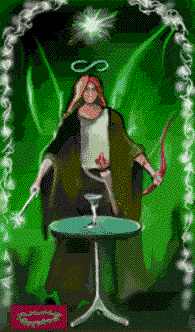
There are some real issues that should be discussed right at the beginning of this section. The first thing that the seeker should know is that much of the "knowledge" that we possess today about Witchcraft and its origins is a combination of archeological data, the myths and legends that have been passed down and some historical documents that have been translated. The rest is conjecture and the "best guesses" of scholars who are working on "bringing it all together." In other words, no one can say for certain what the Ancestors really did or why.
That does not mean that we have NO knowledge-we certainly DO!- just that we do not have THE historical knowledge of the origins of the Modern Craft. Different interpretations will continue to abound both in written materials and in any teachings that you may encounter. There will never be only one Way of practicing Witchcraft. Get used to it. No one has the "one true answer"...and any teacher worth his or her salt will tell you this up front.
The above is your first introduction to what is involved in following the path of Witchcraft. You are expected to do a LOT of research on your own. This is actually a very healthy way to approach the beginning study of any Path you are considering. Read many, many books on the subject-both scholarly and those that some would consider in the "fluff' category. Why? Because this is your first foray into unknown waters. You should approach it with an open mind-ready to question and probe and ponder. I cannot overestimate how useful this first step will be. It can help you to formulate your own ideas about what this Path may mean to you.
Do not try to incorporate all that you read into one cohesive whole at the beginning. Look at whatever material that you are reading as a "theory" or "hypothesis" of Witchcraft. Some things will appeal to you right away. Others will seem "off the wall" or too fantastic to be of use. Accept or reject nothing at this stage; just keep on gathering information. You are doing "research". The more you read, the more a "coming together" of certain aspects will begin to form within yourself. Then you will have a foundation from which you can take the next step.
Wicca is a recently created Neopagan religion. It is based largely on symbols, seasonal days of celebration and deities from ancient Celtic society, supplemented with Masonic and ceremonial magickal components. A Wiccan is a follower of Wicca. Wicca and other Neopagan religions are currently experiencing a rapid growth in the U.S., Canada, and Europe. Many North Americans of European descent, ( as those who setup themself's as the walking in Wicca , they use the wording, but don't know the witch or seek to know the witches truths , instead they seek to serve their physical
A catalytic knowledge in the occult which was considered a magic code. Having solved this, the occultist is deemed to be omnipotent. Many have considered the four letters in the Tetragram, the Kabbalistic words Azoth and Inri, for example, contain this Divine code, once the adepts arrange them in
The Law of Balance is simply a statement for conserving personal energy and achieving the greatest proficiency. One's energy or power level must be kept on an even keel, too much or too little will kill oneself. This energy level is best maintained by avoiding extremes in thinking and action. One must be open minded, able to consider all alternatives, but strong enough to determine one's personal course in life. This requires the right amount of flexibility to be able to examine new ideas or concepts in order to keep the ones which would improve one's life and reject those that would not. In short, one never goes off on deep ends.
The use of magic for religious and/or psychotherapeutic purposes, in order to attain "salvation" or "personal evolution," as defined by P, E. I. Bonewits. This is often referred to as "High magic," which is considered the best use of magic.
In further discussion Bonewitts makes some interesting observations concerning theurgy, especially in relation to tantrism. The official goal, he states, of Tantrra is is theurgic, that attainment of salvation and enlightenment. However, one would soon notice that methods devised for theurgy can usually be used for thaumaturgy as well.
As Bonewitts further explains, in Tantric Buddhism "enlightenment" soon became defined as the union of positive and negative, active and passive, masculine and feminine. This dualism tended to show Buddhism’s apparent male-chauvinistic stance, since "masculine" was associated with "positive" and "active," and "feminine" with "negative" and "passive"; however in Hindu Tantrism thing are the other way around. Again what is termed an universal truth, usually becomes the reality of one belief system.
The term metaphysics originally referred to the writings of Aristotle that came after his writings on physics, in the arrangement made by Andronicus of Rhodes about three centuries after Aristotle's death.
Traditionally, metaphysics refers to the branch of philosophy that attempts to understand the fundamental nature of all reality, whether visible or invisible. It seeks a description so basic, so essentially simple, so all-inclusive that it applies to everything, whether divine or human or anything else. It attempts to tell what anything must be like in order to be at all.
To call one a metaphysician in this traditional, philosophical sense indicates nothing more than his or her interest in attempting to discover what underlies everything. Old materialists, who said that there is nothing but matter in motion, and current naturalists, who say that everything is made of lifeless, non-experiencing energy, are just as much to be classified as metaphysicians as are idealists, who maintain that there is nothing but ideas, or mind, or spirit.
Perhaps the best definition of materialism is that of Charles Hartshorne (Insights and Oversights of Great Thinkers, p. 17): "the denial that the most pervasive processes of nature involve any such psychical functions as sensing, feeling, remembering, desiring, or thinking." Idealists assert what materialists here deny. Dualists say that mind and matter are equally real, while neutral monists claim that there is a neutral reality that can appear as either mind or matter. Philosophers generally are content to divide reality into two halves, mind and matter (extended and unextended reality) and do not emphasize such distinctions within the mind half as spirit and soul.
POPULAR METAPHYSICS
A commonly employed, secondary, popular, usage of metaphysics includes a wide range of controversial phenomena believed by many people to exist beyond the physical.
Popular metaphysics relates to two traditionally contrasted, if not completely separable, areas, (1) mysticism, referring to experiences of unity with the ultimate, commonly interpreted as the God who is love, and (2) occultism, referring to the extension of knowing (extrasensory perception, including telepathy, clairvoyance, precognition, retrocognition, and mediumship) and doing (psychokinesis) beyond the usually recognized fields of human activity. The academic study of the occult (literally hidden) has been known as psychical research and, more recently, parapsychology. Both New Age and New Thought emphasize mysticism and its practical, pragmatic application in daily living, but New Thought discourages involvement in occultism.
in physics, the capacity for doing work. It may exist in potential, kinetic, thermal, electrical, chemical, nuclear, or other various forms. There are, moreover, heat and work--i.e., energy in the process of transfer from one body to another. After it has been transferred, energy is always designated according to its nature. Hence, heat transferred may become thermal energy, while work done may manifest itself in the form of mechanical energy.
All forms of energy are associated with motion. For example, any given body has kinetic energy if it is in motion. A tensioned device such as a bow or spring, though at rest, has the potential for creating motion; it contains potential energy because of its configuration. Similarly, nuclear energy is potential energy because it results from the configuration of subatomic particles in the nucleus of an atom.
Energy can be converted from one form to another in various ways. Usable mechanical or electrical energy is, for instance, produced by many kinds of devices, including fuel-burning heat engines, generators, batteries, fuel cells, and magnetohydrodynamic systems.
of the
Golden Wizard's