| BACK |
| HOME |
| NEXT |
Harmonious Principles for Human Living
|
|
Harmonious Principles for Human Living |
|
| In my early life
I made two very important discoveries. In the first place I discovered
that making money was easy. And in the second place I discovered that making
money and spending it foolishly was completely meaningless. I knew
that this was not what I was here for, but at that time (this was many
years ago), I didn't know exactly what I was here for. It was out of a
very deep seeking for a meaningful way of life, and after having walked
all one night through the woods, that I came to what I now know to
be a very important psychological hump. I felt a complete willingness,
without any reservations, to give my life, to dedicate my life to
service. I tell you, it's a point of no return. After that, you can never
go back to completely self-centered living. And so I went into
the second phase of my life. I began to live to give what I could, instead
of to get what I could, and I entered a new and wonderful world. My life
began to become meaningful. I attained the great blessing of good health;
I haven't had a cold or headache since. (Most illness is psychologically
induced.) From that time on, I have known that my life-work
would be work for peace; that it would cover the whole peace picture--peace
among nations, peace among groups, peace among individuals, and the very,
very important inner peace. However, there's a great deal of difference
between being willing to give your life, and actually giving your life,
and for me, 15 years of preparation and of inner seeking lay between. During
this time I became acquainted with what the psychologists refer to as Ego
and Conscience. I began to realize that it's as though we have two selves
or two natures or two wills with two different viewpoints. Because the
view points were so different, I felt a struggle in my life at this period
between the two selves with the two viewpoints. So there were hills
and valleys--lots of hills and valleys. Then in the midst of the struggle
there came a wonderful mountain-top experience, and for the first time
I knew what inner peace was like. I felt a oneness--oneness with all my
fellow human beings, oneness with all of creation. I have never really
felt separate since. I could return again and again to this wonderful mountaintop,
and then I could stay there for longer and longer periods of time, and
just slip out occasionally. Then came a wonderful morning when I woke up
and knew that I would never have to descend again into the valley. I knew
that for me the struggle was over, that finally I had succeeded in giving
my life, or finding inner peace. Again this is a point of no return. You
can never go back into the struggle. The struggle is over now because you
will to do the right thing, and you don't need to be pushed into it.
However, progress is not over. Great progress has taken place in this third
phase of my life, but it's as though the central figure of the jigsaw of
your life is complete and clear and unchanging, and around the edges other
pieces keep fitting in. There is always a growing edge, but the progress
is harmonious. There is a feeling of always being surrounded by all of
the good things, like love and peace and joy. It seems like
a protective surrounding, and there is an unshakeableness within which
takes you through any situation you may need to face. The world may look
at you and believe that you are facing great problems, but always
there are the inner resources to easily overcome these problems.
Nothing seems difficult. There is a calmness and a serenity and unhurriedness--no
more striving or straining about anything. Life is full and life
is good, but life is nevermore overcrowded. That's a very important thing
I've learned: If your life is in harmony with your part in the Life Pattern,
and if you are obedient to the laws which govern this universe, then your
life is full and good but not overcrowded. If it is overcrowded,
you are doing more than is right for you to do, more than is your
job to do in the total scheme of things. Now there is a living to
give instead of to get. As you concentrate on the giving, you discover
that just as you cannot receive without giving, so neither can you
give without receiving--even the most wonderful things like health and
happiness and inner peace. There is a feeling of endless energy--it
just never runs out; it seems to be as endless as air. You just seem to
be plugged into the source of universal energy. You are now
in control of your life. You see, the ego is never in control. The
ego is controlled by wishes for comfort and convenience on the part of
the body, by demands of the mind, and by outbursts of the emotions. But
the higher nature controls the body and the mind and the emotions. I can
say to my body, "Lie down there on that cement floor and go
to sleep," and it obeys. I can say to my mind, "Shut out everything
else and concentrate on this job before you," and it's obedient.
I can say to my emotions, "Be still, even in the face of this terrible
situation," and they are still. It's a different way of living. The philosopher
Thoreau wrote: If a man does not keep pace with his companions, perhaps
he hears a different drummer. And now you are following a different
drummer--the higher nature instead of the lower. It was only at this time,
in 1953, that I felt guided or called or motivated to begin my pilgrimage
for peace in the world--a journey undertaken traditionally. The tradition
of pilgrimage is a journey undertaken on foot and on faith, prayerfully
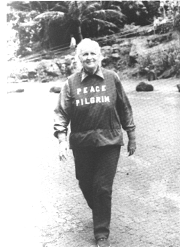
as an opportunity to contact people. I wear a lettered tunic
in order to contact people. It says `PEACE PILGRIM' on the front. I feel
that's my name now-- it emphasizes my mission instead of me. And on the
back it says `25,000 MILES ON FOOT FOR PEACE.' The purpose of the
tunic is merely to make contacts for me. Constantly as I walk along
the highways and through the cities, people approach me and I have
a chance to talk with them about peace. I have walked 25,000
miles as a penniless pilgrim. I own only what I wear and what I carry
in my small pockets. I belong to no organization. I have said that
I will walk until given shelter and fast until given food, remaining a
wanderer until mankind has learned the way of peace. And I can truthfully
tell you that without ever asking I have been supplied with everything
needed for my journey, which shows you how good people really are.
With me I carry always my peace message: This is the way of peace: Overcome
evil with good, falsehood with truth, and hatred with love. There is nothing
new about this message, except the practice of it. And the practice of
it is required not only in the international situation but also in the
personal situation. I believe that the situation in the world is
a reflection of our own immaturity. If we were mature, harmonious
people, war would be no problem whatever--it would be impossible.
All of us can work for peace. We can work right where we are, right within
ourselves, because the more peace we have within our own lives, the more
we can reflect into the outer situation. In fact, I believe that
the wish to survive will push us into some kind of uneasy world peace which
will then need to be supported by a great inner awakening if it is
to endure. I believe we entered a new age when we discovered nuclear
energy, and that this new age calls for a new renaissance to lift us to
a higher level of understanding so that we will be able to cope with the
problems of this new age. So, primarily my subject is peace within ourselves
as a step toward peace in our world. Now, when I talk about
the steps toward inner peace, I talk about them in a framework, but
there's nothing arbitrary about the number of steps. They can be
expanded; they can be contracted. This is just a way of talking about the
subject, but this is important: the steps toward inner peace are not taken
in any certain order. The first step for one may be the last step for another.
So, just take whatever steps seem easiest for you, and as you take a few
steps, it will be come easier for you to take a few more. In this area
we really can share. None of you may feel guided to walk a pilgrimage,
but in the field of finding harmony in our own lives, we can share.
And I suspect that when you hear me give some of the steps toward
inner peace, you will recognize them as steps that you also have
taken. In the first place I would like to mention some preparations
that were required of me. The first preparation is a right attitude
toward life. This means--stop being an escapist! Stop being a surface-liver
who stays right on the froth of the surface. There are millions of
these people, and they never find anything really worthwhile. Be
willing to face life squarely and get down beneath the surface of life
where the verities and realities are to be found. That's what
we are doing here now. There's the whole matter of having a
meaningful attitude for the problems that life may set before you.
If only you could see the whole picture, if only you knew the whole
story, you would realize that no problem ever comes to you that does
not have a purpose in your life, that cannot contribute to your inner
growth. When you perceive this, you will recognize problems as opportunities
in disguise. If you did not face problems you would just drift through
life, and you would not gain inner growth. It is through solving
problems in accordance with the highest light that we have that inner
growth is attained. Now, collective problems must be solved by us
collectively, and no one finds inner peace who avoids doing his or
her share in the solving of collective problems, like world disarmament
and world peace. So let us always think about these problems together,
talk about them together, and collectively work toward their solutions.
The second preparation has to do with bringing our lives into harmony with
the laws that govern this universe. Created are not only the worlds
and the beings but also the laws which govern them. Applying both in the
physical realm and in the psychological realm, these laws govern human
conduct. Insofar as we are able to understand and bring our lives into
harmony with these laws, our lives will be in harmony. Insofar as
we disobey these laws, we create difficulties for ourselves by our
disobedience. We are our own worst enemies. If we are out of harmony
through ignorance, we suffer somewhat; but if we know better and
are still out of harmony, then we suffer a great deal. I recognize that
these laws are well-known and well-believed, and therefore they just
needed to be well-lived. So I got busy on a very interesting
project. This was to live all the good things, I believed in. I did
not confuse myself by trying to take them all at once, but rather,
if I was doing something that I knew I should not be doing, I stopped
doing it, and I always made a quick relinquishment. You see, that's
the easy way. Tapering off is long and hard. And if I was not doing something
that I knew I should be doing, I got busy on that. It took the living quite
a while to catch up with the believing, but of course it can, and
now if I believe something, I live it. Otherwise it would be perfectly
meaningless. As I lived according to the highest light that I had,
I discovered that other light was given, and that I opened myself to receiving
more light as I lived the light I had. These laws are the same for
all of us, and these are the things that we can study and talk about
together. But there is also a third preparation that has to do with
something which is unique for every human life because every one of
us has a special place in the Life Pattern. If you do not yet know clearly
where you fit, I suggest that you try seeking it in receptive silence.
I used to walk amid the beauties of nature, just receptive and silent,
and wonderful insights would come to me. You begin to do your part
in the Life Pattern by doing all the good things you feel motivated
toward, even though they are just little good things at first. You
give these priority in your life over all the superficial things
that customarily clutter human lives. There are those who know and
do not do. This is very sad. I remember one day as I walked along
the highway a very nice car stopped and the man said to me,
"How wonderful that you are following your calling!" I replied, "I certainly
think that everyone should be doing what feels right to do." He then began
telling me what he felt motivated toward, and it was a good thing that
needed doing. I got quite enthusiastic about it and took for granted
that he was doing it. I said, "That's wonderful! How are you getting
on with it?" And he answered, "Oh, I'm not doing it. That kind of
work doesn't pay anything." And I shall never forget how desperately unhappy
that man was. But you see, in this materialistic age we have such
a false criterion by which to measure success. We measure it in terms
of dollars, in terms of material things. But happiness and inner
peace do not lie in that direction. If you know but do not do, you
are a very unhappy person indeed. There is also a fourth preparation, and
it is the simplification of life to bring inner and outer well-being--psychological
and material well-being--into harmony in your life. This was made
very easy for me. Just after I dedicated my life to service, I felt
that I could no longer accept more than I needed while others in
the world have less than they need. This moved me to bring my life
down to need-level. I thought it would be difficult. I thought it would
entail a great many hardships, but I was quite wrong. Now that I own only
what I wear and what I carry in my pockets, I don't feel deprived of anything.
For me, what I want and what I need are exactly the same, and you
couldn't give me anything I don't need. I discovered
this great truth: unnecessary possessions are just unnecessary burdens.
Now I don't mean that all our needs are the same. Yours may be much
greater than mine. For instance, if you have a family, you would need the
stability of a family center for your children. But I do mean that anything
beyond need--and need sometimes includes things beyond the physical needs,
too--anything beyond need tends to become burdensome. There
is great freedom in simplicity of living, and after I began to feel
this, I found a harmony in my life between inner and outer well-being.
Now there's a great deal to be said about such harmony, not only
for an individual life but also for the life of a society. It's because
as a world we have gotten ourselves so far out of harmony, so way
off on the material side, that when we discover something like nuclear
energy, we are still capable of putting it into a bomb and using
it to kill people. This is because our inner well-being lags so far
behind our outer well-being. The valid research for the future is
on the inner side, on the psychological side, so that we will be
able to bring these two into balance, so we will know how to use well the
outer well-being we already have. Then I discovered that there were some
purifications required of me. The first one is such a simple thing:
it is purification of the body. This has to do with your physical
living habits. Do you eat sensibly, eating to live? I actually know
people who live to eat. And do you know when to stop eating?
That is a very important thing to know. Do you have sensible sleeping habits?
I try to get to bed early and have plenty of hours of sleep. Do you get
plenty of fresh air, sunshine, exercise and contact with nature?
You'd think this might be the first area in which people would be willing
to work, but from practical experience I've discovered it's often the last
because it might mean getting rid of some of our bad habits, and there
is nothing that we cling to more tenaciously. The second purification I
cannot stress too much because it is purification of thought. If
you realized how powerful your thoughts are you would never think
a negative thought. They can be a powerful influence for good when they're
on the positive side, and they can and do make you physically ill
when they're on the negative side. I recall a man 65
years old when I knew him who manifested symptoms of what seemed
a chronic physical illness. I talked with him and I realized that there
was some bitterness in his life, although I could not find it at once.
He got along well with his wife and his grown children, and he got
along well in his community, but the bitterness was there just the same.
I found that he was harboring bitterness against his long-dead father
because his father had educated his brother and not him. As soon
as he was able to relinquish this bitterness, the so-called chronic
illness began to fade away, and soon it was gone. If
you're harboring the slightest bitterness toward anyone, or any unkind
thoughts of any sort whatever, you must get rid of them quickly. They aren't
hurting anyone but you. It isn't enough just to do right things and say
right things, you must also think right things before your life can
come into harmony. The third purification is purification of desire. What
are the things you desire? Do you desire new clothing, or pleasures, or
new household furnishings, or a new car? You can come to the point
of oneness of desire just to know and do your part in the Life Pattern.
When you think about it, is there anything else as really important
to desire? There is one more purification, and that is purification of
motive. What is your motive for whatever you may be doing? If it is pure
greed or self-seeking or the wish for self-glorification, I would say,
Don't do that thing. Don't do anything you would do with such a motive.
But it isn't that easy because we tend to do things with very mixed
motives, good and bad motives all mixed together. Here's a man in
the business world: his motives may not be the highest, but mixed in with
them are motives of caring for his family and perhaps doing some
good in his community. Mixed motives! Your motive, if you are to
find inner peace, must be an outgoing motive--it must be service.
It must be giving, not getting. I knew a man who was a good architect.
It was obviously his right work, but he was doing it with the wrong motive.
His motive was to make a lot of money and keep ahead of the Joneses.
He worked himself into an illness, and it was shortly after that I met
him. I got him to do little things for service. I talked to him about
the joy of service and I knew that after he had experienced this, he could
never go back into really self-centered living. We corresponded a bit after
that. On the third year of my pilgrimage route, I walked through his town
and I hardly recognized him when I stopped in to see him. He was
such a changed man! But he was still an architect. He was drawing a plan
and he talked to me about it: "You see, I'm designing it this way to fit
into their budget, and then I'll set it on their plot of ground
to make it look nice." His motive was to be of service to the people that
he drew plans for. He was a radiant and transformed person. His wife told
me that his business had increased because people were now coming to him
from miles around for home designs. I've met a few people who
had to change their jobs in order to change their lives, but I've met many
more people who merely had to change their motive to service in order to
change their lives. Now, the last part. These are the relinquishments.
Once you've made the first relinquishment, you have found inner peace
because it's the relinquishment of self-will. You can work on this by refraining
from doing any not-good thing you may be motivated toward, but you
never suppress it! If you are motivated to do or say a mean thing, you
can always think of a good thing. You deliberately turn around and
use that same energy to do or say a good thing instead. It works!
The second relinquishment is the relinquishment of the feeling of separateness.
We begin feeling very separate and judging everything as it relates
to us, as though we were the center of the universe. Even after we
know better intellectually, we still judge things that way. In reality,
of course, we are all cells in the body of humanity. We are not separate
from our fellow humans. The whole thing is a totality. It's
only from that higher viewpoint that you can know what it is to love your
neighbor as yourself. From that higher viewpoint there becomes just one
realistic way to work, and that is for the good of the whole. As
long as you work for your selfish little self, you're just one cell against
all those other cells, and you're way out of harmony. But as soon as you
begin working for the good of the whole, you find yourself in harmony with
all of your fellow human beings. You see, it's the easy, harmonious way
to live. Then there is the third relinquishment, and that is the
relinquishment of all attachments. Material things must be put into their
proper place. They are there for use. It's all right to use them; that's
what they're there for. But when they've outlived their usefulness
be ready to relinquish them and perhaps pass them on to someone who does
need them. Anything that you cannot relinquish when it has outlived
its usefulness possesses you, and in this materialistic age a great many
of us are possessed by our possessions. We are not free.
There's another kind of possessiveness. You do not posses any other human
being, no matter how closely related that other may be. No husband owns
his wife; no wife owns her husband; no parents own their children.
When we think we possess people there's a tendency to run their lives
for them, and out of this develops an extremely inharmonious situation.
Only when we realize that we do not possess them, that they must live in
accordance with their own inner motivation, do we stop trying to run their
lives for them, and then we discover that we are able to live in
harmony with them. Now the last: the relinquishment of all
negative feelings. I want to mention just one negative feeling which even
the nicest people still experience, and that negative feeling
is worry. Worry is not concern which would motivate you to do everything
possible in a situation. Worry is a useless mulling over of things we cannot
change. Let me mention just one technique. Seldom do you worry about
the present moment; it's usually all right. If you worry, you agonize over
the past which you should have forgotten long ago, or you're apprehensive
over the future which hasn't even come yet. We tend to skim right over
the present time. Since this is the only moment that one can live, if you
don't live it you never really get around to living at all. If you do live
this present moment, you tend not to worry. For me, every moment is a new
opportunity to be of service. One last comment about negative
feelings which helped me very much at one time and has helped others. No
outward thing--nothing, nobody from without--can hurt me inside,
psychologically. I recognized that I could only be hurt psychologically
by my own wrong actions, which I have control over; by my own wrong
reactions--they are tricky but I have control over them too; or by my own
inaction in some situations, like the present world situation, that needs
action from me. When I recognized all this, how free I felt! And I just
stopped hurting myself. Now someone could do the meanest thing to me and
I would feel deep compassion for this out-of-harmony person, this
psychologically sick person who is capable of doing mean things. I certainly
would not hurt myself by a wrong reaction of bitterness or anger. You have
complete complete control over whether or not you will hurt psychologically,
and any time you want to, you can stop hurting yourself. These are
the steps toward inner peace that I wanted to share with you. There's nothing
new about this. This is universal truth. I merely talked about these
things in my own everyday words in terms of my own personal experience
with them. The laws which govern this universe work for good as soon as
we obey them, and anything contrary to these laws doesn't last long.
It contains within itself the seeds of its own destruction. The good
in every human life always makes it possible for us to obey these laws.
We do have free will about all this, and therefore how soon we obey
and thereby find harmony, both within ourselves and within our world, is
up to us. [From a KPFK radio talk, Los Angeles]
SUMMARY
-- FOUR PREPARATIONS -- 1. Assume right attitudes toward life. Stop being an escapist
or a surface-liver as these attitudes can only cause inharmony in your
life. Face life squarely and get down below the froth on its surface to
discover its verities and realities. Solve the problems that life sets
before you, and you will find that solving them contributes to your inner
growth. Helping to solve collective problems contributes also to your growth,
2. Live good beliefs. The laws governing human conduct apply as rigidly as the law of gravity. Obedience to these laws pushes us toward harmony; disobience pushes us toward inharmony. Since many of these laws are already common belief, you can begin by putting into practice all the good things you believe. No life can be in harmony unless belief and practice are in harmony. 3. Find your place in the Life Pattern. You have a part in the scheme of things. What that part is you can know only from within yourself. You can seek it in receptive silence. You can begin to live in accordance with it by doing all the good things you are motivated toward and giving these priority in you life over all the superficial things that customarily occupy human lives. 4. Simplify life to bring inner and outer well-being into harmony. Unnecessary possessions
are unnecessary burdens. Many lives are cluttered not only with unnecessary
possessions but also with meaningless activities. Cluttered lives
are out-of-harmony lives and require simplification. Wants and needs can
become the same in a human life and, when this is accomplished,
-- FOUR PURIFICATIONS -- 1. Purification of the bodily temple. Are you free from all bad habits? In your diet do you stress the vital foods--the fruits, whole grains, vegetables and nuts? Do you get to bed early and get enough sleep? Do you get plenty of fresh air, sunshine, exercise, and contact with nature? If you can answer "Yes" to all of these questions, you have gone a long way toward purification of the bodily temple. 2. Purification of the thoughts. It is not enough to do right things and say right things. You must also think right things. Positive thoughts can be powerful influences for good. Negative thoughts can make you physically ill. Be sure there is no unpeaceful situation between yourself and any other human being, for only when you have ceased to harbor unkind thoughts can you attain inner harmony. 3. Purification of the desires. Since you are here to get yourself into harmony with the laws that govern human conduct and with your part in the scheme of things, your desires should be focused in this direction. 4. Purification of motives. Obviously your motive should never be greed or self-seeking, or the wish for self-glorification. You shouldn't even have the selfish motive of attaining inner peace for yourself. To be of service to you fellow humans must be your motive before your life can come into harmony. -- FOUR RELINQUISHMENTS -- 1. Relinquishment of self-will. You have, or it's
as though you have, two selves: the lower self that usually governs you
selfishly, and the higher self which stands ready to use you gloriously.
You must subordinate the lower self by refraining from doing the
2. Relinquishment of the feeling of separateness. All of us, all over the world, are cells in the body of humanity. You are not separate from your fellow humans, and you cannot find harmony for yourself alone. You can only find harmony when you realize the oneness of all and work for the good of all. 3. Relinquishment of attachments. Only when you have relinquished all attachments can you be really free. Material things are here for use, and anything you cannot relinquish when it has outlived its usefulness possesses you. You can only live in harmony with your fellow humans if you have no feeling that you possess them, and therefore do not try to run their lives. 4. Relinquishment of all negative feelings. Work on relinquishing
negative feelings. If you live in the present moment, which is really
the only moment you have to live, you will be less apt to worry.
If you realize that those who do mean things are psychologically ill,
|