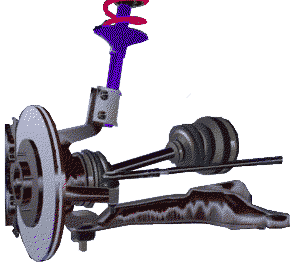
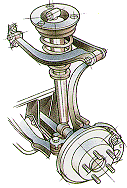
 This is
currently, without doubt, the most widely used front suspension system in
cars of European origin. It is simplicity itself. Unfortunately, the image
on the left doesn't show you all the components but you will get the idea.
However, the system basically comprises of a
'coil-over-oil' spring and shock absorber combo, which pivots on a ball
joint on the single, lower arm. At the top end there is a needle roller
bearing on some more sophisticated systems. The strut itself is the
load-bearing member in this assembly, with the spring and shock absorber
merely performing their duty as oppose to actually holding the car up. The
steering gear is either connected directly to the lower shock absorber
housing (purple in this image), or to an arm from the front or back of the
spindle (in this case). When you steer, it physically twists the shock
absorber housing (and consequently the spring) to turn the wheel. Simple.
The spring is seated in a special plate at the top of the assembly which
allows this twisting to take place. If the spring or this plate are worn,
you'll get a loud 'clonk' on full lock as the spring frees up and jumps
into place. This is sometimes confused for CV joint knock.
This is
currently, without doubt, the most widely used front suspension system in
cars of European origin. It is simplicity itself. Unfortunately, the image
on the left doesn't show you all the components but you will get the idea.
However, the system basically comprises of a
'coil-over-oil' spring and shock absorber combo, which pivots on a ball
joint on the single, lower arm. At the top end there is a needle roller
bearing on some more sophisticated systems. The strut itself is the
load-bearing member in this assembly, with the spring and shock absorber
merely performing their duty as oppose to actually holding the car up. The
steering gear is either connected directly to the lower shock absorber
housing (purple in this image), or to an arm from the front or back of the
spindle (in this case). When you steer, it physically twists the shock
absorber housing (and consequently the spring) to turn the wheel. Simple.
The spring is seated in a special plate at the top of the assembly which
allows this twisting to take place. If the spring or this plate are worn,
you'll get a loud 'clonk' on full lock as the spring frees up and jumps
into place. This is sometimes confused for CV joint knock.
Note: The following four types of system are all essentially a variation on the same theme.
![[suspension1]](../suspension1.gif) This is a
type of double-A arm suspension. The wheel spindles (purple) are
supported by an upper (green) and lower (blue) 'A' shaped arm. If you look
head-on at this type of system, what you'll find is that it's a very basic
lever system that allows the spindles to travel vertically up and down.
When they do this, they also have a slight side-to-side motion caused by
the arc which the levers scribe around their pivot point. This
side-to-side motion is known as scrub. Unless the links are infinitely
long the scrub motion is always present. There are two other types of
motion of the wheel relative to the body when the suspension articulates.
The first and most important is a toe angle (steer angle). The second and
least important, but the one which produces most pub talk is the camber
angle, or lean angle. Steer and camber are the ones which wear tyres.
Also note that the springs/shocks in this example are in a
so-called 'coil over oil' arrangement whereby the shock absorbers (yellow)
sit inside the springs (red).
This is a
type of double-A arm suspension. The wheel spindles (purple) are
supported by an upper (green) and lower (blue) 'A' shaped arm. If you look
head-on at this type of system, what you'll find is that it's a very basic
lever system that allows the spindles to travel vertically up and down.
When they do this, they also have a slight side-to-side motion caused by
the arc which the levers scribe around their pivot point. This
side-to-side motion is known as scrub. Unless the links are infinitely
long the scrub motion is always present. There are two other types of
motion of the wheel relative to the body when the suspension articulates.
The first and most important is a toe angle (steer angle). The second and
least important, but the one which produces most pub talk is the camber
angle, or lean angle. Steer and camber are the ones which wear tyres.
Also note that the springs/shocks in this example are in a
so-called 'coil over oil' arrangement whereby the shock absorbers (yellow)
sit inside the springs (red).
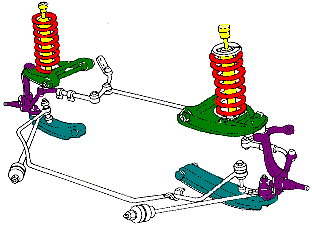 This is
also a type of double-A arm suspension although the lower arm in
these systems can sometimes be replaced with single solid arms. The only
real difference between this and the type 1 system mentioned above is that
the spring/shock combo is moved from between the arms to above the upper
arm. This transfers the load-bearing capability of the suspension almost
entirely to the upper arm and the spring mounts. The lower arm in this
instance becomes a control arm. This particular type of system isn't so
popular in cars as it takes up a lot room.
This is
also a type of double-A arm suspension although the lower arm in
these systems can sometimes be replaced with single solid arms. The only
real difference between this and the type 1 system mentioned above is that
the spring/shock combo is moved from between the arms to above the upper
arm. This transfers the load-bearing capability of the suspension almost
entirely to the upper arm and the spring mounts. The lower arm in this
instance becomes a control arm. This particular type of system isn't so
popular in cars as it takes up a lot room.
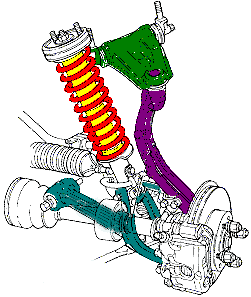 So-called
because the lower and upper arms are the shape of wishbones. The spindle
is a highly complex construction in this system, as are the wishbones
themselves. This rapidly becoming one of the most favoured suspension
types for new cars as it gives excellent roadholding capabilities whilst
taking up very little room under the car. This allows for smoother lines
on the bodywork, and less intrusion in to the engine bay. A 2D diagram
such as that on the right does not do this system any justice. To really
appreciate it, you need to get your head in a wheel well and have a look.
And I know a few mechanics who've still not been able to figure it out
even then.
So-called
because the lower and upper arms are the shape of wishbones. The spindle
is a highly complex construction in this system, as are the wishbones
themselves. This rapidly becoming one of the most favoured suspension
types for new cars as it gives excellent roadholding capabilities whilst
taking up very little room under the car. This allows for smoother lines
on the bodywork, and less intrusion in to the engine bay. A 2D diagram
such as that on the right does not do this system any justice. To really
appreciate it, you need to get your head in a wheel well and have a look.
And I know a few mechanics who've still not been able to figure it out
even then.
 This is the latest incarnation of the double wishbone system
described above. It's currently being used in the Audi A8 and A4 amongst
other cars. The basic principle of it is the same, but instead of solid
upper and lower wishbones, each 'arm' of the wishbone is a separate item.
These are joined at the top and bottom of the spindle thus forming the
wishbone shape. Car manufacturers claim that this system gives even better
road-holding properties, because all the various joints make the
suspension almost infinitely adjustable. There are a few variations on
this theme appearing at the moment, with differences in the numbers of
joints, numbers of arms, positioning of the parts etc. But they are all
fundamentally the same.
This is the latest incarnation of the double wishbone system
described above. It's currently being used in the Audi A8 and A4 amongst
other cars. The basic principle of it is the same, but instead of solid
upper and lower wishbones, each 'arm' of the wishbone is a separate item.
These are joined at the top and bottom of the spindle thus forming the
wishbone shape. Car manufacturers claim that this system gives even better
road-holding properties, because all the various joints make the
suspension almost infinitely adjustable. There are a few variations on
this theme appearing at the moment, with differences in the numbers of
joints, numbers of arms, positioning of the parts etc. But they are all
fundamentally the same.
 This system was favoured by the Americans for years because it was dead
simple and cheap to build. The ride quality is decidedly questionable
though. The drive axle (purple in this image) is clamped (green) to the
leaf springs (red). The shock absorbers (yellow) are also attached to the
clamps. The ends of the leaf springs are attached directly to the chassis,
as are the shock absorbers. Simple, not particularly elegant, but cheap.
The main drawback with this arrangement is the lack of lateral location
for the axle.
This system was favoured by the Americans for years because it was dead
simple and cheap to build. The ride quality is decidedly questionable
though. The drive axle (purple in this image) is clamped (green) to the
leaf springs (red). The shock absorbers (yellow) are also attached to the
clamps. The ends of the leaf springs are attached directly to the chassis,
as are the shock absorbers. Simple, not particularly elegant, but cheap.
The main drawback with this arrangement is the lack of lateral location
for the axle.
 This is a variation and update on the system described above. The basic
idea is the same, but the leaf springs have been removed in favour of
'coil-over-oil' spring and shock combos. Because the leaf springs have
been removed, the axle now needs to have lateral support from a pair
control arms. The front ends of these are attached to the chassis, the
rear ends to the axle. A variation on this has the shock absorbers
separate from the springs, allowing much smaller springs. This in turn
allows the system to fit in a smaller area under the car.
This is a variation and update on the system described above. The basic
idea is the same, but the leaf springs have been removed in favour of
'coil-over-oil' spring and shock combos. Because the leaf springs have
been removed, the axle now needs to have lateral support from a pair
control arms. The front ends of these are attached to the chassis, the
rear ends to the axle. A variation on this has the shock absorbers
separate from the springs, allowing much smaller springs. This in turn
allows the system to fit in a smaller area under the car.
 This
system is used in front wheel drive cars, where the rear axle isn't
driven. (hence it's full description as a "dead beam"). Again, it is a
relatively simple system. The beam runs across under the car with the
wheels attached to either end of it. Also at the ends, the springs and
shock absorbers are attached. The beam has two integral trailing arms
built in instead of the separate control arms required by the
solid-axle-coil-spring system. Variations on this system can have either
separate springs and shocks as shown here, or the combined 'coil-over-oil'
variety. One noteable feature of this system is the track bar (or panhard
rod). This is a diagonal bar which runs from the rear corner of the beam
to a point either just in front of the opposite corner, or in this case,
above the opposite spring mount. This is to prevent side-to-side movement
in the beam which would cause all manner of nasty handling problems. A
variation on this them is the twist axle which is identical with
the exception of the panhard rod. In this system, the axle is designed to
twist slightly. This gives, in effect, a semi-independant system whereby a
bump on one wheel is partially soaked up by the twisting action of the
beam. Yet another variation on this system does away with the springs and
replaces them with torsion bars running across the chassis, and attached
to the leading edge of the beam supports. These beam types are currently
very popular because of their simplicity and low cost.
This
system is used in front wheel drive cars, where the rear axle isn't
driven. (hence it's full description as a "dead beam"). Again, it is a
relatively simple system. The beam runs across under the car with the
wheels attached to either end of it. Also at the ends, the springs and
shock absorbers are attached. The beam has two integral trailing arms
built in instead of the separate control arms required by the
solid-axle-coil-spring system. Variations on this system can have either
separate springs and shocks as shown here, or the combined 'coil-over-oil'
variety. One noteable feature of this system is the track bar (or panhard
rod). This is a diagonal bar which runs from the rear corner of the beam
to a point either just in front of the opposite corner, or in this case,
above the opposite spring mount. This is to prevent side-to-side movement
in the beam which would cause all manner of nasty handling problems. A
variation on this them is the twist axle which is identical with
the exception of the panhard rod. In this system, the axle is designed to
twist slightly. This gives, in effect, a semi-independant system whereby a
bump on one wheel is partially soaked up by the twisting action of the
beam. Yet another variation on this system does away with the springs and
replaces them with torsion bars running across the chassis, and attached
to the leading edge of the beam supports. These beam types are currently
very popular because of their simplicity and low cost.
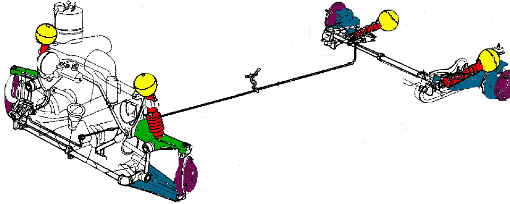 This little wonder was invented by Citro�n in the late 50's and has been
fitted to many of their cars since. I've had to separate it into it's own
category because it is quite different from any other type of suspension
system. Typically, this system works off a one-cylinder high-pressure pump
driven from the oil pump. It's a separate hydropneumatic circuit which is
connected to all four suspension units (which are usually 'double-A' arm
units on the front, and a beam or twist axle on the rear) via a system of
high-pressure hoses (similar to brake lines). Instead of separate shock
absorbers and springs, each suspension unit (red) has a hybrid shock
absorber-type piston with a reservoir (yellow) attached to the top of it.
At 'rest', the car sits very low on the ground. When the engine is
started, the hydropneumatics pump fluid into all the suspension units,
raising the car to operating height. The system boasts automatic and
manual regulation of ride height, which in turn allows for self-levelling
suspension and suspension that will actually roll a car body into a
corner. Other features allow the driver to manually select a ride-height
suitable for the type of road they are driving on. With the latest
technology (again, as in the Activa) the onboard computer can adjust the
settings and ride height of all the suspension units several times a
second to give a very smooth ride. The hydropneumatic suspension is
exclusive to Citro�n, beware second hand vehicles with this system
unless you are rich.
This little wonder was invented by Citro�n in the late 50's and has been
fitted to many of their cars since. I've had to separate it into it's own
category because it is quite different from any other type of suspension
system. Typically, this system works off a one-cylinder high-pressure pump
driven from the oil pump. It's a separate hydropneumatic circuit which is
connected to all four suspension units (which are usually 'double-A' arm
units on the front, and a beam or twist axle on the rear) via a system of
high-pressure hoses (similar to brake lines). Instead of separate shock
absorbers and springs, each suspension unit (red) has a hybrid shock
absorber-type piston with a reservoir (yellow) attached to the top of it.
At 'rest', the car sits very low on the ground. When the engine is
started, the hydropneumatics pump fluid into all the suspension units,
raising the car to operating height. The system boasts automatic and
manual regulation of ride height, which in turn allows for self-levelling
suspension and suspension that will actually roll a car body into a
corner. Other features allow the driver to manually select a ride-height
suitable for the type of road they are driving on. With the latest
technology (again, as in the Activa) the onboard computer can adjust the
settings and ride height of all the suspension units several times a
second to give a very smooth ride. The hydropneumatic suspension is
exclusive to Citro�n, beware second hand vehicles with this system
unless you are rich.
 |
![[brace]](../brace2.jpg) |
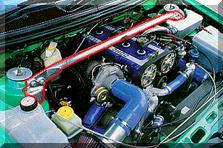
| Simple straight brace(highlighted). | Complex brace (highlighted). |
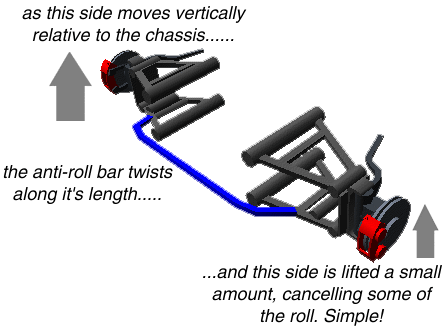
If you're loaded, you can buy cars with active anti-roll technology now. These sense the roll of the car into a corner and deflate the relevant suspension leg accordingly by pumping fluid in and out of the shock absorber. It's a high-tech, super expensive version of the good old mechanical anti-roll bar. You can buy anti-roll bars as an aftermarket addon. They're relatively easy to fit because most cars have anti-roll bars already. Take the old one off and fit the new one. In the case of rear suspension, the fittings will probably already be there even if the anti-roll bar isn't.
 Typical
anti-roll bar (swaybar) kits include the uprated bar, a set of new
mounting clamps with polyurethane bushes, rose joints for the ends which
connect to the suspension components, and all the bolts etc that will be
needed.
Typical
anti-roll bar (swaybar) kits include the uprated bar, a set of new
mounting clamps with polyurethane bushes, rose joints for the ends which
connect to the suspension components, and all the bolts etc that will be
needed.
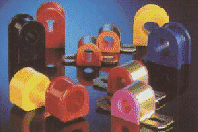 These are the
rubber grommets which separate most of the parts of your suspension from
each other. They're used at the link of an A-Arm with the subframe.
They're used on anti-roll bar links and mountings. They're used all over
the place, and from the factory, I can almost guarantee they're made of
rubber. Rubber doesn't last. It perishes in the cold and splits in the
heat. Perished, split rubber was what brought the Challenger space shuttle
down. This is one of those little parts which hardly anyone pays any
attention to, but it's vitally important for your car's handling, as well
as your own safety, that these little things are in good condition. My
advice? Replace them with polyurethane or polygraphite bushes - they are
hard-wearing and last a heck of a lot longer. And, if you're into
presenting your car at shows, they look better than the naff little black
rubber jobs. Like all suspension-related items though, bushes are a
tradeoff between performance and comfort. The harder the bush compound,
the less comfort in the cabin. You pays your money and makes your choice.
These are the
rubber grommets which separate most of the parts of your suspension from
each other. They're used at the link of an A-Arm with the subframe.
They're used on anti-roll bar links and mountings. They're used all over
the place, and from the factory, I can almost guarantee they're made of
rubber. Rubber doesn't last. It perishes in the cold and splits in the
heat. Perished, split rubber was what brought the Challenger space shuttle
down. This is one of those little parts which hardly anyone pays any
attention to, but it's vitally important for your car's handling, as well
as your own safety, that these little things are in good condition. My
advice? Replace them with polyurethane or polygraphite bushes - they are
hard-wearing and last a heck of a lot longer. And, if you're into
presenting your car at shows, they look better than the naff little black
rubber jobs. Like all suspension-related items though, bushes are a
tradeoff between performance and comfort. The harder the bush compound,
the less comfort in the cabin. You pays your money and makes your choice.