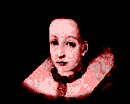
Elizabeth Bathory
We now turn our attention to the infamous "Blood Countess" of Transylvania, Elizabeth Bathory.
Born at Esced Castle in 1560 to a prominent Protestant family, Elizabeth was yet another arguably undesirous result of inbreeding between members of a dwindling royal family. Little is known about her parents George (Esced branch) Bathory and Anna (Somlyo branch) Bathory. Some of the other family members, however, were apparently a lively bunch to say the least, seducing and outraging all aspects of a somewhat purtianical society in an age when even the slightest provocation could get any peasant woman tortured and killed as a witch. These social morals did not generally apply to nobles. As in the case of Dracula, this caused young Elizabeth to run amok, ensuring the church graveyards would be filled for quite some time.
In all fairness there were many positive aspects to the Bathory family. Many later relatives went on to achieve great fame and success and they certainly cannot all be condemned by the actions of a few of their members. These actions were, however, strange to say the least. During the mid 16th century the family boasted an uncle supposedly "addicted to rituals and worship in honor of Satan, an aunt (Klara) who was a well-known lesbian and enjoyed torturing servants, and Elizabeth's brother, Stephan, who was a drunkard and a lecher"(19). McNally also mentions, "there is some genealogical evidence that the Bathory clan was related by marriage to that of the infamous ruler Vlad Dracula, the Impaler"(19). Remember him??
As a child Elizabeth witnessed many extremely brutal "punishments" of peasants and gypsies that I really don't want to get into here. The climate of the times was much the same as Dracula who lived only a century before in the same geographical area. As was stated in my page bearing his name, the politics and laws of the time were unbelievably violent and cruel. Justice was swift and final - for the poor. The lines of good and bad, right and wrong were much more blurred at the noble level. If a noble should accidentally run over a peasant child or two with a horse no one would bat an eyelash. If the same child's mother was seen visiting her son or daughter's grave after dark, this could lead to her being hanged for witchcraft or worse. The Church was used to keep the masses in line. The law was used to punish them. Nobility were generally exempt or at the very least ignored. In short, atrocities against peasants were committed every day in the name of the law. A child witnessing such things may grow up to be a monster....and in this case did.
Elizabeth was an ardent student. This is an area where she flourished, becoming fluent in Hungarian, Latin and German at a time when most Hungarian nobles were illiterate and even Princes could barely read or write their own names. Elizabeth became engaged at the age of eleven to a 16 yr old nobleman named Ferec (pronounced "Ferents") Nadasdy. The Nadasdy family was considered as prestigous as the Bathory's yet not as noble or as old. Perhaps someone took a look at the latest Bathory clan and decided it was time for some new blood to be intermingled? In any case there are records pertaining to her future husband which were kept by his widowed mother. It seems he was not quite the student she was. Ursula Nadasdy writes "Ferenc was not a good student. He barely learned how to write some Hungarian and to speak and read a little German and Latin.... Ferenc... developed into an athlete, but little else.... Although he acquired little academic education, he was evidently popular among his peers"(28). In short, Ferenc was a jock. Although many jocks are intelligent and articulate (your humble webmaster being one of them :D) he apparently was not. Ferenc was strong, Ferenc was popular, and Ferenc was rock stupid. Fortunately, it would be another 400 years before "Jeopardy" became popular, and he was a true 16th century man.
Ferenc married Elizabeth on May 8, 1575 in "a lavish, gala event"(30) to which even the Holy Roman Emperor Maximilian II was invited (though he was unable to attend personally, due to the hazards of traveling during a time of political unrest, he instead "sent a delegation to represent him and an expensive wedding present"[30]) The marriage, which joined two prominent Protestant families, was held at Varanno Castle where the "bearded young Count Ferenc Nadasdy henceforth added her last name to his. But Elizabeth, fully emancipated...[by that time,]... chose to remain a Bathory, rather than take his name, since she considered that her name was much older and more illustrious than his"(30).
Not surprisingly, Ferenc became a soldier. As with anyone choosing a militairy career he wasn't around very much, but off tending to the business of war. This left Elizabeth alone at the family castle (Castle Sarvar) tending the homefront and the task of disciplining the servants. Here is where we see the beginning of something going terribly wrong. The countess carried her 'disciplining' to a point that would be considered sadism today"(32). Beating the girl servants with a heavy club was the least of her "punishments," according to accounts. Often she would stick "pins into the upper and lower lips of the girls...into the girls' flesh and... under their fingernails"(32). One particularly harsh "punishment" would be to drag girls out into the snow where she or her women servants poured cold water on them until they froze to death.
Through the first ten years of their marriage Elizabeth bore no children due to lack of time with her husband, always at war. In 1585 her first child "Anna" was born and she bore two more girls over the course of the next decade: Ursula and Katherina. In 1598 her first and only son, Paul was born. Accounts from contemporaries show the Countess to be a very good wife and mother. She was protective and somewhat doting. People outside the family were treated a bit differently.
Something that Elizabeth enjoyed doing while her husband was away at war was to "visit her aunt Klara, an open bisexual. Wealthy and powerful, Klara always had plenty of available girls around. Elizabeth presumably enjoyed herself with her aunt Klara, since she visited her aunt's estate frequently"(33). While the Countess amused herself with the young girls, Ferenc was making his own mark on history. He had become a fearsome warrior. The Balkans area was a great place for war as it was constant and unrelenting. The Turks provided a never ending sea of enemies for good Christian soldiers of the time. By 1598 he had become a bona fide war hero. "He was one of five.....sharp sabred heroes known as 'the unholy quintet' who inspired fear in the Turks. The Turks even dubbed him with a popular nickname to indicate their fear of him, 'The Black Knight of Hungary' " (36)
Then the unthinkable happened....Near the close of 1603, "Ferenc suddenly became very ill, and died on the morning of January 4, 1604, as a heavy snow fell on his castle at Sarvar"(38).
Ferenc Nasdasy had basically lived as a man of his time. To say he was evil would be an injustice to him. To say he was good would be a bit of a lie. We do not know if he was aware of the actions of his homicidal wife. It is documented however that when he was home between campaigns he also took part in some quite sadistic torture of servants. He did not torture them to death, however. Again, in these times such things were not unheard of at all. In all other ways he would be considered a good man for his time, an excellent soldier and loving father and husband.
About four weeks after the death of her husband, the Countess began making appearances at court once again. It was at this time that Elizabeth began becoming obsessed with aging. It is my personal opinion that perhaps the death of her husband made her start feeling her own mortality. The lifespan of a sixteenth century woman, although longer than a man, was still very short. "One old legend states that while out riding with a young gentleman, she apparently was verbally abusive to a very old woman whom she found utterly repulsive in appearance. The old woman countered with the remark " 'Take care, O vain one, soon you will look as I do and then what will you do?' "(40) This is where the stories of Elizabeth's famed "blood baths" were born. The stories persist to this day that she bathed in the blood of virgins to keep young. Still, there have been no witnesses or accounts of any true blood baths, although blood DID flow by the gallons. Several accounts of her tortures described her as being so bathed in blood that she had to change her clothes before continuing on.

.
Works Cited
McNally, Raymond T., Dracula was a Woman: In Search of the Blood
Countess of Transylvania. McGraw-Hill Book Company, 1983.