
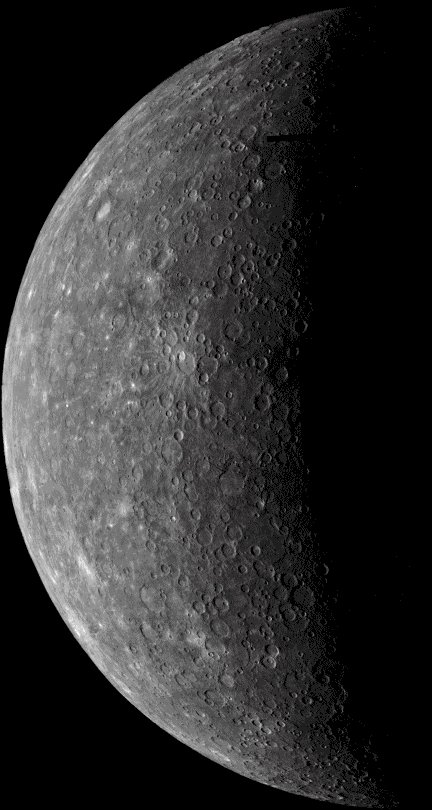
Mercury is the 2nd smallest planet in our Solar System. It has a high
density of 80% of it's mass in it's huge iron core. the surface is scarred by thousands of
craters and cliffs that formed when the planets yound core cooled and shranked,
contracting the surface crust. Mercury has almost no atmosphere because it's surface
gravity is too weak to hold on to one. Mercury was named after one of the Roman Gods
because it travels so quickly across Earths sky. Mercury's largest crater is named Caloris
Planitia. It measures 875 miles (1,400 km) across. Mercury can only be seen from Earth at
twilight either just before dawn or just after sunset. The Mariner 10 made it's way to
Mercury in 1973. The probe took 5 months to reach the planet.
|