How these days came to be
The mathematics of the pre-Christian calendar
And how it shaped our year.
Both the Greeks and the Celts considered the number nineteen
greatly significant and this played a part in the calculation of
the year cycles. The period of nineteen years, the Golden Year,
is referred to frequently and is represented, for our purposes,
in it's astronomical context. It is the time period for the apparent movement of the sun and stars and the sequence of lunation's to coincide. That is the period of time taken for the lunar and solar calendars meet before diverging again. The exact period is 18.61
years, or 6,797 days. The Golden Year was divided into nineteen
year units, each unit was divided into four sections governed by
the midsummer and midwinter solstice and the vernal and
autumnal equinox. These all have a slightly variable date
because of the earth's eccentric orbit and the angle of 10 degrees between the line of the solstices and the major axis of the earth's ellipse giving rise to different time periods between each transit.
For convenience, the dates are usually given as 21st March, vernal
equinox; 21st June, summer solstice; 21st September, vernal
equinox and 21st December for the winter solstice. For example,
the spring equinox may fall on either the 20th or 21st May
depending when the alignment takes place.
There is a large amount of inferential evidence to be drawn
from Celtic history, art and mythology, as well as classical and vernacular sources, which suggest the Celts maintained effective astronomical observations and a sophisticated esoteric calendar,
both of the year and the greater cycle of the Golden Year. This
was written down, having been passed from generation to
generation orally in the Middle Ages in variously bowdlerized
forms in legends and mystery tales. There was also the Coligny Calendar, but that is incomplete, remaining in fragmented form.
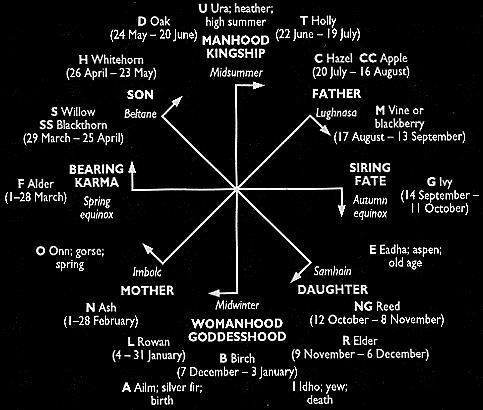
The year was further subdivided into a total of eight section
governed by the moon's cycle. These dates were later
incorporated into the church calendar as Christian Holy Days.
I have covered the chain of events leading to these adoptions in
the individual festival's information page.
Samhain 31st Oct - 2nd Nov, became All Saints and All Hallows
Alban Arthuan or Midwinter 21st Dec, became Christmas
Imbolic 2nd Feb, became Candlemas
Alban Eiler 21st March, became the Easter period
Beltain 1st May, became May Day (celebrated but not Christian)
Alban Heruin 21st June
Lughnasdh 1st Aug, became Lammas
Alban Elued 21st Sept became Harvest Festival
Each of the Celtic festivals and their subsequent month
corresponded with a comparative 'age of man', each also had
it's own plant and, in more recent times, letter associated with it.
The Celtic Year Cycle