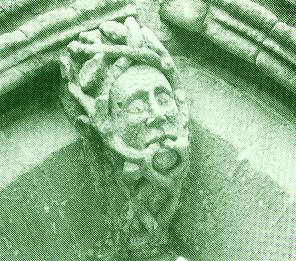
The Green Man.
The Green Man is a symbol of many
meanings and has been described as 'one
of the most pagan and archaic concepts in the imagery of the Christian
church.
' The name, The Green Man, a recent catch all term, has its roots in pagan
times, the original symbol has resurfaced many times in different contexts
throughout history. It is a favourite name for public houses whose signboards
litter the
English landscape with various depictions of Green Men. Latterly it has
come
to represent the environmental movement.
One of his earliest incarnations
is as half man half tree, he is a bizarre image, a severed human head,
almost always male, with leaves and foliage intertwined
around it and often sprouting from the mouth and nostrils as well. The
image is found, usually hidden, in Christian churches where it has been
carved upon roof bosses, capitals, rood screens and misericords. Why these
pagan symbols were permitted to be carved in churches while all around
pagan sites were being
destroyed in the name of Christianity is a mystery. Early folklorists tended
to
view them as representations of a pagan fertility spirit. The oldest appear
to
date from the Norman Conquest and evidence shows that there origin in this
form was imported with the Normans. There was a great upsurge in carving
during the fourteenth and fifteenth centuries, which coincided with the
writing
of the poem 'Sir Gawain and the Green night' in northwest England.
In an influential article 'The
Green Man in Church Architecture' published in
the Folklore Journal in 1939, Lady Raglan who gave the carvings their name
suggested a connection with another pagan ritual festival. She concluded
the
Green Man was the synonymous with the character who danced, adorned in
foliage, in many rural May Day processions and in the isolated village
of
Castleton Derbyshire was paraded on horseback covered in a garland of leaves
and flowers. She also made a connection with James Frazer's theory in 'The
Golden Bough', which related to the annual Celtic ritual of sacrificing
of the
sacred king. The king a personification of the god was symbolically killed
at the beginning of spring, in a ritual to fertilize the earth.
Kathleen Basford said her personal
quest for the Green Man began when she
saw a striking carving upon the apex of one of the tall windows at twelfth-century
Fountains abbey in North Yorkshire. She was the first person to publish
an
academic study of the symbol. It was 'a head with vegetation coming from
its
mouth, coiled around its brow and twisted over its throat'. The stone becomes
more prominent here than in different settings because of the total lack
of any
other imagery or sculpture at Fountains Abbey. It remains a mystery how
the
Green Men's effergy survived here in a strict Cistercian establishment,
where
even statues of angels are rare.
Unlike Lady Raglan, Kathleen Basford
did not see the image of the Green Man
as representative of May Day celebrations or Jack-in-the-Green, but as
a symbol
of death or ruin - 'a thing of sorrow'. Her study showed that these heads
are also found in French and Romanesque churches, and the ancient prototype
for the carvings appeared to be masks sprouting vegetation in Roman sites
in the Rhineland and in Rome itself. Faces emerging from a leafy background
also
appear in Iron Age La Tene art and Jupiter columns of the Romano-British
age. Those found in medieval churches had a more 'menacing' or 'demonic'
appearance than the more ancient examples and one folklore authority says
'some of the better carved specimens have such a mysterious intensity of
expression which makes it difficult to believe that they have no cult significance.'
The Green Man who is also associated
with the mythological aspects of the
Robin Hood legend and the Greenwood have yet to be fully investigated.
Good examples are located within Sherwood Forest itself at the fourteenth-century
chapter house at Southwell Minster in Nottinghamshire that was built on
top
of the ruins of a Roman villa. Here there are twelve green men, each highly
individual, depicting heads emerging from, peeping out of, or merging with
various sacred plants including Hawthorn, Maple and Ivy, which are suggestive
of the May Day and the Jack-in-the-Green figures.
Many medieval English cathedrals
have good examples of Green Men carved
on wooden roof bosses including those at Exeter, Norwich and Canterbury.
Some
of the finest, but least known examples are in Sheffield Cathedral in the
Lady Chapel where there is a complete suite of pagan carvings on the wooden
roof, decorated with gold paint. They date from the fifteenth-century and
are clearly placed their deliberately and they appear to have some religious
significance
which is not of the Christian tradition.
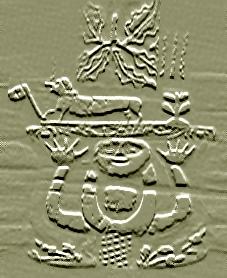
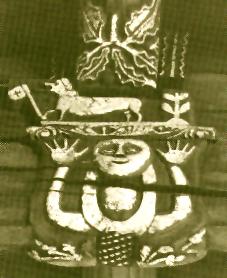
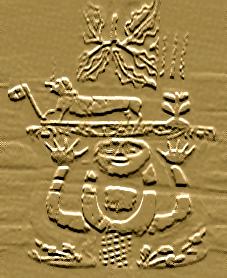
The centrepiece of the carvings
in Sheffield is the figure of the Mother Goddess herself, in the form of
a Sheela-na-gig, sitting upon tree roots that gush from the mouth of the
head on the apex of the great stained glass window. Seven carved bosses
depicting the Green Man appear in the Lady Chapel, all arranged geometrically
and surrounded by stylized foliage. It appears the medieval masons were
trying to bring into this holy space pictures of the forests and trees
outside,
and perhaps also memories of idols which once adorned the pagan temple
which
the church replaced.