Legend: A good
samaritan warns a female driver about the armed and dangerous man
hiding in the back seat of her car.
Examples:
[Collected on the Internet, 1998]
It was a dark and
foggy night. Denise was having trouble staying awake and the
road was slick. Her anxiety level was not helped by the fact
that she was running low on gas and didn't know where the
next town was. 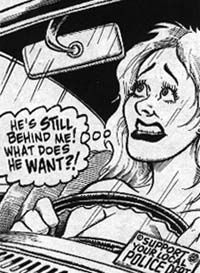 Finally, just as she thought she
would have to pull over and sleep till morning on the side of
the road, a tiny gas station appeared -- very rundown, but a
gas station nonetheless. She pulled in. The attendant made
his way around the car and seemed to be very distracted as
she asked him to fill it up, and even seemed to be making
faces at her. He finally agreed to get the gas, but then
asked her to pop the hood of the car because it "smelled
like trouble." Her anxiety from being on the road was
starting to flare up again, she was all alone in a creepy gas
station out in the middle of nowhere and an attendant was
finding reasons to keep her there. He asked her to come look
at the engine, he had to "show her something". Not
knowing what else to do, almost as if in a daze, she did as
he asked, all the while wondering why she didn't scream. As
she rounded the front of the car he grabbed her arm and said,
"This car needs a tow, you'll have to come with me into
the office." Then he put his hand over her mouth and
forced her into the office. She began to bite his hand once
they were inside and he let her go and said, "I'm sorry,
but there is a man crouched down in the backseat of your car
and I didn't want him to know that I'd seen him."
Finally, just as she thought she
would have to pull over and sleep till morning on the side of
the road, a tiny gas station appeared -- very rundown, but a
gas station nonetheless. She pulled in. The attendant made
his way around the car and seemed to be very distracted as
she asked him to fill it up, and even seemed to be making
faces at her. He finally agreed to get the gas, but then
asked her to pop the hood of the car because it "smelled
like trouble." Her anxiety from being on the road was
starting to flare up again, she was all alone in a creepy gas
station out in the middle of nowhere and an attendant was
finding reasons to keep her there. He asked her to come look
at the engine, he had to "show her something". Not
knowing what else to do, almost as if in a daze, she did as
he asked, all the while wondering why she didn't scream. As
she rounded the front of the car he grabbed her arm and said,
"This car needs a tow, you'll have to come with me into
the office." Then he put his hand over her mouth and
forced her into the office. She began to bite his hand once
they were inside and he let her go and said, "I'm sorry,
but there is a man crouched down in the backseat of your car
and I didn't want him to know that I'd seen him."
They called the
police who came to arrest the serial killer who, unbeknownst
to Denise, had stowed away in her car and was waiting for the
opportune moment to add her to his list of victims. Denise
and the gas attendant now own the station and their three
kids help them with the chores. Isn't that sweet?
[Collected by Brunvand,
1981]
A woman living in
the city [Salt Lake] was visiting some friends in Ogden. When
she got into her car in front of this friend's house, she
noticed that a car started up right behind her car. It was
about 2:00 in the morning, and there weren't any other cars
on the road. After she had driven to the highway, she began
to think that this car was following her. Some of the time he
would drive up real close to her car, but he wouldn't ever
pass. She was really scared to death and kept speeding to try
to get away from him.
When she got to Salt
Lake, she started running stop lights to get away from him,
but he would run right through them too. So when she got to
her driveway she pulled in really fast, and this guy pulled
in right behind her. She just laid on the horn, and her
husband came running out. Just then, the guy jumped out of
the car, and her husband ran over and said, "What the
hell's goin' on here?" So he grabbed the guy, and his
wife said, "This man's followed me all the way from
Ogden." The man said, "I followed your wife because
I was going to work, and as I got into my car, I noticed when
I turned my lights on, a man's head bob down in her back
seat." So the husband went over to her backseat, opened
the door, and pulled this guy from out of the backseat.
Variations:
- The woman is either
drawn into safety by a gas station attendant when she
stops to fill up, or she is pursued (and ultimately
warned) by a male motorist whom she mistakes for an
assailant. In common with all "murdering
madmen" legends, the intended victim is female, and
both the evil fiend and the rescuer are male.
- Sometimes the fiend
is discovered to have a knife, a hatchet, or a meat
cleaver in his possession; other times there's no mention
of a weapon. If he does have a weapon, though, it will be
a sharp-edged one.
- In versions where
the woman drives to the safety, the pursuer (rescuer) is
often said to be a burly truck driver or a tough-looking
character. Barring that, he's often said to be black.
(Both varities clearly show white, middle class fears of
minorities or of groups believed to be socially inferior,
according to Brunvand.)
- The pursuer
sometimes periodically flashes his lights as he chases
the woman's car. It's later revealed that his doing so
kept the fiend from attacking her while she drove: every
time the bad guy rose up in the back seat to assault her,
the pursuer would bathe him with his high beams and
prevent him from striking.
- A hybrid of the
"gas station" version crossed with the Lights
Out! legend appeared in 1993. In this variation, the man
hiding in the back seat confesses that as part of a gang
initiation he has to sneak into the cars of two women in
order to rape and murder them.
Origins: This
legend first appeared in 1967 and quickly caught on, becoming one
of the favourite scary legends of that period. In addition to
circulating orally, it showed up in Ann Landers' column in 1982,
presented as a harrowing experience that had befallen the letter
writer's friend.
Despite the legend's
many incarnations and long history, there's no record of its ever
coming true. It's a cautionary tale, warning us to be vigilant of
our surroundings.
There just aren't that
many bad guys lurking in backseats to get worried about. Though
there have been rapes wherein the attacker hid in the back seat
of an automobile, they can be counted on the fingers of one hand.
As for carjackings, in the overwhelming majority of them the
assailant opens the door and gets into the car while the driver
is behind the wheel. There's little of this "lurking in the
backseat" bit.
The legend might have
been prompted by a real news story, though:
[Drake, 1968]
Research shows that
one true case of "The Killer in the Backseat" did
occur in 1964 in New York City, when an escaped murderer hid
in the backseat of a car. The car, ironically, belonged to a
police detective who shot the man. Though the differences
between the legend and the true occurrence are vast (the real
occurrence did not feature a lone female; it didn't
necessarily happen at night; and no third person was
involved), the legend may have sprung out of this real
incident.
[de Vos, 1996]
The warnings that
the woman misunderstood as aggression lead to a surprising
turn of events: her fear was misdirected and the danger came
from somewhere much closer than she realized, the backseat of
her own car!
Even as a horror legend,
this one is sexist to the core. As mentioned earlier, the prey is
always female and both the evil fiend and the rescuer are male.
There are no exceptions to this typecasting. Both of the male
figures are seen as powerful: the fiend for his evilness and mad
intent, the rescuer for his coolness in knowing what to do and
his ease in dispatching the fiend.
The woman, by contrast,
is portrayed as completely and unredeemably ineffective. In none
of the tellings does she catch on to the source of the peril
she's in -- she always needs a man to set the record straight.
(The task of rescuing her from a dangerous situation also falls
to a guy; the woman is never involved in either containing the
bad guy until the police arrive or in tussling with him if he
tries to escape.) Her inability to take care of herself is
further driven home by her resolutely acting on the assumption
that the man either chasing after her or trying to lure her into
the gas station means her harm. Unaided, she can't tell friend
from foe.
In those recountings
where anyone's race is mentioned, the man hiding in the car or
the rescuer is invariably black. It's easy to see those versions
as a racist reaction to anxiety about being attacked by a member
of a feared group: the lurking black man represents the perceived
menace of his race, waiting for the proper moment when a back is
turned to strike; the potential rescuer is ignored because his
color marks him as much more likely to be an attacker than a
protector.
Though it's rarely
stated outright, the bad guy is generally assumed to be lurking
in anticipation of raping the woman, not of robbing her. He might
kill her afterwards, but the fear of his doing so is secondary to
fear of sexual violation. Murder is seen as a completion of the
story, not as the main horrific element.
Back
From snopes.com