737s
737 Family Overview
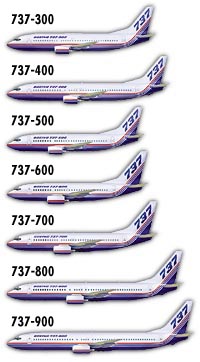
The twin-engine 737 demonstrates how Boeing develops a family of
models to meet specific airline needs. Airlines can choose from
seven models of the world's most popular jetliner. Smallest of
this "Classic" series of 737s in production is the
737-500, seating 110 passengers; the 737-300 accommodates 126
passengers; and the 737-400 is capable of carrying 147
passengers, all in two classes. All three versions of this 737
series share the same two-pilot, new-technology flight deck, so
pilots qualified to fly one model can also fly the others.
In November 1993, the company launched a derivative 737 family to
build on the 737's extraordinary success and extend the airplane
type well into the 21st century. Since then, the Next-Generation
737s have outsold all other airplanes in their market category.
The 737-600, -700, -800 and -900 will fly faster, higher and
farther than previous models, with additional improvements in
operating costs, noise, fuel burn and thrust. All of this is
accomplished while maintaining crew commonality with the previous
737 lines. Like Classic 737s, these new family members are
offered in multiple sizes, with the 737-600 accommodating 110 to
132 passengers, the 737-700 seating 126 to 149 passengers, the
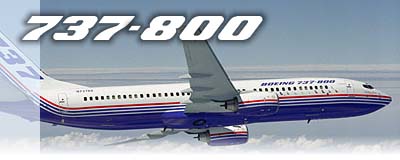
737-800 capable of carrying 162 to 189 passengers, and the
737-900 seating 177 to 189 passengers.
In December 1997, Southwest Airlines became the first airline to
take delivery of a Next-Generation Boeing 737-700. 1998
milestones include delivery of the first 737-800 to Hapag-Lloyd
in April and delivery of the first 737-600 to SAS planned for
September.
In July 1996, Boeing and General Electric announced a joint
venture, called Boeing Business Jets, to market a business jet
derived from the Next-Generation 737-700. GE also became the
plane's launch customer, ordering the first two BBJs, with first
delivery at the end of 1998. A convertible freighter version of
the 737-700 is scheduled for delivery in 2000.