CHAPTER 2
Review
of the Literature
Introduction
In order to
conduct a complete and thorough investigation into the true impact of the
Internet upon our teachers, schools, and education, as with any formal study,
one must go through a systematic investigation of the literature that is
available, from a variety of different viewpoints, different medias, and
different angles. Following is a review of the literature in which the
researcher has attempted to offer viewpoints from every angle, including that of
the student, teacher, administrator, board member, community leader, business,
leader, parent, average citizen, and politician. There is documentation to
support both the positive and negative of using the Internet in the classroom. Through this research, the following topics,
though not only these, will be dealt with:
What exactly is the Internet and what does it offer the teacher? Are
teachers using the Internet (with success) in the classroom? How are teachers using
the Internet in the classroom? Are there benefits to the students? What are the
negative and positive aspects of using the Internet in class? Is there ample
Internet training for teachers? How much of a factor is money in getting
schools connected? Will the role
of the teacher change as more teachers use Internet in the classroom?
What is the Internet?
The Internet was
started as a needed link between two departments of the military. It started as
a link between two 'networked' computers, called ARPANET (Advanced Research
Projects Agency Network)(See Figure 1).
Within one year of establishing that direct, networked connection, there
was an E-mail message sent. The two departments were able to access each
other's data and modify data on either machine as if they were sitting at a
terminal in front of the machine (available World Wide Web: http://www.internetvalley.com/ intval.html).
__________________________________________
Figure 1
ARPNET NODE #1
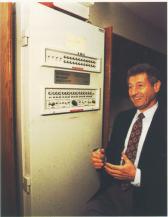
(available World Wide Web: http://www.internetvalley.com/intval.html)
__________________________________________
Following are archived records about that 'first
contact' (from the UCLA archive library, 1969)
__________________________________________
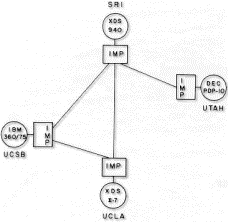
Figure 2
First
network conversation
According toVinton Cerf: |
|
|
|
Around Labor Day in 1969, BBN delivered an Interface Message Processor (IMP) to UCLA that was based on a Honeywell
DDP 516, and when they turned it on, it just started running. It was hooked
by 50 Kbps circuits to two other sites (SRI
and UCSB) in the four-node network: UCLA, Stanford
Research Institute (SRI), UC Santa Barbara (UCSB), and the
University of Utah in Salt Lake City. |
||
|
|
||
|
The
plan was unprecedented: Kleinrock,
a pioneering computer science professor at UCLA, and his small group of graduate
students hoped to log onto the Stanford computer and try to send it
some data. They would start by typing, "login,"
and seeing if the letters appeared on the far-off monitor. |
||
|
|
"We set up a
telephone connection between us and the guys at SRI...,"
Kleinrock ... said in an interview: "We typed the L and we asked on the phone, "Do you see the L?" Yet a revolution had begun"... |
|
|
|
||
(available World Wide Web: http://www.internetvalley.com/intval.html)
__________________________________________
Once the idea of
networking caught on, one location would network itself internally (called an
intra-net), and then connect one of their computers to the growing external
national network. Within a few short years, there were many networks connected
to each other via the Inter-network links that were being established. The
Internet was born out of a network of networks (Sellers, 1994).
By mid-1970, ten nodes were connected,
spanning the USA. BBN designed the IMP to accommodate no more than
sixty-four(64) computers and only one network. Electronic mail (E-mail) was an
ad-hoc add-on to the network in those early days and it immediately began to
dominate network traffic; indeed, the network was already demonstrating its
most attractive characteristic, namely, its ability to promote "people-
to-people" interaction. The ARPANET evolved into the Internet in the
1980's and was discovered by the commercial world in the late `80's; today, the
majority of the traffic on the Internet is from the commercial sector, whereas
the scientific research community had earlier dominated it. Indeed, no one in
those early days predicted how enormously successful data networking would
become? (available World Wide Web: http://millennium.cs.ucla.edu/LK/Inet/birth.html).
As of February
1999, an estimated 154 Million people worldwide are on-line, North America has
87 million(available World Wide Web: http://www.nua.com)
. When people talk about the being on-line on the Internet today, they are
usually referring to E-mail, IRC (CHAT), news-groups, bulletin boards, and the
World Wide Web. There are other aspects of the Internet (gopher, Archie, etc),
but researchers, government agencies, and professional organizations generally
use them more.
A network is
connected to the Internet via an Internet
Service Provider (ISP), perhaps Earthlink, America On-Line(AOL), Microsoft Network(MSN), or some other
provider. The ISP is either connected directly to one of the Internet
backbones, or goes through another ISP to (eventually) get to (one of) the
actual Internet backbones. These backbone
providers are mainly companies such as PSINet, UUNet, and MCI. It is through these ISPs that the world of
the Internet is brought into an individual classroom.
One of the
aspects of the Internet, which is mostly responsible for the Internet craze over
the last few years, is called the World Wide Web. Imagine any page that can be visited on the World Wide
Web (WWW), such as www.discovery.com or www.teacher.org. All across that page are hyperlinks that
will lead to a variety of other sites
or pages which have hyperlinks that lead
to a variety of other sites, and so on. (A hyperlink is any word,
picture, or object on a web page which, when the cursor is positioned over it,
turns into a hand, thus allowing to connect to it's site with a click of the
mouse). These links (crisscrossing the globe below) 'virtually' crisscross all
over the world giving a creative image of a complex never-ending spider web.
__________________________________________
Figure 3
World Wide Web abstract
diagram
(World Wide Web
crisscrossing)
__________________________________________
This whole
system seems like a lot of cooperation to be happening amongst computers, from
various companies, countries, libraries, schools, and homes that have no actual
connection to each other---but that is the beauty of the Internet; it works
because the entities that have chosen to be connected have all agreed to a
standard protocol (TCP/IP) that allows computers of all types to talk, pass on
messages, and receive E-mail from anywhere in the world in a matter of seconds.
E-mail exists on
the same principle as does the 'real life' post office. A message has content, a destination address
and a return address. Just as with the WWW, a message is passed from network,
to network, to network until it finds the actual network where the destination
address exists. If the top is reached and still the destination address has not
been located, it is then sent back via the same type of path to its original
sender and stamped 'returned mail'.
Imagine sitting
down at a library and having an endless stream of librarians come to offer
help. One is asked to bring back all research related to the space program. The
next is asked to bring an audio recording of some of the communications between
NASA and the Apollo-13. Another is asked to find biographies of each of the
T.V. movie actors who played the parts of the astronauts in the T.V. movie of
the Space Shuttle tragedy. Even another
is asked to research information on the moon surface and perhaps find some
names and contact information of researchers to whom we could ask some
questions. A last one is asked to find
some of the reactions of foreign newspapers to the battle of the U.S.A. and
Russia to get to the moon first. And so on. Imagine that each will come back
within seconds with even more than requested. It is now the job of the person
who asked for the information to sort through all the information to determine
what is useful, legitimate, accurate, and related to what is being sought.
This, in digital form, is what the Internet bring any on-line user.
In Hunter's article (1998),
'The Internet is?'
Teachers
'...It's like a
library that never closes'
'...it's like
having many teachers in the room at once'
'...students are
learning without actually realizing they are
'..can go on
field trips without spending money...'
Library specialists
'...up-to-date
articles, reports, news, weather'
'...more hands-on
ways to explore increasing self esteem'
'...various types
of searching skills are developed'
Students
'...fast way to
get all the information you need, in any format you need it (photo,
text, audio,
video?)
'...people are
more interesting on the Internet than in a book'
What
is available on the Internet for students and teachers?
The
Internet offers instant access to: every major library, database, company, or
entity and all digitalized documents in their possession. There are
up-to-the-minute weather, current events, movies, TV shows, video reviews,
sport schedules, politician voting records, college information, sightseeing
suggestions for any city in the world, airline reservations, flower delivery,
university class registration, curriculum ideas, lessons plans, complete
up-to-date encyclopedia sets, major magazine articles, discussion groups of
peers in same subject area who exchange messages on a daily basis, interactive
'chat' rooms where you type a question and the expert on the "other end of the
line" sees it and responds immediately,
etc. It is very likely that there is
more information than you could ever have time to review (NPR, 1999).
The
best-supported subject areas on the Internet are:
_______________________________________________
Table
1
The
best supported subject areas on the Internet
1. Research/Reference 69.5%
2. Science 63.1%
3. Social Studies 62.2%
4 Geography 38.2%
5. Art/Music 27.3%
6. Integrated Curriculum 18.9%
7. Writing 15.3%
8. Mathematics 13.7%
9. Reading 12.9%
(National Survey
of Internet Usage, 1997)
_______________________________________________
Are
teachers using the Internet in class?
One reason why
there is so much uncertainty concerning the usage of Internet in our classrooms
is that the Internet, in the context that we are using it, is really only a few
years old. There have been very few thorough surveys done to attempt to
determine the value and benefits of using the Internet in the curriculum. In
many cases, the level of technology has changed so significantly that many
surveys become obsolete before they can even be completed (NCES, 1997).
Actually, there was no comprehensive national data on the status of advanced
telecommunications in elementary and secondary schools until 1994, when a
survey of public schools was finally obtained. However, it was not until late
1995 when a similar survey was taken to collect information concerning private
education. Private schools represent
about twenty-four percent
(24%) of all elementary and secondary schools in
America (and about eleven percent (11%) of the
of the students).
A very
interesting point obtained from that survey was that during the 1995-96 school
year, seventy-five percent (75%) of private schools were without
Internet access. Out of those schools, sixty percent (60%) had no plans for connecting in the future (NCES,
1997). Unfortunately, since that time,
there have not been any similar reports done to find more recent numbers. In comparison, Internet access in public
schools increased from thirty-five percent (35%)
to seventy-eight percent (78%) from 1994 to
1997 (NCES, 1997).
Sandham (1997)
finds that it is rather interesting and ironic that private schools, which are
thought to be the elite of schools are actually, according to a variety of
surveys and studies, 'behind the times' in connecting to the Internet. Many
private schools already have to operate on slim budgets in an effort to keep
tuition competitive. Oftentimes, there is simply not the money available to
invest in the technology needed to connect their school to the Internet. In addition, most private schools do not
have access to the large grants and bonds that public schools do. Especially with teachers demanding higher
salaries, many private schools are having to raise funds just to meet basic
operating costs; at these times technology has taken a back burner. Of course, private schools are not looking
for sympathy here; the nature of their school is also what allows them to
operate the way they prefer, without having to abide by the same rules and
regulations as public schools.
Sixty-one percent (61%) of the private schools surveyed said inadequate
funds were the main reason for their lack of Internet access (NCES, 1997). Within the religious private schools
surveyed, a full third (1/3) of Catholic schools were connected, compared to
half that for non-Catholic private schools.
Non-religious schools were also in the thirty-three percent (33%) range. The
NCES survey ( NCES, 1997) found that the percentage of computers on the
Internet in nonsectarian private schools was almost four times higher than the
percent in schools with religious affiliations. There were no reasons given or
even suggested for the variance.
The following
table (Richards, 1996) shows usage percentages by subject areas:
_______________________________________________
Table
2
Internet usage percentages by subject
areas
Library/Research 59%
Computers/ Technology 49%
All Elementary subjects 37%
English 37%
Social Studies 32%
Science 30%
Math 20%
_______________________________________________
In the
Southeast, an estimated thirty-two percent (32%) of schools
are actively using the Internet in the curriculum. This is about half of the
national average of seventy-eight percent (78%)
(National Survey of Internet Usage, 1997)
However, only three percent of all classrooms, labs, and libraries are
connected to the Internet. One should note that not all classrooms need the
Internet. There are some classrooms and labs that truly have no need for
computers, much less the Internet. So, when considering these statistics, that
point must be kept in mind. Most supporters of incorporating the Internet into
the classroom do not believe that EVERY
classroom should have access. School personnel must be wise in decisions of how
and where to bring in the Internet ("On-line investment", 1995).
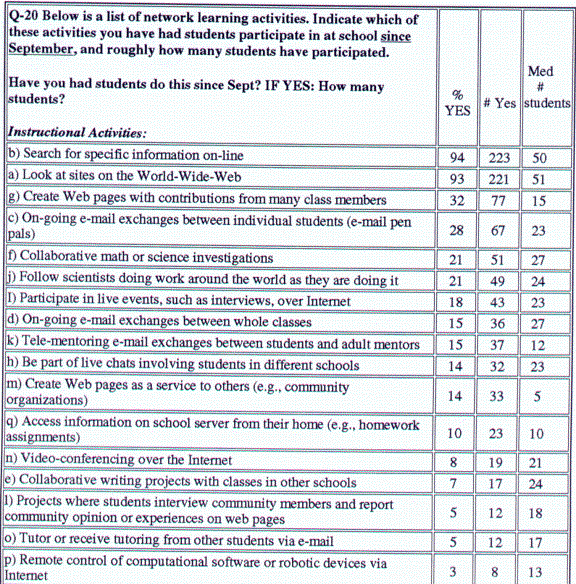
Hunter(1998)
reports that there are a variety of ways that teachers are having their
students use the Internet (See figure 4):
___________________________________________
Figure
4
Use of Internet
__________________________________________
A majority of the active Internet-using teachers
said the most substantial benefit they witnessed was students applying
themselves for much longer periods of time.
They did not necessarily have a deeper understanding of the materials,
but they were preparing students for life in a technological society. As early as 1994, when schools realized what
the Internet might offer the educational process, most said they looked forward
to students learning via larger, deeper collaborative projects across state and
national borders. While these types of learning have taken place, the numbers
are still lower than one might have hoped. In 1997, only about twenty-one
percent (21%) of one survey group were actively involved in collaborative science
projects or writing projects. This is
still a thirty percent (30%) increase from a couple years back, but even higher
numbers would be necessary to be able to really see if there are substantial
improvements in learning because of those types of long term, thorough
assignments. A very promising part of
the survey (NCES, 1997) was dealing
with the ideas of students and real-world projects and understanding. In this
study, learner-centered classrooms actively using the Internet were providing
for long-term projects dealing with real-world scenarios. Sixty percent (60%)
of the teachers interviewed attributed these benefits directly to the Internet
A national
survey (National Survey of Internet Usage, 1997) found that approximately
eighty percent
(80%) of students spend their time 'browsing' the
Internet, seventy-five percent (75%)
downloading information, and seventy percent (70%)
searching. This brings up some related
problems concerning effective use of the Internet while at school or in class:
There is not really enough time in class, or in the school day, for students to
cram in the extra time required to just 'surf', search, and browse. Class
periods are already very short, and with limited computers in the classroom,
class is over before the exercise has been achieved.
Though there are
specific references to very productive uses of the Internet to complete
projects or activities, in truth, surveys indicate that for Internet activities
such as electronic forums, asking 'experts', conducting surveys, and on-line
publishing are all listed in the low five to thirteen percent (5%-13%) usage range (NCES, 1997). Many users of the Internet in the classroom felt that students
were not necessarily producing better results because of the Internet, but were
getting some 'real world' context and injections of motivation for students.
There are many magazines and journals available
that discuss the Internet and ideas for bringing it into the classroom. A
popular one is called Classroom Connect (See figure 5). It is
focused entirely on using the Internet in classes. It gives plenty of success
stories (and failures), suggested web sites for students & teachers,
curriculum ideas for projects, lessons plans, requests for joint projects from
other schools (sometimes even in other countries).
Bill Burral (Classroom Connect,
November1996), a middle school teacher in West Virginia, used the Internet to
open up doors of communication between students and prison inmates. Students
were able to ask questions to try to understand crime and why it happens, and
how the punishment system of our country works. The project became so popular
that fifty thousand(50,000) students from schools in twenty-two(22) countries
participated. A combination of bulletin and E-mail was used to allow
'risk-free' access to a 'high risk' environment .
Global Learning and Observations to Benefit the Environment (GLOBE) is a network available on-line where
students enter data about the weather in their city (The Globe Program,
1997). Researchers then take that data
and provide feedback about their data in graphical and text form on their
website, along with that of over three thousand (3000) other schools in
forty-four (44) countries who use this site regularly. This site allows communication between far
away schools and allows them to interact with activities and games while also
learning about the world's atmosphere and weather
Sara DiRusco
(Classroom connect, October 1996), of Sunnydale, California, tells of a
fantastic experience with the Computer lab. As in many schools, there are
problems trying to mainstream special education students or handicapped
students. Students at Cupertino Middle School loved the Internet lab so much,
the students were all racing to get the 'best computers' at break and lunch and
many of the special education kids were regularly interacting with 'normal'
kids and feeling good about themselves.
Dwyer and Steele
(1996) report on a student, Brad Pilon,
a senior at Nelson High School in Burlington, Ontario, Canada, who received
on-line help for his research paper on a rare form of diabetes. Via E-mail,
discussion groups, and chat rooms, he communicated with the researchers at
Hamilton's McMaster University. Within a few days, Brad was able to find the
answers to all his posted questions from the scientists who were the experts in
the field. "The subject is very new and
hard to find in any books, " says Brad, " Besides, you can?t ask questions to a
book !"
Dyrli(1995)
speaks of a web site on a California school web site that links to a "Live from
Antarctica" multimedia resource for teachers and students. On the site can be found up-to-the-minute
reports and statistics on ozone depletion, a hypermedia exhibit with journal
entries of several of the team members stationed there, audio recordings made
during "Grand Antarctic Circumnavigation", and copies of The New South Polar
Times (an on-line newsletter written at the Amundsen-Scott South Pole Station).
Many classes have used this site as a basis for their studies on Antarctica and
also the atmosphere.
Many teachers (Classroom
Connect, January 1998) see E-mail and web publishing as writing practices.
There are many options available: pen-pals ("keypals"), publishing essays and
reports, and collaborative stories. Students sometimes feel more comfortable
talking to a peer rather than an adult. And sometimes writing to someone you
don't know adds a level of excitement to writing. Students can take ownership of their writing assignment by picking
a key-pal from organized lists (available at many educational sites. i.e. www.keypals.com
), and learn responsibility of keeping regular contact, while writing, when otherwise (s)he would not
be writing. Publishing any text or art on-line is a very powerful tool to
improve writing or artwork. Knowing that many others will scrutinize the work
encourages students to spend extra effort making their work 'more
professional'. There are a variety of web sites available that publish (free)
work of students from K-12 ( i.e. www.kidnews.com). Many classes have had a
wonderful experience doing collaborative projects with classes in other cities,
states, or even countries. Students or groups rotate writing sentences,
paragraphs, or chapters of a story and it is continued over the course of a few
weeks. Foreign language teachers find E-mail a wonderful practice tool when
doing exchanges with foreign students. Students must write in each other's
language and must write once a week. Then, in class, they can discuss what they
wrote about.
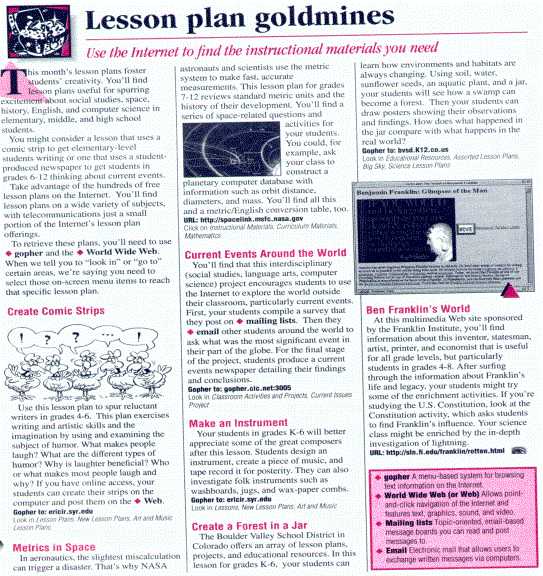
The following page (see Figure 5)
available to teachers (Classroom Connect, April 1996):
__________________________________________
Figure 5
Magazine lesson plan example
_______________________________________________
In the National Survey of Internet Usage
(1997), educators
indicated that web sites with instructional activities already planned, tested,
and posted on their web pages, with reference links to the common textbooks and
other related resources are most likely what it would take to get them to use
the WWW on a more regular basis
The top five
rated educational web sites(The National Survey on Internet Usage,
1997) were:
_______________________________________________
Table
3
Top five rated educational web sites
1. National
Geographic On-line
2. NASA
3. PBS On-line
4. Scholastic
Network
5. American On-line
Education
_______________________________________________Almost fifty percent (50%) of teachers surveyed said if a site provided materials
to fit their needs in a variety of ways that they return to that site several
times a week; almost thirty percent (30%) said
they would return daily.
The Internet
allows for a new type of 'book' (Censorship News, 1997). These new 'books' are
incredibly rich with content and a variety of media in addition to words which
allows students to access not only text, but on-line audio and video interviews
with appropriate individuals, interactive spreadsheets which allow students to
visually see the implications of changing (with their own numbers) data from
the book or article, and related topic references with the click of the
mouse "The Internet has the
distinctive power to compliment, reinforce, and enhance some of our most effective
traditional approaches to teaching and learning" (Censorship News, 1997).
Johnson (1998)
participated in a creative and touching Internet-based activity with her the 4th
grade students at Custer Park Elementary School in Illinois. After the
explosion of the Space shuttle, in which teacher, Christa McMauliffe lost her
life, there was an outpouring of emotion and questions. Students at Ms.
McMauliffe's school, Bloomfield School, published, on-line, a series of fifty
(50) technical questions about the space shuttle, the space program, and the
terrible accident ( http://bloomfield.k12.mo.us/ ). Johnson's
4th grade class was among many who helped to remember that
terrible day. They used the Internet to search for the answers to all those
questions. They learned that SRB stood for 'solid rocket booster' and that the
Kennedy Space Center runway is about three miles long. They learned that
President Reagan's speech soon after the tragedy included a short excerpt from
the Poem, " High Flight" by John Magee, Jr. They also learned that Astronaut
Greg Jarvis put thank-you cards under the windshield wipers of cars with
Florida license plates to commemorate the ten-year anniversary. They learned
about the many foundations that were started by family members and friends.
They collected all the poems, pictures, remembrances, and stories they ran
across and presented them to Ms. McAuliffe's mother when she visited the
Bloomfield School.
One school had a
yearlong activity with a collaborative partner in New Zealand (New Zealand
Collaboration, 1998). First, both
schools decided to take advantage of the various medias available on the
Internet. They both installed VoxPhone, which offers voice, video, and text
transfer in real-time. This would allow both schools to communicate in many
ways. Two Physical Education teachers were eager to establish an international
relationship, so they used their classes (aged eleven-thirteen(11-13)) to
compare fitness scores. This was done with-mail and even speaking. Once the students
knew each other, pen pals naturally developed, and they began exchanging
hobbies and interests. Once both
teachers realized they had a 'good thing going here', they began to expand the
collaboration by incorporating the social studies classes to use MapQuest
program to pinpoint each other's locations and hometowns. Science classes
incorporated discussions of weather, landforms, temperature, bodies of water,
and mountain ranges. Art classes created pictures, and drawings of American
life and New Zealand life, which they sent back and forth. The music classes
rehearsed classical native music and actually sang on-line to each other! They
learned about each other's metric systems when they compared fitness
results. The project became such a
success that local TV stations and newspapers ran specials about the
schools. This experience allowed Rex
Wood, the instructor, to truly incorporate cross-curriculum study, which the
students will remember for many years.
It allowed them to learn, apply, and share new information, not only
with each other, but with peers across the world.
Sellers (1994)
found one school has begun a nationwide, inter-school project tracking the
paths of migratory birds and butterflies. Schools along the known migratory
routes communicate with a central site, thus allowing all involved schools to
be involved with the sighting and population counts of various bird (or
butterfly) species. Professional
lepidopterists have also been incorporated into the projects to answer
questions and help understand observations.
Are
the students benefiting because of the Internet?
Holt (1998)
writes that the utopian vision of education is where all students
become eager learners and even become teachers to others while learning. Students master extremely
challenging curricula which are tailored based to their individual needs, while
at the same time, having the world's libraries, art galleries, and concert
halls at their virtual fingertips. Some
of this is no longer just fantasy inside Utopia; it is available now.
Stephen Gerkey,
educational consultant at IBM (Holt, 1998), says access to the Internet and all
the information it connects to, in many ways changes the way the educational
system (should) work. With worlds of
information available to the click of the mouse, rote memorization and
knowledge of pure facts is not such a priority. Finally, we can attempt to
focus on what teachers have been trying to focus on for generations: inquiry
and problem solving.
For example:
Students doing on-line research on turtles may get tens of thousands of
responses in a search engine. They must be able to know how to find the right
information that applies to them that supports their needs.
Holt (1998)
shows that there is not really any evidence to show that people are doing any more research just because they are on
the Internet than if they went to the library or similar place. The Internet, as a tool, simply gives us the
ability to flip through many sources very quickly while searching. Real learning and true research takes
patience and time, regardless of the media in which it is done. Just because "...the information is out there,
as it always has been, does not mean that you know it"(Harrison, Betty ,
superintendent of Chaffey Joing Union High School District, Ontario, Canada).
Dyrli and
Kinnaman (1996) believe that learning takes place when students interact with
concrete materials; they learn by doing. In that regard, the Internet as part
of the curriculum has the potential for tremendous power, since the media
itself requires learners to interact with the on-screen resources and navigate
through a myriad of links. On the Internet, it is possible to find science
writings posted by middle school students as easily as it is to find writings
by scientists. This forces students to learn to evaluate the content and
quality of their findings. Dwyer and Steele(1996) support these concepts
through a study that found that students who work on the Internet actually
retain more information because of the all the medias available at the click of
the mouse (See Table 4):
_______________________________________________
Table 4
Information retained via media
Information retained via media:
Reading 10%
Hearing words 20%
Looking at
pictures 30%
Watching
something being done/ viewing an exhibit 50%
Talking 70%
Simulating a
real experience/doing the real thing 90%
_______________________________________________
The National
Survey on Internet Usage (1997), throughout all the research, found that one of
the best loved aspects of the Internet, was the fact that the Internet can
offer up-to-date information on current events and even topics covered in
textbooks. Sometimes textbook are many years behind.
Neil Rudenstine ("The Internet and Education",
1997), president of Harvard University, comments on the important good the
Internet offers. For hundreds of years,
teachers have felt that education should be student driven; students should
take an active part in the own educational development. Finally we are at a
point in time where the world around us supports that type of environment. The Internet reinforces the concept of
students as 'active agents' in the classroom. Most teachers would love to have
the student who asks questions, searches eagerly for relevant information, discusses
ideas with others, and becomes an investigator and discoverer. The Internet not
only encourages these characteristics, but actually requires them to get around
successfully on the Internet. Not only can students discuss issues with
classmates, but they can talk with students at other schools, in other states
or countries, without concern for distances, phone charges, and how to find
people ('experts', business men and women, local community members) with whom
to talk via E-mail, Chat (IRC), or Internet-phone. And because these students are communicating, that means they are
writing, they are forming questions, synthesizing information, and making
contacts that would otherwise not be possible.
However,
Rudenstine also makes note that the need for books and other tangible documents
as research tools cannot be forgotten.
Nor should face-to-face contact be forgotten. But, in the same
sense, the Internet must not be
mistaken as a fad or recreational tool just for play. Society must accept and harness the power of the
Internet and take advantage of a transformational technology that might change
the way we live, learn, and work. In some ways, it already has.
Gore (1998)
notes that the
Education Department of the United States has been doing a decade long study of
computers and students. They have found that students with computers in their
classrooms outperform (by thirty percent (30%)) their peers on standardized
tests of basic skills. This seems to
indicate that through understanding of hardware and software, students are
carrying over their knowledge into other areas. A 1996 study showed that
students with access to the Internet not only turned in more creative work, but
also work that was more complete and synthesized. Gore (1998) points out that many
of the studies he saw indicated that technology as whole brought energy and
motivation to the classroom. Schools
with Internet access are seeing better attendance rates, better writing skills
of their students, and better thinking skills (See Chapter 4).
Gore understands
some institutions may be hesitant to lunge forward into technology. He is quick
to point out that throughout history, new technology has always brought on
anxiety. In old Greek days, when paper was being imported into Athens, Socrates
condemned it, saying it would "...replace public discourse with less desirable and potentially dangerous private
communications and disrupt human ties..." In the 1700s, Diderot was said to have
look upon the rapid popularity of printed books and foresaw a day when it would
be almost as difficult to learn anything from books as from the direct study of
the whole of the universe. "The world of learning will drown in books". Now,
books are the foundation of our learning process. Looking back to the 60's and
70's (Holt, 1998), there were many feeble attempts at bringing technology into
the classroom (flash cards programs, matrixes of multiplication, noisy dot
matrix printers, etc.). At that time, before the world outside was in
the true information age, the money or time needed to bring technology into the
classroom could not be justified. The idea of E-mail and web sites were mere
fantasy and were nowhere close to being available to the public.
Jane David
("Computers in Schools", 1996), Director of Bay Area Research group, says, the
simple fact that students are learning to be experts on the Internet is reason
enough to incorporate it into the classroom. Computers are found at all job
levels, from entry level clerical to higher management positions.
Currently, many
companies who use a WAN(wide area network) to connect their computers use
a combination of CAT-5 cable, Telco
telephone lines, ISDN lines, even Frame relay lines to interconnect their
network. Christenbury, Project Manager at BellSouth Enterprises, (C.A
Christenbury, personal communication,
August 20, 1999), says:
There is a new
technology called VPN (Virtual Private network) that will actually use the
Internet to connect a company's computers in a fast, secure, inexpensive media.
Students who are already familiar with the technology of the Internet will be
able to move immediately into jobs using these types of networks.
Dwyer and Steele
(1996) note that two of the major complaints from teachers about their classes
are discipline and motivation. Ken France (cited in Dwyer and Steele, 1996)
says that when he introduced computers and the Internet to his lessons, many of
those same discipline and motivation problems went away. Students just responded better.
One experiment that seems to show a positive impact
on technology and Internet was with the I.J. Simpson Jr. High School in
Newfoundland, Canada. The administration made a serious attempt at making their
school a leading edge technology center in their area. They worked with local
businesses and within a few years, had one of most high-tech schools (with
connections to the Internet all across the school) in the province. Since
that time, the school has seen a forty percent (40 %) drop in absenteeism,
while the percentage of students moving into the advanced classes has risen
twenty percent (20%). Fred Durant (cited in Dwyer and Steele, 1996) says, maybe
it cannot explain why working on the Internet instead of in a book helps
students learn better, but he sees his students fascinated with the technology
of the 1990's.
"That makes it a wonderful tool. So what if this
makes school fun" (p. 46)
He has no patience for people who say learning should be a difficult
affair.
Howe (1998) says, the main goal of any school is to
transfer knowledge, through the curriculum, with the intention of preparing
students for higher education and life thereafter. Tools, such as the Internet, help deliver the academic curriculum
in a number of ways. It allows students to quickly access, search, and print
from existing library materials as well as materials existing on external
sites. Students who actively use the search engines, periodical database
indexes, and on-line catalog databases are learning valuable skills in how to
organize, search, and categorize data.
As the Internet becomes more and more popular, it will also become more
standardized. This means that once you are familiar with the basic navigation
tools of the Internet, they are the same no matter where you go or what you
access. The vast amount of information
available also allows teachers to encourage students to be selective and to
learn how to identify appropriate, reliable information and sources of
information. Howe (1998) uses Bloom's Taxonomy to express some of his views
about the Internet being a great tool in teaching cognitive skills:
Knowledge/Comprehension-
Awareness of and Selecting from the
various sources
available on the Internet.
Analysis- Define a topic
and generate related, broader, and
Narrowed search
terms
Logical-
Selecting search strategies that develop actual search
statements(with
Boolean operators: AND,OR,NOT)
Information
skills- Resource based learning across the curriculum.
They learn to
identify and assess results of their searches.
Evaluating-
Deciding what information is reliable, dependable, and
true.
Synthesizing- In preparing
report, oral and written, students learn
to put it all
together in presentable format and in a
meaningful way.
Dwyer and Steel
(1996) have some contrasting remarks about the Internet:
The unspoken assumption about the Internet is that
it must be good, it must out weigh all negative effects. But in fact, some feel that we are allowing
it to chip away at our education system. We are now in a world where dinosaurs
teach us math and rabbits teach us how to read. We have turned out schools into glorified theme amusement
parks. We must recognize that the
Internet is not the solution to our problems, rather a tool for the choices we
need to make (p. 42).
David Galernter (1998),
professor of computer Science at Yale, in contrast to Gore(1998), believes the
Internet has no business being in our schools. He equates the Internet with
fishing. It is a fun hobby that you do after you finish your lessons.
"First learn reading and writing, history and arithmetic.
Then play Frisbee, go fishing, and surf the Internet" (p. 55).
While he does concede that
writing is on the increase because of E-mail and FAX, it is no more than a
simple tool. As a university professor, he sees the outcome of unprepared
students: they lack all the basic skills. He is a believer than education
should not be fun ---- "...sit down
and shut up and learn.." He agrees that the wealth of information
available on the Internet is fantastic, the problem with our educational system
is not, nor has it ever been, insufficient data. Sure, students can gather lots
of 'the latest' information on the Internet, but too many have not read Mark
Twain, Shakespeare, or Wordsworth, or a serious book on the history of the U.S. They are bad at math, bad at science,
hopeless at writing. His question is how will connecting those students to
other countries help? An interesting
correlation:
It is as if the administration has just announced that every child must have the fanciest scuba gear on the market,yet many kids do not know how to swim.
Galernter also attacks
another aspect of what the Internet promotes: attention spans. In a world full
of eighty (80) station cable TV, thousands of magazines, video games, and
fifty-five (55) breakfast cereals, the attention span of students today is
already too short. The WWW promotes short attention spans: The instant you
become the slightest bit bored, you can click the mouse and off you go. With such easily accessible information
available at only a click of the mouse, the Internet is full of garbage, lies,
filth, and inappropriate sites.
Dyrli and
Kinnaman (1996)speak of a lesser known 'evil' inherent in the Internet that we
must consider. Imagine students are
involved in a project where they will be working with local community and
business members as part of their research. With the ease and speed of the
Internet, students may be too quick to go on-line when face-to-face interviews
might be more effective. Or they may spend a great deal of time browsing the Internet
for information when the local school librarian might have resources in the
school library that would be just as useful.
Becker and Jason
(1997) made a very interesting point about incorporating Internet into all
classrooms: Internet-based curriculum is high risk and high-cost relative to
traditional conventions. High risk comes into play when we have to continue to
compare schools based on standardized tests. Though a student may be involved
in a deep, long term collaborative project with a partner group in France, if
we cannot see directly-related higher test scores, administrators will be
pressed to reevaluate the role of the Internet in their schools. Internet based
curriculum requires substantial student motivation, independence, and initiative.
That requires flexibility and trust between the teacher, administration, and
student. Administrators must be willing to let teachers experiment to find
lessons that work. Students must be motivated enough to see that the Internet
is not just a toy, but a tool that helps them learn.
Marsh (1998) has
very strong opinions about the 'bad' of the Internet. She is quick to note that
there are those who say that, because there is so much filth on the Internet,
it should not be allowed in the
classroom, just as we might ban pornographic magazines. One educator tells a
story of a student who mistyped a popular Internet site name and was taken to a
pornography site that looped over and over when the student tried to back
out. Example: If you type www.whitehouse.com,
instead of www.whitehouse.gov,
you will go to a site full of pornographic materials. Any E-mail address can be obtained easily as any user surfs the
net and within minutes, that E-mail address is on a mass-mailing list. So,
students might receive inappropriate materials during a class lesson involving
E-mail. Naive students, who are in the
mode of 'I know all' and 'I am invincible', might also find themselves in
potentially dangerous situations. Marsh (1998) speaks of one educator, from her
studies, who speaks of a high school student that told his administrator he had
met a fantastic girl on-line in a chat room who excelled in academics, sports,
etc, so he claimed to be a junior in college so she might like him and they
discussed meeting. The administrator asked if he was sure the girl was who she
said she was. "Yes", the boy responded, "she wouldn't lie to me." We have all heard the horror stories about
kids that face similar situations and follow through only to find their
'partner' far from who they thought. In a world of rape, violence, and murder,
naïve students might be in real danger.
Sellers (1994)
says we must accept that, by the nature of a self-regulating Internet, there
will be time where students can run across inappropriate materials. While there
are many programs out there that filter out known adult sites (ex. www.safesurf.com
, www.childbrowse.com
, www.pearlsoftware.com/csnoop3/snoop.html , www.Dnai.com/~children/, ), in
reality, these sites are created by the hundreds daily and there is no real way
to truly filter out all the garbage. If students really want to find it, or
someone really wants to get something to you, there will be a way. The only means we have that are effective
are close supervision, AUP (Acceptable Use Policy), trust of our students, and
teaching the ethics involved in appropriate behavior on the Internet.
Bennets (1999)
discusses a much under-noticed negative associated with the rapid growth of the
Internet. While she concedes that there is much that is great about the
Internet and what is offers those on-line, there is a concern she has for those
who are not on-line. Seymour Papert,
author of "The Connected Family: Bridging the Digital Gap" (cited in Bennets,
1999), says, "A minority of the kids who have access to computers are streaking
ahead in their rate of learning and preparation for the modern world. This
increases the gap between the have and the have-nots, in terms of knowledge,
skills, and ways of thinking for the 21st century. It's going to get
worse before it gets better." Just as now we have many schools in lower income
areas that are disadvantaged in text-books, facilities, and quality of
teachers, so are they lacking in what they are able to offer the students at
their schools access to computers, much less the Internet. As these students
graduate and move on, they will be competing against those students who had the
luxury of technology and far-reaching fingers of the Internet. So, the jobs
that offer financial stability, challenge, and opportunities will continue to
be only for those with the sets of skills that the 21st century will
require of its citizens.
As stated the
President's Committee of Advisors on Science and Technology (PCAST) report
(1997), the Internet offers underprivileged students and schools access to
places, people, and information never before available to them. Finally we have
the potential to empower historically disadvantaged groups of Americans with
greater access to the sorts of knowledge-building and communication tools that
might help them to overcome at least some of the respective disadvantages.
However, we are still bound by the same barriers that have held back
lower-income schools for generations. As long as property tax is the main basis
to funding for public education, these same schools will continue to be left
behind. While concerns such as asbestos
in walls present problems for cabling and setting up classrooms to go on-line,
we are finding it incredibly expensive to wire classrooms, so our students
continue to be denied access to the Internet.
Esther Dyson (cited in Bennets, 1999), editor of Release1.0 and
Release2.0, takes an interesting stance on the growing gap of have and
have-nots: "If we want to solve the problem, we need to educate people so they
will be able to afford computers and have a good education, the computer
problem pretty much takes care of itself. I don't see computers as creating the
digital divide; I see them as an artifact of it. Don't focus on trying to give
poor people computers; focus on teaching people how to read and write and think
and calculate. And don't expect computers to solve the problems of public
education." His words echo the Confucius proverb: "Give a man a fish and he
eats for a day. Teach a man to fish and he eats for a lifetime."
Gore (1998) sees
the 'digital divide' as a serious problem and has reacted accordingly. His opinion is that the tools of the
information age are no longer a luxury for the average American;they are a
necessity. School personnel have a responsibility
to provide the skill sets that make students ready to contribute in our
business world. Information technology
itself has provided more than a quarter of our total economic growth; the surge
of technology is not just a trend or a fad;it is a fact of life.
In contrast to the 'great divide' discussed above,
Andrew Moulton (1997) found that the most significant gap was mainly in at-home
computers. In poverty-level homes, fewer than eleven percent (11%) had access
to the Internet, while homes with incomes of over fifty thousand dollars
($50,000) , there were almost sixty percent (60%) with access. At school,
however, he found, based on race, that Internet access was almost even.
Hispanics, Caucasian, and black students were all within ten percent (10%) of
each other (averaging around fifty-five percent (55%)). What this suggests is
that poor students will only get
Internet skills at school. Cheryl Lemke (cited in Moulton, 1997), executive
director of the Milken Family Foundation says this is why there must be
Internet access in our schools nation-wide.
Barth (1998)
writes about Ross Todd, Head of Information Studies at the University of
Technology in Sydney, New South Wales. Todd lists what he believes are four
things we are going to have to do to the Internet if it is to be a useful
learning tool for students (See figure 6):
_______________________________________________
Figure 6
How to harness the power of the Internet
1)
Domesticate it.
Become so proficient with the Internet that it is just part of our ordinary
experience of life.
2)
Integrate it. Our
teachers and librarians need to evaluate and modify their teaching methods to
make sure we are using the Internet to best provide the ultimate learning
experience for our students.
3)
Scale it. Realize that the Internet will not replace other source of information;
it is just one more tool we can use to find what we need.
4)
Prove it. We
need to be able to find evidence tat the Internet is, in fact, really
empowering learners and providing qualitatively different, and better, learning
outcomes.
_______________________________________________
Michael Scott
(cited in Gray, 1999), says we need to accept that the role of education is to
teach students how to solve problems using tools (for
example: The Internet), instead of showing them how to just use tools. In a similar context, Johnson (1998), fourth
grade teacher in Illinois, says she feels a responsibility to show her students
how to access information, how to solve problems, and how to learn to learn. For her, the Internet
offers her many resources that do just this. She has been incorporating the
Internet in her classroom for two years now and she says she is still learning.
In some cases, her students are the 'natives' in the information Age, and
she is the immigrant.
Dingle, Gooch,
Napp, and Kelly (1996) found that the Internet allows the student to
self-select, at least partially, areas of interest for further investigation.
Upon finding useful information through discovery, it becomes the student's
responsibility to be able to evaluate and internalize the instruction being
presented so that true learning can occur. This requires a mature student and a
trusting relationship between the teacher and the student(s).
Sellers (1994)
believes the Internet offers a hands-on tool. Studies have shown students are
more motivated when they are involved in hands-on projects.
In a six thousand (6000) school survey
(National Survey on Internet Usage,1997), one conclusion showed that students
really appreciated having on-line access to professionals and scientists from
all over the world, The report also said that educators are looking for
'real-life' curriculum ideas, by subject and age, to use with their students while on the Internet
Dertouzos
(1998), in his research, found a very interesting happening: former Israeli
Prime Minister Binyamin Netanyahu, in asking for help funding his plan to
provide 250,000 of their students with interconnected computers, was asked why
he wanted to do so. He looked stunned at the question, but answered,
"...computers are good for learning..". But are they really? Is there proof?
Certainly the promises of technology and the Internet hold a dramatically
different future for us all, but is the Internet, in the classroom, truly helping
students have a better learning environment? U.S. students have FAR
greater access to computers than our Asian counter parts, however, in physics
and math, the U.S. consistently ranks from 12th to 18th(in
the world), while Asian students lead
the world. So, what can be done? Give
up? Throw away the computers? Dertouzos (1998) definitely believes that we
should invest creatively, but carefully, until we find out what really works
and why. When the time comes that we know how to harness the essence of the
Internet and make it work for our students, then invest massively
throughout all schools!
O'Hara (1998)
writes about a study done with some middle school students in a rural
elementary school. From the survey, the most powerful observation was that the
students became increasingly stimulated as they progressed through the explored
web sites to complete a worksheet. At
the end of the school year, surveys by the students indicated, regardless of
experience with computers, none of the students showed any intimidation towards
technology. This might imply that these same students might feel comfortable
enough on the Internet to use it as a tool in their assignment and project
work.
Charp (1997)
found a class of 7th grade students in New Jersey, which were part
of an experiment where students and their teachers were equipped with networked
computers at home and school. Students worked in cooperative groups and used
the Internet in most of their assignments. Within one year of beginning this
experiment, those same students showed very drastic improvements on
standardized tests.
In Oxnard,
California, 'smart classrooms' are equipped with computers in the desks and use
a collaborative curriculum which encourages interaction with Internet, other
students and teachers. School faculty have seen significant increases in
motivation, comprehension, and achievement.
Gray (1999) writes about The
Scholastic Network and Council of the Great City Schools, which sponsored a
study conducted by the Center for Applied Special Technology (CAST), which
compared work of five hundred (500) students, all of which had computers, but
only half of which had access to the Internet. The initial results show
significantly higher scores on measurements of information management,
communication, and presentation of ideas for the group with on-line access. Obviously there are other variables to
consider, as with any survey, but at least it points in a direction.
In response to a
questionnaire sent out by the Mercury News editors ("Computers in Schools",
1996), Reilly (cited
in "Computers in Schools", 1996) makes
a good point about measuring the impact of the Internet: Today's means of
measurement are not really able to measure what (skills) students are learning
as they use the Internet for their school projects. Much of what the Internet
offers students, in addition to the vast amounts of instant information, is
subjective. Peter Lindquist (cited in "Computers
in Schools", 1996) says incorporating the Internet
into the classroom is a very valuable lesson if it is done in conjunction with solid, challenging, rigorous course lesson
work. Using computers just to appease bored students who do not a have the
commitment to learning is a waste of time. Wasley, Hamped, and Clark (1996)
make their point very clear about rigor and curriculum: The most important
aspect of lessons plans and curriculum is that we have rigor involved
throughout. To keep the children's attention by keeping them challenged and
controlling their own learning. In
similar context, Brian Knittle (cited in "Computers in Schools", 1996) comments that the Internet should only be used where it
offers a new experience or clear advantage. The Internet offers this as a
fringe benefit to the enormous amounts of information available. Arpita Mishra
(cited in "Computers in Schools", 1996) says
the Internet offers resources in a non-threatening environment for students who
may be shy or uncomfortable asking questions in class. Lois Smallwood (cited in
"Computers in Schools", 1996) says her students
are more excited to write and problem solve and are generally more eager to
learn new topics whenever it includes computers and the Internet.
Oh (1998) speaks
of the lack of evaluation as one of the biggest pitfalls with the Internet. It
is subjective in many ways and thus causes problems in determining if it is
worth it or not. In any research
situation, there must be a control group where students would do the same work without the Internet, as the other group
does WITH the Internet. Is it realistic that we can expect to find such an
environment?
Richards (1996)
has some interesting conclusions from her thesis survey. She studied fourteen (14) various results,
and found, in all areas, except one, teachers, students, and library
specialists (seventy-eight percent (78%) of them) found the Internet to
be a very positive impact on the learning process. Students felt that reluctant learners, their peers, are more apt
to become involved if the Internet is used in class. Students work better with
class members when using the Internet.
Teachers say students showed increased enthusiasm for learning, work
better with others,
Howe (1998) did a survey where she
studied the impact of technology and the Internet on students. What she found
was that students were not mastering the electronic media on their own. Nor
were they mastering the electronic search skills. They were using Boolean
operators, but not correctly or at the correct time. Many students did not
understand the difference between keyword and subject searches. These are tools
now that are the driving force behind search engines on the Internet (Yahoo,
Lycos, Alta Vista, Goto.com, WebCrawler, etc).
Howe made some informal conclusions of
her study which are of interest to the focus of this paper. She found that,
contrary to popular belief, not all students liked or understood
computers. Many students still
preferred traditional methods of research (i.e. card catalog). Often times, once students were competent on
network and Internet use, they became more curious about hacking than focused
search. And one very important
observation, though many students who claim to be competent computer users, are
in fact only competent computer game users and are not in fact very good at
electronic searching.
Is
money an issue with getting connected?
There is some
light we can shed on helping to relieve the financial burden of wiring school
for the Internet. First, the cost of computers and peripherals has dropped
dramatically over the last few years while the power of computing has
skyrocketed. Schools are able to get
inexpensive computers and connectivity very cheap. Many On-line search engines
(Available World Wide Web: http://www.alovista.com
) and advertising sites are now offering free on-line Internet connections
through their network. With advertisers bearing the costs of connectivity,
schools are able to pass on the costs associated with getting their classrooms
connected. Many brand name computer manufacturers are offering discounted, or
free, computers for signing up for Internet service. There are also options available for free Internet access for
those with computers already. Of course, there are some things to be considered
before jumping into such agreements, however, one of the main obstacles of
Internet connectivity, COST, is being broken down. Through trade offs such as forced viewing of
advertising, we can offer the world to students who would not otherwise have
that chance.
There are also many organizations (Bennets,1999) that are helping schools, both in time and money to get connected
to the Internet(See Figure 7):
_______________________________________________
Figure 7
Charitable Organizations
Bill and Melinda Gates Foundations: Assists libraries to offer
Internet to its patrons
The Community Technology Centers' Network: Provides public access
to the Internet in rural and low-income urban areas.
New Generation Education Network: Offering lower income families
on-line connectivity
Plugged In: Offering free Internet to teen-agers
_______________________________________________
There has also
been an increase in the number of and amount of grant money available for
schools to use to improve their telecommunications and connectivity (Classroom
Connect, trial issue). The following organizations (See Figure 8) offer grant
money to public and private schools:
_______________________________________________
Figure 8
Grant money for Internet
The Secretary's
Fund for Innovation in Education (FIE)
AMP
Foundation
E.I.
Dupont de Nemours
Alabama
Power Foundation
The Foundation
Center On-Line
_______________________________________________
There are many
school districts that are very supportive of technology and the Internet
('On-line investment', 1995). In
Denver, Colorado, one of the school districts voters passed a multi-million
dollar bond to finance a project to link EVERY classroom and office in the
district for voice, video, and data
Holt (1998) notes one concern: Is the money being spent on
technology and Internet in our classrooms worth it? Are we getting return on
our investment? Gerkey (cited in Holt, 1998) comments that it is very difficult
to assess the return of the various types of technology in our classrooms
because the field, especially the Internet, is always changing. The American Association of School
Administrators (AASA) is
attempting now to do a multiyear study to track technology use in the twenty
(20) to thirty (30) top schools districts. The group hopes to compile some
figures to determine if it is truly worth the money. Some people feel that in such
a field that changes every eighteen (18) months (Moore's Law (Classroom
Connect, October 1996)), it is useless to spend the time on such research
because by the time it is compiled and made public, the industry has already
changed. This frustrates a lot of researchers.
Oh (1998),
writes that , in contrast, Brad Thode, a teacher, sees Moore's Law in a
different context. He says if the amount of technology really doubles every 18
months, then we must work even harder; we have to prepare students for a world
that is even different from
today.
Around the
country, and world, more and more school districts are realizing the benefits
for their students of having their school 'wired' for the Internet. What some schools have found (Barks, 1998)
is that while they can find the money to get computers, networks, and Internet
in their classroom, the new technology is never used to it's full potential, if
even at all. Faculty who are even very capable do not have the time or desire
to change their routines. School personnel are seeing that in addition to
getting funding for the equipment, just as importantly, they need funding for
training. There are many teachers out there who went through college before
computers were as popular as now. Some of these faculty members may not have
the skills needed to suddenly just incorporate technology into their
curriculum. Nor can they compete with
new graduates who are extremely proficient in the use of computers and how to
bring them into the classroom.
Sun Microsystems
saw this when they donated almost three hundred thousand dollars ($300,000)
worth of technology to school districts. But instead of only offering the
computers and software, they also included training for teachers who require
it. Mitchell (1996) saw that with training
classes today costing more than two hundred dollars ($200) per day per person,
many schools couldn't afford to train all their teachers. 3Com networking
company also realized this and came in after a school district purchased a
large amount of equipment and spent thousands of hours helping and training the
district to best design their networks to maximize their school environment.
Some school districts have even declared a Net-Day to bring computers,
networking, and Internet access to their schools. In California, over one
hundred(100) schools worked with more than sixty(60) companies to not only get
computers in their classroom, but to learn how to use them to improve their
lessons.
Is there
training and support available for
teachers?
MCI released a
study (Barth, 1998) saying that there was a five hundred percent (500%) increase of people using Internet connections at
libraries. This shows that, 'if you build it they will come'. However, in
contrast, an Educational Testing Service study (Nellen, 1998) showed that only
fifteen percent (15%) of teachers have more
than nine hours of formal training.
As of February 1999, only
two states required teachers to prove computer proficiency to work in their
schools (Mathews, 1999). (Twenty-five (25) required at least one computer
class) 'Investing in computer technology and connections to the Internet in
schools without investing in teacher preparation is like building the space
shuttle and sending the crew to space with no training,' says Crane (cited in Mathews,
1999). Crane identifies that Internet
and computers in the classroom have very little effect on student achievement
EXCEPT when used by well-trained teachers who can go beyond simple classroom
drills. This company believes it is the responsibility of local companies,
community members, and parents to form partnerships with schools to help give
training for teachers.
While schools
will spend eighty-eight dollars ($88) per student on computers and Internet
connections they will spend just six dollars ($6) per student for teacher
training. A study by the Education Department ('Mandatory Technology Training',
1999), revealed that only twenty percent (20%) of teachers
felt they could use technology and the Internet in a productive way in their
lessons. One point to consider is that just thirty percent (30%) of teacher colleges were prepared to instruct teachers
on how to use computers (including the Internet) in their classroom.
One coincident
with the Internet is that through the Internet Distance Education is finally
possible across great distances for minimal cost (Hunter, 1998). Teachers can
learn how to use the Internet and how to incorporate it into their lessons
ON-LINE. There are thousands of web sites on the WWW that offer advice,
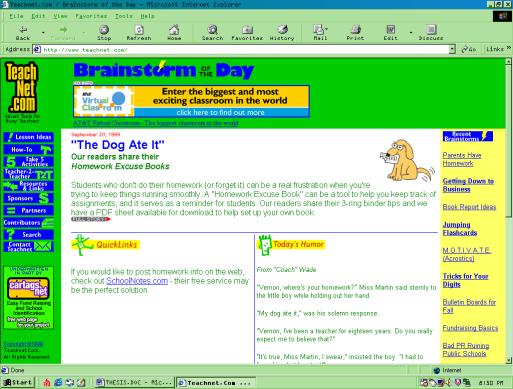
curriculum, chat rooms, forums, discussion groups, and demos. One, www.teachnet.com,
is a good example of what is available twenty-four (24) hours a day, seven days
a week, FREE OF CHARGE (See Figure 9).
_______________________________________________
Figure 9
Example teacher help web site
____________________________________________________________________________________
_______________________________________________
If teachers can
just get connected to those sites with the help of peers or students, they can
be led through the training by the course itself. While this sounds like it is
a great aspect of the Internet, it has apparently not caught on as much as we
might like. Though the numbers have likely increased some, they are still not
as high as one would like: Hunter indicated that out of the strongest
'Internet-using' teachers, still fewer than fifteen percent (15%) of those
surveyed reported using newsgroups, chat rooms, or electronic mailing list in
their job. Some might argue that the
Internet is forcing professional
development just to learn how to use the Internet itself. The argument is that rather than being a
solution to the professional development situation, the Internet has added
additional learning requirements for teachers.
The silver lining of this is that knowledge of computers and the
Internet is also useful in their own everyday life, especially in the
Information Age of today.
Are
teachers using the Internet to learn more about their subject area?
Sellers (1994)
writes about the same-subject-colleague-isolation teachers go through. The
Internet allows them to form on-line professional contacts and colleagues,
where they might not be available at their school. For example, especially in small rural schools, there might only
be one or two faculty in a given subject. This severely limits the
inter-teacher collaboration that might be available in larger schools. The Internet, through E-mail lists,
discussion groups, bulletin boards, and newsgroups, teachers are able to
interact with others in their profession.
One of the most
important themes in many of the researched surveys (National Survey on Internet
Usage, 1997) was the teacher's request for training. Most felt that once the Internet becomes more organized with
content evaluation by subject and grade levels, they will start to see students
achieving better results as a direct result of Internet usage.
What is the
role of the teacher using Internet in the classroom?
Teachers will
see their role move away from information 'disseminator' and lecturer and move
towards an interactive, collaborative environment where they assume the role as
coach and facilitator (Dyrli and Kinnaman, 1995). Great teachers are crucial to
the learning process and are also critical to the success of incorporating the
Internet into the classroom. Tools, such as the Internet, will allow teachers
to have an even more dynamic role!
One important
point to remember: just as with the
discovery of any new media (paper, books, film projectors, video, computers,
Internet, etc.), the role of the teacher using that media will change. In the
case of the Internet, when so many of the skills the students are learning are
subjective (i.e. knowing potential bias & usefulness of information,
evaluating web sites and on-line research, knowing the most effective search
tools, filtering through the vast amounts of available data, synthesizing the
information into their own words), now, more than ever, we need the guidance
and leadership of our teachers.
Teachers, now, must be able to keep students from being overwhelmed and
also from getting led down false paths in the browsing. Teachers who are incorporating the Internet
into their lessons, must take the time each day to discuss successful ways of
searching for information, obtaining the information in the best manner
(download, print, e-mail, newsgroup, etc.), and showing effective use of the
students time spent on the Internet. It
would be very easy for students to become distracted on the YAHOO website as
they were typing in their search words. It is the role of the teacher to help
them focus their efforts on the task at hand (just as they would with any
research tool). In their on-line
research, students will undoubtedly run across many surveys, articles,
pictures, animations, videos, etc. While it would be easy for the teacher to
help students analyze that data, teachers must opt for the 'What do you notice
about these survey results' style of questions rather than the 'Notice the
pattern in these survey results' style of advice.
In summary, there is a great deal of interest in
using the Internet in the classroom, but by the nature of technology itself, it
is a difficult topic to study. Many of
the positive results seen are only non-measurable observable data and cannot be
directly linked to higher test grades, as the government demands in its'
analysis. Unless the government changes the way it evaluates new media, it may
remain hard to justify through standardized test scores. There is a great deal
of excitement just in the possibility of what the Internet offers. However,
many see harnessing the energy of the Internet into productive classroom
lessons as a top priority. How we do that is what researchers today are trying
to determine. School administrators are
generally supportive of efforts by teachers to experiment in class with the
Internet and more and more schools are getting connected. While it may be years
before proven curriculum plans are available to the general public, there is a
wide variety of information available for teachers.