CHAPTER 4
Introduction
The focus of this study has
been to describe the current state of Internet usage and it's impact in private schools in the southeastern United States. Through the literature, a thorough reflection of the
general attitudes, opinions, impact, and statistics of Internet usage across
America was obtained. Through the survey used
in this study, an analysis of Internet usage, comments, opinions, attitudes,
and statistics of teachers in private
schools in the southeastern United States is presented.
Specifically, this chapter
includes the information gathered from the survey instrument in response to,
but not limited to, the following research questions of the study:
In
private education in the southern United States,
1)
Are
teachers using the Internet in class?
2) What is the frequency of use?
3) Do teachers perceive improvements that are directly related to
Internet usage?
4) What Internet tools have proved to be most effective for the
students to use?
5) Should the skills needed to traverse the Internet be considered a
basic skill?
6) Are teachers using the Internet to learn more about their subject
area?
7) Are
schools taking an active role in getting their classrooms connected to the
Internet? Are they encouraging use of the Internet in class?
8) Do
schools taking an active role in training (or helping to train) teachers to use
the Internet in class?
9) Do
teachers see the Internet as a powerful media of instruction? Do the positive traits outweigh the negative
for using the Internet is class?
10) What
relationships exist between age, subject, years of experience, or degree as
they relate to Internet usage?
Description
of the Sample Population
The
survey administered in this study (See Appendix B) was sent to thirty private
schools in the United States, randomly selected from The Handbook of Private Schools (1998) and surveys were
returned from thirteen (13) schools with a total of one hundred-two
responses. There were more female than
male teachers (See Table 5) represented
in the survey and the average age of
the teachers was in the forty to fifty year group (See Table 8). The mean number of years experience for the
teachers (see Table 7) was ten to
fifteen years and they evenly represented grades six through twelve (See Table 9).
Following, are a variety of
tables, which show the responses, by specific questions, and by single-variable
and multi-variable comparisons. Comments, conclusions, and summary of the data
are in the CONCLUSIONS section at the end of Chapter 4.
__________________________________________
Table 5
Number
of responses by sex
_______________________________________________________________________
Sex Returned
Surveys
_______________________________________________________________________
Female 63
Male 36
NR 3
_____
Total 102
__________________________________________
Almost twice as many female
responded (See Table 5) as males,
however, no data was acquired about the male-female ratio at each school, so
this comparison cannot be used.
Table 6
Number of responses by age
____________________________________________________________________
Age Returned
Surveys
____________________________________________________________________
50+ 26
40-50
34
30-40 17
20-30 23
NR 2
_____
Total 102
The highest number of returns (See Table 6) was thirty-four (34), by that of the (40-50) group, with the (50+) and (20-30) group with twenty-six (26) and twenty-three (23) respectively. However, no data was acquired to indicate the age bracket ratios in the school, so this comparison cannot be made to the total population.
Table 7
Number of responses by years of
experience
________________________________________________________________________
Years Experience Returned
Surveys
________________________________________________________________________
15+ 22
10-15
38
5-10 15
0-5 24
NR 3
_____
Total 102
Teachers with (10-15) years
of experience (See Table 7) returned the most, thirty-eight (38), more than
doubling the returns for the newer teachers (5-10 years). The (15+ years)
experience and least experienced (0-5 years) both submitted in the low
twenties.
Table 8
Number
of responses by subject area
(Some
teachers teach more than 1 subject)
________________________________________________________________________
Subject Returned
Surveys
________________________________________________________________
English 26
Math 21
History 21
Science 18
Computer 10
Language 10
Geography 5
Religion 3
Art 2
Music 2
PE 1
Economics 1
NR 7
_____
Total 137
__________________________________________
The four main core subject
(See Table 8) returned the highest numbers of returns (between eighteen (18)
and twenty-six (26)). This number coincides with the fact that ratio of core
subject teachers to elective and non-core teachers are usually higher. Language
teachers submitted ten returns.
_______________________________________________
Table 9
Number
of responses by grade
(Some
teachers teach more than 1 grade)
_______________________________________________________________________
Grade Returned
Surveys
_______________________________________________________________________
6 38
7
47
8 51
9 32
10 36
11 33
12 36
NR 4
_____
Total 277
_______________________________________________
The returns by grade level
(See Table 9) were pretty even and steady across all levels. Seventh and eighth
grade teachers responded the most with fifty-one (51) and forty-seven (47). All
others were between thirty-two (32) and thirty-eight (38).
Are
teachers using the Internet is class?
If so, how often?
Table 10
Internet usage in the classroom
_______________________________________________________________________
Do you use
the Internet in the classroom?
_______________________________________________________________________
YES 69
No 23
NR 10
There was almost three times
the number of Internet-users (in class) than non-users (See Table 10). It is
likely that the NR responses would be non-users, but that cannot be verified.
The number of 'Yes'(sixty-nine) responses is actually higher than the number
who responded that there was an Internet connection in the classroom. This can
be justified with number of NR responses.
Table 11
Computer and Internet access
________________________________________________________________________
Computer at
Home? Computer in Classroom? Have Internet in classroom?
________________________________________________________________
Yes 94 87 65
No 8 15 36
NR 1
_____ ______ ________
Total 102 102 102
Eighty-seven (87) of the
surveyed teachers have at least one computer in their classroom (See Table 11)
. Three fourths (¾) of these actively use the Internet in the classroom. Almost
all responded that they had a computer at home. Sixty-five (65) of the surveyed
teachers have and use at least one Internet connection in the classroom.
_____________________________________________
Table 12
By state,
the number of teachers who use Internet in class
____________________________________________________________________
TEACHERS USING
STATE INTERNET
IN CLASS
____________________________________________________________________
South
Carolina 30/35 (86%)
Florida 14/17 (83%)
Alabama 12/13 (92%)
Tennessee 10/12 (83%)
Georgia 12/17 (71%)
North
Carolina 8/8 (100%)
Each state (See Table 12)
had a pretty high rate of Internet usage (Georgia had the lowest with a still very
high seventy-one percent (71%)). The average rate for all returned surveys was
eighty-six percent (86%). North Carolina had one hundred percent (100%) usage
rate, but also only eight returns, all from one school which was very active
with technology. The percentages were not skewed , even though the total number
received from the six states varied (especially South Carolina)
_____________________________________________
Table 13
Frequency of Internet Use
____________________________________________________________________
Frequency Returned
Surveys
____________________________________________________________________
More than once a week 29
Once a week 9
Once
every 2 or 3 weeks 10
Once a month 13
Once a semester 8
Once a year 0
Never, but want to 15
No use at all 9
NR 9
_____
Total 102
__________________________________________
The highest number of
returned surveys, by double, was more-than-once-a-week Internet users (See
Table 13) . The next highest was the Never, but want to. Once-every-2-or-3
weeks and Once-a-month were the next highest returns. Others users were all
less than ten responses.
Table 14
Opinions about the Internet
______________________________________________________________________
School should train If you knew more, Are Internet skills Is it worth it?
Teachers? would you use it? part of basic skills of
education?
______________________________________________________________________
Yes 87 82 80 91
No 6 9 16 2
NR 9 11 6
9
_____ ______ _______
_______
Total 102 102 102 102
Almost one-third of the teachers
responded that they use the Internet at least once per week in class (See Table
14) . The next highest percentage was in the "Never, but want to" coincides
with the fact that eighty-two percent (82%) of the respondents said they would
use the Internet more in class if they could learn more about it. More than
fifty percent (50%) of those teachers who use the Internet use it at least
every couple weeks. Less than ten
percent (10%) of the teachers said they had never used it and have no plans to
use it. Over ninety percent (90%) of
the teachers responded that it is worth the money, time, energy, and work to
get our schools connected. Even the teachers who did not use it saw a need for
Internet skills for the students.
Do teachers
perceive improvements that are directly related to Internet usage?
Fifty-nine
(59) teachers said that their classes were better because of the Internet. Only
twenty-eight (28) teachers said that they did use the Internet but did not feel
that their class was any better because of it.
Thirty-six (36)teachers saw
objective improvements in their students' performance because of the use of the
Internet in class. Twenty-eight (28) teachers said there were no observable
improvements.
_______________________________________________
Table 15
Student Improvements and
Benefits of Internet Usage
Are
there measurable improvements in your class
directly
related to using the Internet?
________________________________________________________________________
Yes 36
No 28
If so, what are they?
Increased participation 36
Better test/quiz/homework scores 10
Increased attendance 1
_______________________________________________________________________
Are
there non-measurable improvements in your class
directly
related to using the Internet?
________________________________________________________________________
Yes 58
No 8
If so, what are they?
Increased enthusiasm 49
Increased motivation 41
Increased higher learning skills 15
Increased social skills 7
_______________________________________________
One hundred percent (100%)
of the teachers, who saw improvement, listed participation as one of the areas
where they could measure improvement. Ten (10) teachers felt actual grades were
increasing (See Table 15) . Over ninety percent (90%) of the teachers who saw
non-measurable improvement listed increased enthusiasm and motivation as the
two main areas of improvement. These results are consistent with the National
Survey on Internet Usage (1997), the O-Hara (1998) study, and NCES (1997)
study.
Eighty-five percent (85%) of
the teachers felt that the Internet offered the students things they are not
able to get out of a textbook. However, only about half of the teachers who
felt that their classes were better because of the Internet felt that the
students also improved because of the Internet usage.
Sixty-one percent (61%) of
the teachers felt that they were actually better teachers, at least in part,
because of the Internet.
An interesting point that
almost all of the teachers, who actively use the Internet in class, said was
that they did not have to drastically change their curriculum to incorporate
the Internet into their class.
What
Internet tools have proved to be most effective for the students to use?
Table
16
Internet tool usage
________________________________________________________________________
What
do you use in class? What is most valuable?
________________________________________________________________
Search
engines 65 69
E-mail 50 47
Specific
web site 43
On-line
magazine/article 30 34
Download 19 15
Newsgroups 16 13
Design
web pages 12 2
Live(or
recorded) audio or video 6
Bulletin
Board, message board 5
Chat
room 1
_______________________________________________
Almost all users of the
Internet listed the search engines (See Table 16) as both the most used tool and the most valuable tool for their
classroom. This indicates that the major use of Internet activity is for research.
Of course E-mail was the next highest for both teacher and student Internet
use. Teachers identified 'going to a
specific website' and ' on-line magazines' as the third and fourth most used
activity during class. Downloads,
newsgroups, and designing web pages were listed, but not as commonly used. An
interesting point is that only one teacher listed chat rooms as used in class
and no teachers valued it as important. This statistic might sooth some of the
fears of worried parents and skeptic teachers.
_______________________________________________
Table 17
School Support and Training
________________________________________________________________
Support efforts Training Assistance
to learn
In class? Available? (money,
time)?
________________________________________________________________________
Yes 89 69 75
No 3 28 21
NR 10
5 6
_____ ______ ________
Total 102 102 102
Almost ninety percent (90%)
of all returned surveys said their school supports their on-line efforts in
class. Very few, three, said that their school did not (See Table 17). Almost
seventy percent (70%) reported training opportunities at school for the
Internet. Approximately the same percentage felt that their school offered
assistance in their own efforts to learn about the Internet.
Are
teachers using the Internet to learn more about their subject area?
Table 18
Professional self-development using
Internet
_____________________________________________________________________________________
Do
you use the Internet to learn more about your subject area?
________________________________________________________________________
Yes 82
No 18
NR 2
_______________________________________________
Eighty-two (82) of the teachers
who responded said they use the Internet in their extra time to learn more
about the Internet. An interesting
point: Twelve of the above eighteen (18) 'No' responses were by teachers who
did not have any Internet access in their classroom. Eighty-seven (87) teachers responded that they were better
teachers because of something that the Internet has offered them (See Table
18).
Are schools taking an active role in getting their
classrooms connected to the Internet? Are they encouraging use of the Internet
in class?
One
school, in Georgia, is now in the process of installing one hundred percent
(100%) wireless LAN, which would provide instant Internet access from anywhere
on campus. They were extremely proud of their effort and the teachers, while they
did not have any access now, all wrote comments about what they hope to do. The
excitement level was very evident.
Eighty-five (85) of the
teachers (See Table 11) responded that they had a computer in their room and
sixty-five (65) responded as having Internet access. Eighty-nine (89) teachers (See Table 17) said that the school supports their efforts
to experiment with the Internet in class.
Are schools taking an active role in
training (or helping to train) teaches to use the Internet in class?
Eighty-seven (87) (See Table
15) of the surveyed teachers felt that schools should be training their faculty
to use the Internet. Sixty-nine (69) of the teachers said their schools already
offer training for the Internet and seventy-five (75)teachers said that the
school offers assistance (time or money) to learn about the Internet.
Do teachers
see the Internet as a powerful media of instruction?
Over eighty percent (80%) of
the returned surveys said that Internet skills should be included in the basic
educational skills such as math, science, or English. Eighty-five percent (85%) said that the Internet offers something
they cannot find in a textbook. More than twenty percent (20) of the surveys
had comments about the up-to-date data that is available on the Internet, which
helps to supplement the textbook. Eight-five (85) of the teachers felt that it
was worth the money, time, energy, and effort to get the classrooms connected
to the Internet. Eighty-nine (89) of
the teachers said they were very excited about the possibilities the Internet
offers students and teachers. Only three of the teachers have had negative
experience on the Internet, compared with eighty-seven (87) who have had a very
positive Internet experience so far.
What
relationships exist between age, subject, years of experience, or degree as
they relate to Internet usage?
There
were no great differences between male and female as far as Internet usage in
the classroom or in using the Internet as a tool on a daily basis.
Forty-nine (49) out of sixty-one (61), or eighty
percent (80%), females and twenty-eight (28) out of thirty-five (35), or eighty
percent (80%), males used the Internet in their classes. However, forty-two
(42%) of the women who used the Internet in class used it more than once a
week, compared with only twenty-eight (28%) of the males.
Table 19
By age breakdown of Internet usage
_____________________________________________________________________________________
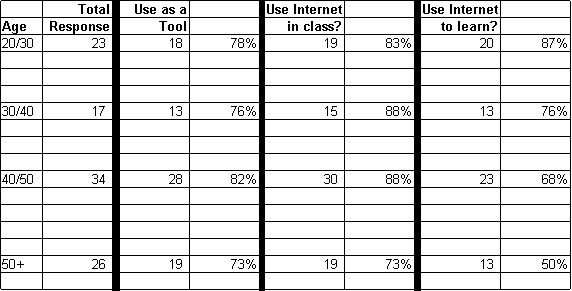
_______________________________________________
The highest percentage of
Internet usage (See Table 19) was from
the age group (40-50) with eighty-two percent (82%). The other three age groups
were within a few percentage points of each other (73%, 76%, 78%). The (30-40)
and (40-50) age group had the highest percentage, eighty-eight percent (88%),
of use of the Internet as tool throughout the day. The (20-30) age group was
most likely, eighty-seven percent (87%), to use the Internet to help them learn
about their subject area. The least likely to do so was the over-fifty (50+)
age group, with fifty percent (50%).
Table 20
By degree breakdown of Internet usage
_____________________________________________________________________________________
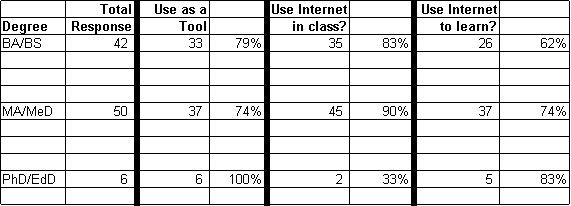
_______________________________________________
The Ph.D./Ed.D. degree
holders (See Table 20) had one hundred
percent (100%) usage percentage for using the Internet as tool throughout the
day. The BA/BS and M.A./M.Ed both had seventy-nine percent (79%) and seventy-four
percent (74%), respectively. Ninety
percent (90%) of the M.A./M.Ed. degree holders used the Internet in class as
opposed to eighty-three percent (83%) of the BA/BS and only a third as high, thirty-three percent (33%) for
Ph.D/Ed.D. Ph.D./Ed.D. degree holders
had the highest percentage of using the Internet to learn about their subject
area, with M.A./M.Ed. and BA/BS with seventy-four percent (74%) and sixty-two
percent (62%) respectively.
Table 21
By subject breakdown of Internet usage
_____________________________________________________________________________________
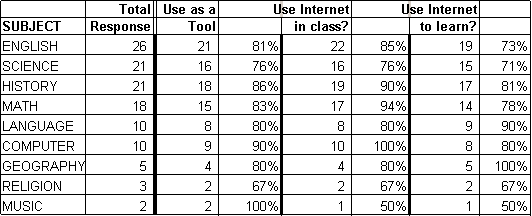
_______________________________________________
The
core subjects (math, science, history, language, and English) had a much larger
sample population resulting simply from a higher number of faculty in those
positions at schools (See Table 21). The differences between the percentages
were not so great, indicating that all the major subjects use the Internet as a
daily tool in class relatively equally.
Math had the highest percentage of Internet use in class with
ninety-four percent (94%), with history at about ninety percent (90%). The
percentages in all subject area dropped in the next category (using the Internet
to learn about the subject area). The highest was geography and language (one
hundred percent (100%) and ninety percent (90%)), with the other subjects in
the seventy percent (70%) to eighty percent (80%) range.
Tables 22 - 25 use the following questions from the
survey instrument (See Appendix B)
#9a Do you
use the Internet in your classroom?
Possible responses:
1 more than once a week
2 once a week
3 once every 2 or 3 weeks
4 once a month
5 once a semester
6 once a year
7 never, but WANT TO
8 never have, never will
#10b Should Internet skills be
included in the set of basic skills (math, science,
English, etc.) that we teach students?
#11 Do you use the Internet to
learn more about your subject area?
#12 Are your classes(or certain
sections) better because of the Internet?
#13a Are the measurable
improvements in student performance using Internet based
lessons?
#14a Are the non-measurable
improvements in student performance using
Internet based lessons?
_______________________________________________
Table 22
Multiple-survey-answer array by SEX
____________________________________________________________________________________
#9a (See
above for question and possible responses)
Response Male Female
1 8 21
2 5 4
3 4 6
4 5 8
5 4 4
6 0 1
7 6 7
no 3 6
#10b (See above for complete question)
Response Male Female
Yes 30 49
No 8 9
__ __
38 58
#11 (See above for complete question)
Response Male Female
Yes 32 51
No 7 11
__ __
39 62
#12 (See above for complete question)
Response Male Female
Yes 24 36
No 11 17
__ __
35 53
#13a (See above for complete question)
Response Male Female
Yes 13 23
No 14 14
__ __
27 37
#14a (See above for complete question)
Response Male Female
Yes 21 37
No 4 4
__ __
25 41
_______________________________________________
All results compared by gender (See Table 22) were
relatively equal. Question 13a, concerning whether or nor the students had
improved (measurably), was the only one where there was a significant
difference with difference between the 'yes' and 'no' answers for female
responses when the male response for that question has the 'yes' and 'no' about
equal.
______________________________________________
Table 23
Multiple-survey-answer array by AGE
__________________________________________________________________________________
#9a (See above for question and
possible responses)
Response 20-30 30-40 40-50 50+
1 6 2 10 10
2 3 1 3 2
3 4 4 3
4 3 4 5 2
5 3 2 4
6 2 1
7 5 1 3 4
no 2 2 1 4
#10b (See above for complete
question)
Response 20-30 30-40 40-50 50+
Yes 16 14 28 24
No 6 3 5 2
__ __ __ __
22 17 33 26
#11 (See above for complete
question)
Response 20-30 30-40 40-50 50+
Yes 20 16 28 20
No 3 2 6 7
__ __ __ __
24 18 34 27
#12 (See above for complete
question)
Response 20-30 30-40 40-50 50+
Yes 12 10 21 16
No 6 4 8 10
__ __ __ __
18 14 29 26
#13a (See above for complete
question)
Response 20-30 30-40 40-50 50+
Yes 6 6 15 9
No 7 4 7 10
__ __ __ __
13 10 22 19
#14a (See above for complete
question)
Response 20-30 30-40 40-50 50+
Yes 15 9 20 16
No 2 1 2 3
__ __ __ __
17 10 22 19
_______________________________________________
Teachers over forty (40-50, 50+) were much more likely to use the
Internet at least once a week (See Table 23).
All other question showed no major variations among the ages.
_______________________________________________
Table 24
Multiple-survey-answer array
by Degree
________________________________________________________________________
#9a (See above for question and
possible responses)
Response BA/BS M.A./M.Ed. Ph.D./Ed.D.
1 13 14 2
2 3 6
3 1 9 1
4 6 7 1
5 4 3
6 1
7 7 4
none 3 4 1
#11 (See above for complete
question)
Response BA/BS M.A./M.Ed. Ph.D./Ed.D.
Yes 33 42 45
No 7 8 1
__ __ __
22 17 33
#13a
(See above for complete question)
Response BA/BS M.A./M.Ed. Ph.D./Ed.D.
Yes 14 20 2
No 13 13 1
__ __ __
27 33 3
_______________________________________________
One of the most noticeable items was the low number
of responses by Ph.D./Ed.D. degree holders (See Table 24) . Because of that low number, it is not
possible to compare Ph.D./Ed.D. to
either of the other two degree. There were no significant differences between
the BA/BS and M.A./M.Ed. degree holders.
__________________________________________
Table 25
Multiple-survey-answer array
by Years of Experience
____________________________________________________________________________
#9a
Response 0-5 5-10 10-15 15+
1 7 5 4 12
2 4 2 3
3 1 1 4 6
4 3 3 2 6
5 4 3
6 1
7 4 5 4
none 3 2 4
#10b
(See above for complete question)
Response 0-5 5-10 10-15 15+
Yes 17 12 12 31
No 4 2 5 5
__ __ __ __
21 14 17 36
#11
(See above for complete question)
Response 0-5 5-10 10-15 15+
Yes 18 13 16 29
No 4 1 4 7
__ __ __ __
22 14 20 36
#12
(See above for complete question)
Response 0-5 5-10 10-15 15+
Yes 17 11 8 22
No 3 7 4 12
__ __ __ __
20 18 12 34
#13a
(See above for complete question)
Response 0-5 5-10 10-15 15+
Yes 6 8 5 16
No 5 7 3 11
__ __ __ __
11 15 8 27
#14a
(See above for complete question)
Response 0-5 5-10 10-15 15+
Yes 14 12 8 23
No 0 3 0 4
__ __ __ __
14 15 8 27
_______________________________________________
There were more responses by
teachers with over fifteen (15) years experience. These same teachers were more
likely to use the Internet in class at least once a week (See Table 25). They
were extremely supportive of teaching Internet skills to students. The less
experienced teachers (0-5 years) were much more likely to see their classes as
better because of the Internet than the other groups. The other questions
showed no major differences based on years of experience.