Today, there’s much talk about information highways and Asynchronous
Transfer Mode (ATM). Just as the Internet revolutionized worldwide communication,
ATM brings new meaning to high-speed networking. However ATM is emerging
as the primary networking technology for next-generation, multimedia communication.
Besides, the ATM protocol designed to handle isochronous (time critical)
data such as video and telephony (audio), in addition to more conventional
data communications between computers.
ATM can define as the transport protocol. It’s a way of transmitting
data, voice and video from one place to another. However, ATM gives you
more than a basic transmission capability such as
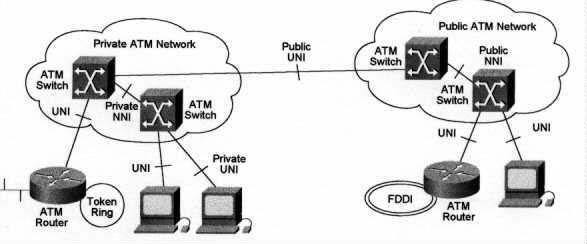
1) It support both private and public networks
2) Uses the same technology for Local and Wide Area Network
3) Transports voice, video, and data traffic on a common circuit
4) Delivers bandwidth on demand
However, it comes at a low price. Contrary to common misconceptions,
ATM is a very complex technology, perhaps the most complex ever developed
by the networking industry. While the structure of ATM cells and cell switching
do facilitate the development of hardware intensive, high performance ATM
switches, the development of ATM network requires the overlay of a highly
complex, software intensive, protocol infrastructure. This infrastructure
is required to both allow individual ATM switches to be linked into a network,
and for such networks to inter-networking with the vast installed base
of existing local and wide area network.
ATM is the networking technology that satisfies these requirements.
For LAN users, you’ll get more bandwidth with ATM than with many of today’s
LANs. You can begin to use new applications and improve the performance
of existing applications. ATM also provides more flexible bandwidth for
your Wide Area Network (WAN). WAN users can expect enchanted bandwidth
management and bandwidth on demand, which can reduce the cost.
Furthermore, the advantages of the ATM network are ATM is a very
flexible bandwidth allocation and It simple routing due to connection oriented
technology. Besides, It is the high bandwidth utilization due to statistical
multiplexing.
However the disadvantages of the ATM are overhead of cell header and complex mechanisms for achieving Quality of Service. Finally, it very congestion and it may cause cell losses.
Nowadays, there are many reasons why ATM will be the networking technology for the near future and beyond. The success of this technology has not been left to chance, because ATM technology is been engineered in a manner to proactively address the problems that will be encountered with next-generation networks. One of the reason it successes is that ATM technology is designed to handle all aspects of multimedia (video, audio and data) for the LAN, MAN, and WAN. However there are few basic concept for the ATM how it be the next generation networking.
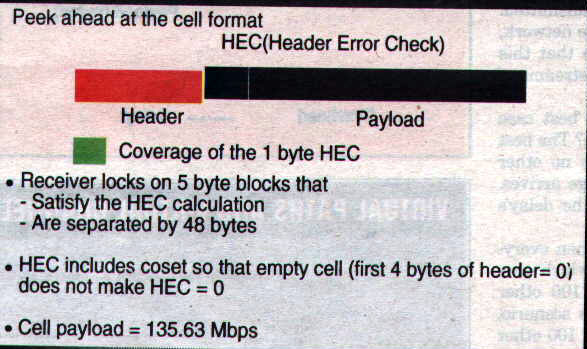
- Information Transfer: ATM is a fast packet oriented transfer mode based on asynchronous time division multiplexing and its uses fixed length (53 bytes) cells. Each ATM cell consists of 48 bytes for information field and 5 bytes for header (see figure 1). The header is used to identify cells belonging to the same virtual channel. ATM Adaptation layers (AAL) are used to support
- ATM Resources: ATM is connection oriented and the establishment of the connections includes the allocation of a VCI i.e. virtual channel identifier and VPI i.e. Virtual path identifier and also includes the allocation of the required resources on the user access and inside the network. These resources, expressed in terms of throughput and quality of service, can be negotiated between user and network either before the call setup or during the call.
- ATM Cell Identifiers: ATM cell identifiers, i.e. Virtual Path Identifier, Virtual Channel Identifier and Payload Type Identifier (PTI) are used to recognise an ATM cell on a physical transmission medium. VPI and VCI are same for cells belonging to the same virtual connection on a shared transmission medium.
- Throughput: Peak Cell Rate (PCR) can be defined as a Throughput parameter which in turn is defined as the inverse of the minimum interarival time T between two consecutive basic events and T is the peak emission interval of the ATM connection. PCR applies to both constant bit rate (CBR) and variable bit rate (VBR) services for ATM connections. It is an upper bound of the cell rate of an ATM connection and there is another parameter sustainable cell rate (SCR) allows the ATM network to allocate resources more efficiently.
- Quality Of Service: Quality of Service (QOS) parameters include cell loss, the delay and the delay variation incurred by the cells belonging to the connection in an ATM network. QOS parameters can be either specified explicitly by the user or implicitly associated with specific service requests. A limited number of specific QOS classes will be standard in practice.
- Usage Parameter Control: In ATM, excessive reservation of resources by one user affects (traffic for other users. So the throughput must be policed at the user-network interface by a Usage Parameter Control function in the network to ensure that the negotiated connection parameters per VCC or VPC between network and subscriber is maintained by each other user. Traffic parameters describe the desired throughput and QOS in the contract. The traffic parameters are to be monitored in real time at the arrival of each cell. CCITT recommends a check of the peak cell rate (PCR) of the high priority cell flow (CLP = 0) and a check of the aggregate cell flow (CLP =1), per virtual connection.
- Flow Control In order to control the flow of traffic on ATM connections from a terminal to the Cletwork, a General Flow Control)(GFC) mechanism is proposed by CCITT at the User to Network Interface (UNI). This function is-supported b~ GFC field in the ATM cell header. Two sets of procedures are associated with the GFC field i.e. Uncontrolled Transmission which is for use in point-to-point configurations and Controlled Transmission which can be used in bothpoint-to-point and shared medium configurations.
(Figure 1)
Various services and provide service specific functions. This AAL specific information is contained in the information field of the ATM cell.
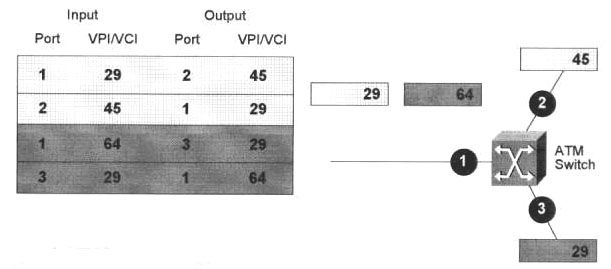
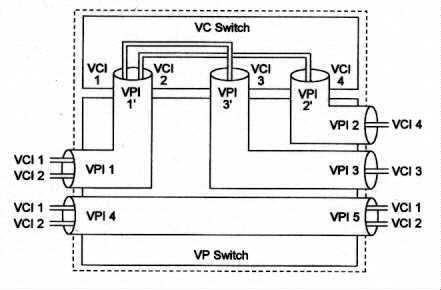
Routing: ATM is a connection-oriented mode. The header values (i.e. VCI and VPI etc.) are assigned during the connection set up phase and translated when switched from one section to other. Signaling information is carried on a separate virtual channel than user information. In routing, there are two types of connection i.e. Virtual channel connection (VCC) and Virtual path connection (VPC). A VPC is an aggregate of VCCs. Switching on cells is first done on the VPX and then on the VCC. We will discuss these two connections later.
Following we will discuss about why we using ATM Network as our next generation network? The following is the benefit of using ATM network:
- One Network-ATM will provide a single network for all traffic types-voice, data, and video. ATM allows for the integration of networks improving efficiency and manageability.
- Enables new applications-Due to its high speed and the integration of traffic types, ATM will enable the creation and expansion of new applications such as multimedia to the desktop.
- Compatibility-Because ATM is not based on a specific type of physical transport, it is compatible with currently deployed physical networks. ATM can be transported over twisted pair, coax and fiber optics.