 |
|
|
| Operation:
Kilo Punch
Palmerola, Honduras "Stand in the Door!" "Get your gear together, don’t tell anyone what you’re about to do," Master Sergeant Wilson D. Goldie told me. "You’re going on a little trip down south." Having arrived at the 82nd Airborne Division three months earlier, I wasn’t sure what I had gotten myself into. The adrenaline was flowing. MSgt. Goldie was sending me to Honduras. That sounds pretty tame in retrospect, but at the time... well let me paint the picture. The Reagan Administration was deeply involved in ensuring the failure of Communism in Central America. In Nicaragua, Daniel Ortega and the Sandanistas were in power. El Salvador was the next battleground. They were fighting a civil war. Death Squads, U.S. Special Forces Advisors, kidnappings... not a nice place at the time. Would they go the same way as their neighbors? It was March 1984 and national elections were about to be held in El Salvador. I guess the United States wanted to make sure everything would go smoothly. That’s why a big chunk of the command structure of the US Army’s Rapid Deployment Force, along with an Emergency Deployment Readiness Battalion, was about to parachute into Palmerola, Honduras... along the border with El Salvador. That's not a lot of people... under 1,000, but it made even a new trooper like myself wonder about what was happening. |
| Master
Sergeant Goldie was quite a character. With his signature long, stogie
stuck in his mouth, he assured me that this was nothing big and that I
would do my job well. He'd been around the block, his rough language and
mannerisms gave him a certain credibility. I trusted him.
"Just stick by the major," he said. "Or you'll find yourself 'tango uniform' right quick". Later I found out that was his way of saying "dead"... "tango uniform"... in civilian terms it meant "teats up"... funny guy. Anyway, he was right. Our officer, Major Barry Willey, was a combat experienced infantryman. A West Point graduate, he inspired his soldiers to always do the right thing. So there we were. It was a cold night at Fort Bragg, North Carolina. We had just received our weapons from the headquarters arms room -- along with a full combat issue of live ammunition. To me, a sign that this was for real. Arriving at the assembly area, Major Willey and I joined the ranks of the soldiers of the 2nd Battalion, 504th Infantry (Airborne). They were all waiting... waiting to board the cattle trucks for the short ride to Pope Air Force Base. If you would have noticed me at that moment, you would have seen a young man who was visibly nervous and excited at the same moment... not sure just how things were going to end up. At Pope, we all gathered for pre-jump exercises. Imitating every detail of the planned airborne operation, going over rules-of-the-air... getting ready to board the aircraft. The airplanes were C-130 Hercules -- small, stout planes that give a paratrooper confidence. We boarded with our weapons and our gear... the parachutes lay on pallets at the rear. They call it "in-flight" rigging. We all felt lucky. It would be a five hour trip to Honduras. Five hours. At least we didn’t have to wear the tight, restraining harnesses of the parachutes for the whole journey. I tried to think of what lay ahead. |
| After leaving
U.S. airspace, the planes began to fly "nap-of-the-earth", a technical
Air Force term for "Let’s make the paratroops throw-up". Unfortunately,
it worked. Guys were making use of their flight sickness bags. The odor,
the mood, and the tension made the flight miserable.
Soon enough though, the Jumpmaster was up and shouting. Like a well trained team, the soldiers started to pass out and put on the T-10 Parachutes. Quietly and efficiently, the soldiers readied themselves. Jumpmasters climbed through the airplane, making sure everybody was ready to exit the aircraft. "Outboard Personnel... STAND UP!" shouted the Jumpmaster. Up went the soldiers on both sides of the plane. Getting their footing and waiting for the next jump command. "Inboard Personnel... STAND UP!" It was tight now. All the troopers were standing. "HOOK UP!" Now the adrenaline began to flow. Each soldier, hook in hand, was reaching for and connecting with the static line. This was the line that ensured your parachute would be pulled open. When a jumper leaves the aircraft, the line pulls open the back of the parachute pack, allowing the chute to fall out and deploy. As the training took over, we all focused on the immediate task at hand... leaving the aircraft safely. In the back of my mind though, I wondered... what would happen? Then the doors opened... the air rushed through the plane. The soldier front of me yelled back, "We're at "750 feet!" I passed it back. "Winds 11 knots!", they shouted. The fact that I was about to leap out of an aircraft for only my seventh jump was flashing through my mind. Fresh from jump school, I had only jumped once with my unit at Fort Bragg. I was still a "cherry" jumper. Well, no time to think about that now. "GREEN LIGHT" "GO, GO, GO" The airborne shuffle had started and a moment later... "shoosh" "1000... 2000... 3000..." I shouted. The chute opened fully. What a view! Chutes all around me, and the mountains, they were gorgeous. It was early morning and we were about ready to hit the ground. There’s something to be said for the soft fields of Fryer Drop Zone at Jump School, or the soft sands of Sicily Drop Zone at Fort Bragg. "Thuuud" ...Honduras is not soft. Quickly I let the air out of the chute by disconnecting one of the risers... the air was knocked out of me, but I got up anyway and gathered my equipment. Quietly I joined the paratroopers that were moving to the assembly area. We made it. At the assembly area, they collected the ammo and sent us on. We established a base camp and met the Honduran Army. The whole purpose for our being there was to train with them... nothing had been officially mentioned about the weekend elections in neighboring El Salvador. At the base camp, I saw the XVIII Airborne Corps Commander and the 82nd Airborne Division Commander had come along. If something was going to happen this weekend, the US Army was not about to be caught unprepared. Nothing happened though. The elections in El Salvador went smoothly. The Task Force 2-504 was left doing practice parachute jumps with the Honduran Parachute Battalion. Surprisingly, we jumped "Hollywood" -- no gear or weapons, just the parachute. Troops liked this, I liked this. It was fun. The huge CH-47 Helicopter loaded up over and over again, giving all the Americans and Hondurans a chance to jump together. |
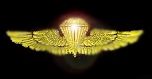
| In a ceremony
the next day, the Honduran soldiers were honored with the American Parachutist
Badge... those famous silver wings. In return, the Honduran battalion commander
moved through the Americans -- pinning on the golden Honduran Parachutist
Badge.
Not bad. We moved out and headed for Fort Bragg the next day. MSgt. Goldie looked at me a little differently when we got back to the shop. He had seen hundreds of adventures during his long career. For me though, Honduras had become my first adventure in the United States Army. ©1997 All Rights Reserved. |