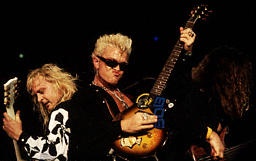
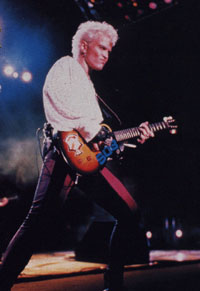
Spiky blond hair cut + dopey crooked sneer + leather goods = Billy Idol.# Born William Albert Michael Broad on November 30th, 1955, Billy Idol started his musical career in 1976 as a member of the Bromley Contingent, a group of followers of the Sex Pistols, which included members of the Clash and Siouxsie & the Banshees. The then Mr. Broad changed his name to Idol. A school teacher had returned a paper proclaiming him "idle" in class; he then twisted the word into a parody of rock idols. A parody that would later define his comment on his. The biting irony of the moniker is almost too much for one brain to bear.
Idol teamed with lyric writer and bass guitarist Tony James (later of Sigue Sigue Sputnik and Sisters of Mercy). Both joined the well-known punk legend Chelsea in its first incarnation, with Idol on the guitar. Idol and James subsequently left and formed Generation X, taking the name from a book about 60's Youth Rock Culture. Though Generation X never toured the US, they did take it by storm in 1980 with their single named "Dancing with Myself," featured on their last album with a new shortened name: GENX. "Kiss Me Deadly" was released with no impact in England. A breakup followed due to managerial problems.
Idol, disillusioned with his homeland, made a pilgrimage to New York City. He released an E.P. Don't Stop in 1981, with 2 GENX remixes and a cover of Tommy James's "Mony Mony." Idol utilized producer Keith Forsey, ex-Kiss manager Bill Aucoin, and ex-Elvis bodyguard Ed Parker in his corner. Idol then found raven-haired, spikey-top, veteran New York guitarist Steve Stevens. They released four records together: Billy Idol, Rebel Yell, Whiplash Smile, and a best-of-studio-mixes album, Vital Idol.
Before the release of the album Charmed Life in 1990, Idol had a near-tragic motorcycle accident in which he almost lost a leg. The artist recovered to release Cyberpunk (1993), a work that combined the writings of William Gibson and the likes with a computer driven techno back beat.
more Billy Idol info
After Generation X's demise, Billy Idol packed his bags and moved to New York, got himself managed by former Kiss svengali Bill Aucoin and began recording with local players and producer/drummer Keith Forsey (Giorgio Moroder's prot�g�). The first results of that union--a four-song EP--had only an awkward but entertaining cover of "Mony Mony" and a five-minute edit of Gen X's phenomenal "Dancing with Myself" to recommend it. (Interestingly, the belated CD credits the track, which had already been a single under the group's name, to "Billy Idol with Generation X.")
Billy Idol and a series of generally noxious videos made the former William Broad a huge star while providing erstwhile fans of his original band with an ideological dilemma: was he new wave's ultimate Frankenstein mutation or an arena-metal fraud trading on his now-dubious punk roots? In any case, the record--a marriage of Moroder's trademark Midnight Express sequencer sound and a throbbing rock beat--proved to be a lode of memorable hits ("White Wedding," "Hot in the City," "Love Calling"). Steve Stevens' caricatured Ronson/Thunders guitar wildness noisily matches Idol's macho postures and sneering vocals; the powerfully built modern rock band has subtlety and near-metal strength. An album to despise while you hum along.
With only writing partner Stevens held over from the first record, Idol kept the same producer and formula on Rebel Yell, another collection of hits that run hot ("Rebel Yell," "Blue Highway"), cool ("Eyes Without a Face," "Catch My Fall") and both ("Flesh for Fantasy"). Refined and carefully groomed for platinum success, it's an undeniably good rock'n'roll record that is also reprehensible for its phoniness and calculation.
Whiplash Smile repeats the recipe: Forsey, Stevens and a duotone program of hard/soft songs. Characteristically, the staggering guitar riffarola of "Worlds Forgotten Boy" runs directly into the engagingly modest, sweet-voiced technobilly of "To Be a Lover." The problem here is that there's no wind in Idol's sails: he takes it easy and relies too heavily on his partner's pyrotechnics. Unlike Idol's previous records, his vocals here lack the gism that made his hits soar with enthusiasm and energy. With second-rate material (the notable "To Be a Lover" is a non-original) and Idol out of contention, Stevens easily steals the spotlight; all of the record's best moments are his.
Naturally, that was a cue the partnership was over. The guitarist went off and eventually made a terrible every-style-imaginable solo album with a shrill metal singer. Except for a shallow interest in the blues, Stevens' axework here reveals nothing new; a carbon-copy rendition of the Sweet's "Action" is about as clever as Atomic Playboys gets.
The release of Charmed Life was delayed and nearly overshadowed by Idol's serious motorcycle crash in February 1990. Haunted by the ghost of Jim Morrison (a crummy version of "L.A. Woman" is only the most overt evidence of Idol's interest in the Doors), the Forsey-produced record has less blazing guitar than usual, reaching for a charged atmosphere rather than hooks and explosive rock power. But since the songs are deadly dull, the absence of instrumental diversion makes them seem endless. Even Billy's 'billy cover--Jody Reynolds 1958 "Endless Sleep"--sacrifices momentum for mood and winds up flat. The only tunes that work are an unpretentious three-chord singalong ("Love Unchained") and "Cradle of Love," a simple, restrained rock'n'roll single that seethes with echo and passion.
Available in the UK for two years before its American release, Vital Idol is a remixed greatest hits LP: extended versions of such Idolisms as "White Wedding," "Mony Mony," "Catch My Fall," "Dancing with Myself" and "Flesh for Fantasy." With a lot of material overlap, Idol Songs is simply a collection of hit singles in their original versions.
questions?commments? please feel free to E-MAIL me