This is the project concept for my project at Johns Hopkins University.
Prof. Pablo Iglesias is my project and faculty advisor.
Dan Carrizosa, a fellow EE candidate, is also working on this project with me.
Cancellation and Superposition
Implementation/Experimentation
The fundamental purpose of this project is to lay a theoretical framework for ANC experimentation, create a physical testbed for ANC experimentation, and actually carry out some tests based on these.
Theory

Cancellation and Superposition
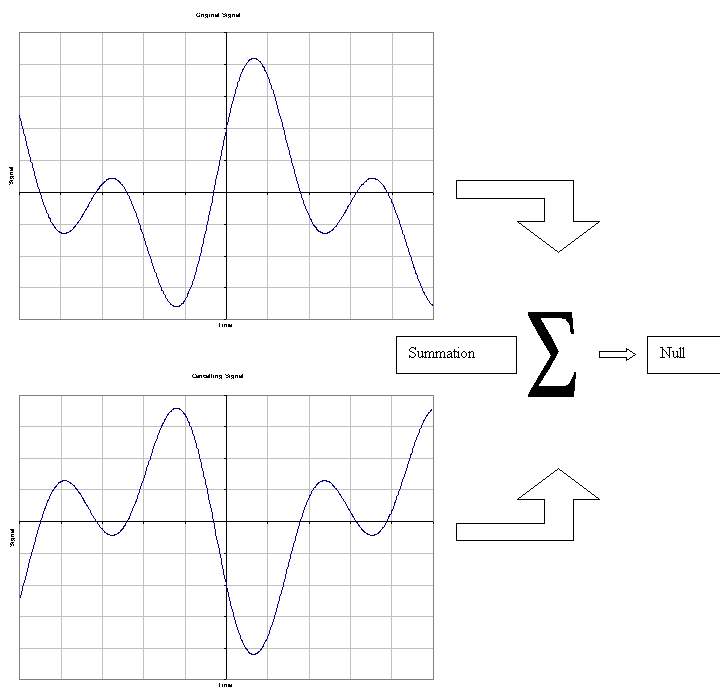
The fundamental theory that governs ANC is to produce a signal that is the anti-phase version of the original signal. By the principle of superposition, when this cancellation signal is aligned in time with the original signal and then added to it, a null signal should be produced.
Acoustic Duct Modeling
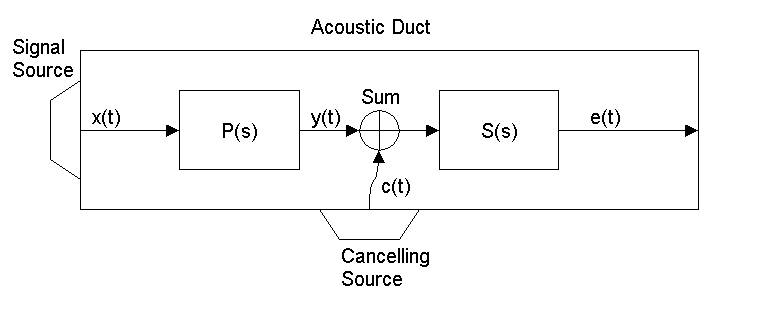
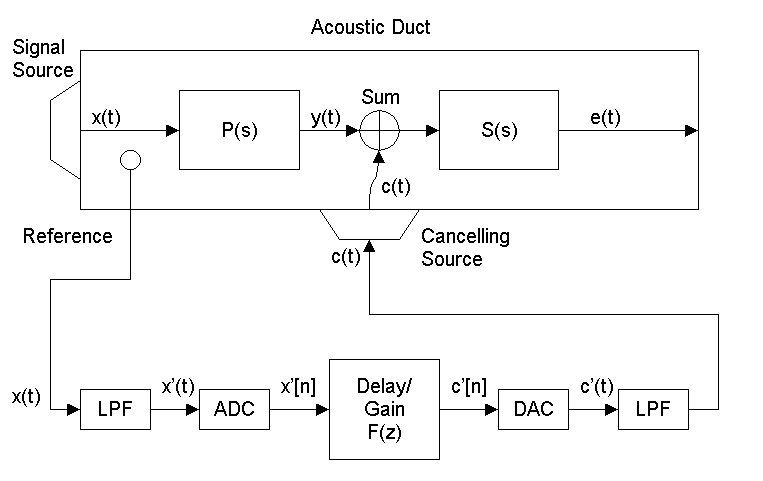
This is a visual representation of the simplest mathematical model of an acoustic duct with a single signal source (x(t)). In this case, the duct is represented as a combination of the transfer functions P(s) and S(s). The canceling source is shown to demonstrate how the model will be adapted to analysis of a noise cancellation system. For simple duct simulation, the canceling source would be considered to be a null signal. The output signal is represented by e(t).
Single-Channel Feedforward Systems
One method of ANC is to sample the noise (reference signal) between the source of the noise and the source of the canceling signal. This is called feedforward because the exact content of the signal is known when creating the canceling signal. The reference to single-channel comes from there being exactly one reference sensor, one canceling source, and, when used, a single error sensor.
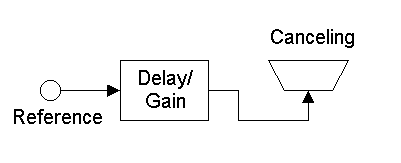
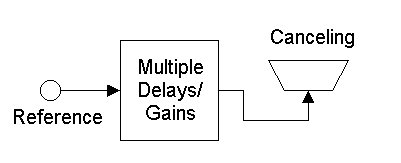
The simplest form of feedforward ANC involves a one-dimensional delay and gain filter. The reference signal, x(t), is fed into this filter. Through calculation, the values for delay and gain are set to identify the system and produce the correct cancellation signal, c(t), that exactly matches the signal, y(t). The main disadvantage of this system is that it is static, the precision is low, and the values for the filter must be calculated ahead of time. Advantages to this are simplicity and low cost.
This form of ANC involves a multi-dimensional linear digital filter that can take multiple parts of the signal in the past, adjust them, sum them, and use this to create a cancellation signal. This system is still static and all calculations must precede the implementation; however, the precision is increased.
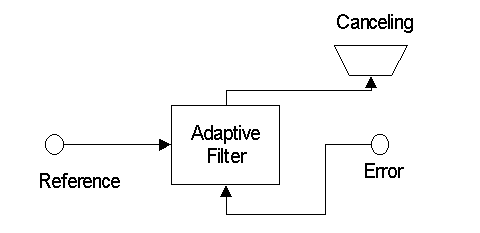
The most advanced form of feedforward ANC involves the use of an error signal, e(t), and a complex multi-dimensional linear digital filter (known as an adaptive filter). This sensor dynamically adjusts the filter coefficients to maximize the cancellation. This has many advantages since it is a dynamic system and constantly adjusts itself. It also requires no prior specific calculations. However, there is a significant increase in complexity and cost.

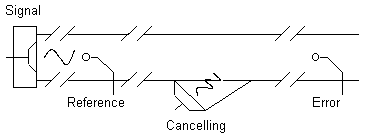
The testbed will consist of a length of aluminum ductwork divided into two-foot sections. Onto one end of this will be attached a speaker (signal source) in a closed box. The other end will be left open. One side of the center section will be removed and the cancellation speaker will be mounted at an angle somewhere between parallel and perpendicular to the duct. The idea is to minimize the reflections and their effects on the cancellation signal while it merges with the original signal. Microphones will be mounted on small brackets and placed inside the duct as required by the experiment.
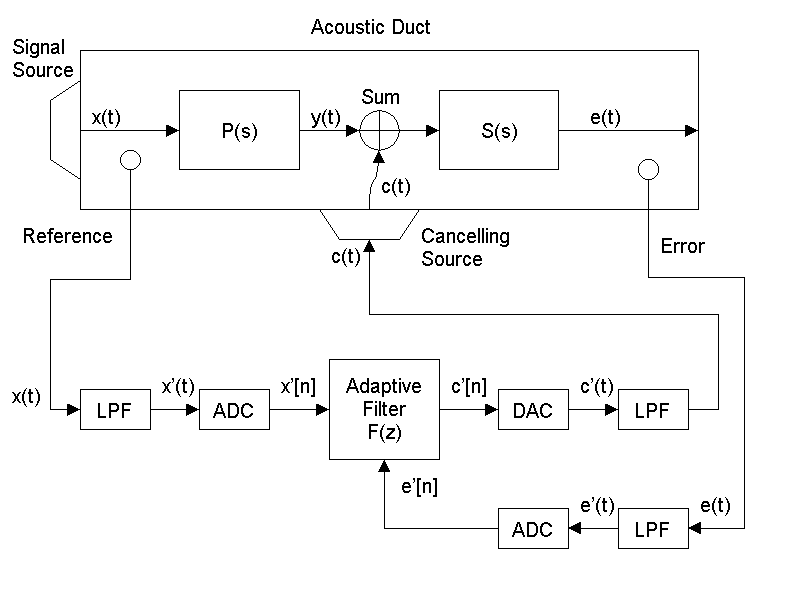
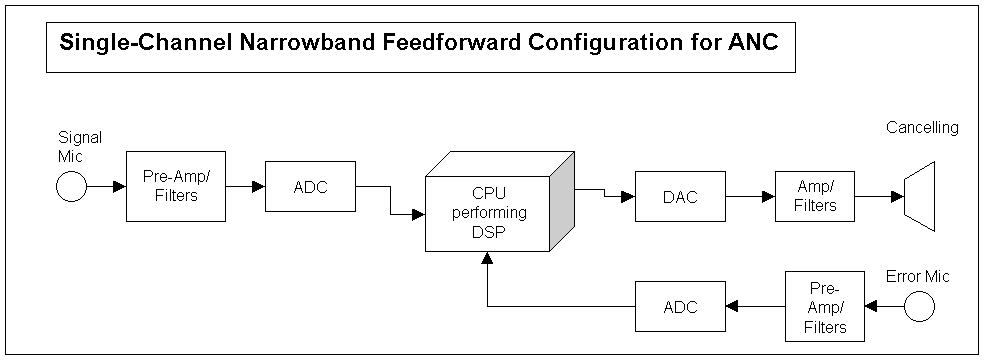
The ANC system hardware will consist of a computer, ADC/DAC interface card, low pass filters, and necessary pre-amps for interfacing components.
Implementation/Experimentation
Possibilities
 Simple sine waves of varying wavelengths
White noise (even power spread over entire spectrum)
Human speech
Fan noise
Combustion engine noise
Car cabin noise
Plane cabin noise
Relative positioning of noise control components in duct
Method of noise control
Algorithm used in adaptive method
Sampling rate
Filter depth
Residual noise, power and spectrum
Speed of adaptation
Stability of adaptive filter
Block Diagram of Setup
Simple Delay/Gain Arrangement
Adaptive Filter Arrangement