
| Douglas Adams (1952- ) : Adams states that the Hitchhiker's Guide To The Galaxy, his five-part "trilogy", was inspired by a book he once owned way back in his University days, Hitch Hiker's Guide To Europe. Originally a radio series, The Hitchhiker's Guide to the Galaxy became two novels right alongside the BBC production. At the same time, Adams was Dr. Who's story editor while producing another radio show. The medling of space adventure, comedy, mathematics and physics (gone awry, mostly) provided Adams with an outlet to show normal incidents (many of which happened to him) in a particula light, or in the darkness of space. Adams' popular series is, at last count, up to five volumes: The Hitchhiker's Guide to the Galaxy (1979), The Restaurant at the End of the Universe (1980), Life, The Universe, and Everything (1982), So Long, and Thanks for All the Fish (1984), and Mostly Harmless (1992). There have been the usual TV, comic, and game adaptations, as well as a long-stalled film project associated with it. Adams has haslo produced two other novels in the same vein: Dirk Gently's Holistic Detective Agency (1987), and The Long Dark Tea-Time of the Soul (1988). The respect and admiration he gained from working on the Hitchhiker's books has hindred what he still considers his most important work to date, Last Chance to See (1990, with Mark Carwardine), his entry into the topic of endangered species. Despite that disappointment, however, Adams has endeared himself to the science fiction universe by issuing these words to live by: "Don't Panic."Top |
| Alfred Bester (1913-1987) : A singularly imaginative man, Alfred Bester has not only written for science fiction, but has also contributed clssic stories for comics books as well. His two major works, The Demolished Man (1953), where he will forever be known as the man who invented a way to escape telepathy, (and which has won him the first Hugo award) and The Stars My Destination, a work as innovative and as unique as any in science fiction. With these two classics, Alfred Bester has assured his place among the greats of science fiction. Top |
| Isaac Asimov (1920-1995) : A Russian-born biochemist and writer, his writing career spanned more than forty-five years and produced 477 published books of nearly every type of fiction and nonfiction. He published his 300th book, Opus 300, in December 1984; his 200th book appeared in 1979. He has written popular works on science and the history of science, as well as a number of science-fiction classics, including I Robot (1950), The Foundation Trilogy (1951-53), and The Gods Themselves (1972), which won both the Hugo and Nebula awards. Asimov received a doctorate in biochemistry from Columbia University in 1948 and since 1949 has been a professor of biochemistry at Boston University. A Choice of Catastrophes (1979) demonstrates his effective approach in writing about science for children and nonscientific adults: he examines various notions about how the world might end, incorporating geology, bacteriology, social history, and astrophysics in his discussion. Recent Asimov works include In The Beginning (1981), in which the biblical book of Genesis is explored from both the fundamentalist and the evolutionist point of view; and The Measure of the Universe and Counting the Eons (both 1983). Asimov has also published volumes of his autobiography. Top | 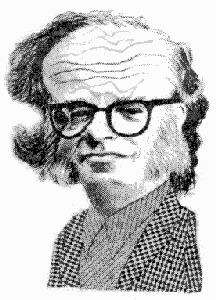 |
| Arthur C. Clarke (1917- ) : Arthur C. Clarke is one of the most celebrated science fiction authors of our time. He is the author of more than sixty books with more than 50 million copies in print, winner of all the field's highest honors. He was named Grand Master by the Science Fiction Writers of America in 1986. His numerous awards include the 1962 Kalinga prize for science writing, which is administred by UNESCO; the 1969 AAAS-Westinghouse science-writing prize; the Bradford Washbur Award; and the Hugo (2 times), Nebula and John W. Campbell Awards. His bestsellers include Childhood's End; 2001:A Space Odyssey; 2010: Odyssey Two; 2061: Odyssey Three and most recently, The Ghost from the Grand Banks; Rama II and The Garden of Rama (with Gentry Lee). In 1968 he shared an Oscar Academy Award nomination with Stanley Kubrick for the film version of 2001: A Space Odyssey. He co-broadcasted the Apollo 11 , 12 and 15 missions with Walter Cronkite and Wally Schirra for CBS. His invention of the satellite communication with satellites in geostationary orbit in 1945 has brought him numerous honors, such as the 1982 Marconi International Fellowship; a gold medal of the Franklin Institute; the Vikram Sarabhai Professorship of the Physical Research Laboratory, Ahmedabad; the Lindbergh Award and a Fellowship of King's College, London. He's a science fiction writer whose imaginings reverberate outside the realm of fiction. He is past Chairman of the British Interplanetary Society, a member of the Academy of Astronautics, the Royal Astronomical Society and many other scientific organizations. He has lived in Colombo, Sri Lanka since 1956. Top |
| Robert A. Heinlein (1907-1988) : Robert Anson Heinlein, born in Butler, Missouri, grew up in Kansas City, Missouri. After graduating from high school, he attended the US Naval Academy in Annapolis, Maryland, from 1924 to 1929. He served on many vessels, a.o. on the USS Lexington, the most advanced aircraft carrier at that time. His military career came to an abrupt halt in 1934 because of suffering from lung tuberculosis. He was suspended from service, but kept his deep devotion for the forces and all militaria till the end of his life. In the years after, he worked in many different professions, from real estate up to silver mining, and studied physics and mathematics at UCLA in Los Angeles, California. His first story, Lifeline, was published in the August edition, 1939, of Astounding. John W. Campbell, Jr.,�the editor, had found his author at last, who was soon to start up the Golden Age for the magazine. Robert A. Heinlein had found his definite profession. Misfit, Requiem, The Roads Must Roll, Logic of Empire, Waldo, Coventry, By His Bootstraps, Blowups Happen, Solution Unsatisfactory, They, The Devil Makes the Law(alias Magic, Inc.), and many other stories belonged to the first ones and became what was later called The Future History. 1941 saw the first appearance of Lazarus Long and the Howard family. During WW II , Heinlein worked at the US Naval Air Experimental Center in Philadelphia, Pennsylvania. After the war, RAH was the first SF author who succeeded in leaving the pulps: In 1947 he sold four stories to The Saturday Evening Post, including his classicThe Green Hills of Earth. It was 1947 as well, when he released the first of his novels for young people, Rocket Ship Galileo. In the course of the next years there were more novels which were to be called the Juveniles . During the '50s and early '60s, many novels were released. The Puppet Masters in 1951, Double Star (winning him a HUGO Award) in 1956, The Door into Summer in 1957,� Starship Troopers in 1959 (intended by RAH to be his 13th Juvenile but rejected by Scribner's as militaristic and released otherwise, i.e. Putnam's, winning him another HUGO Award), Stranger in a Strange Land in 1961 (another HUGO Award), Podkayne of Mars in 1962, Glory Road in 1963, Farnham's Freehold in1964, followed by one more HUGO-Award-winning novel in 1966, called The Moon is a Harsh Mistress. In his older days, RAH concentrated on more philosophic things, like love or death. Most of his novels written in the 70's and 80's brought him into the bestselling book charts. After his death a collection of letters was released in 1989, called Grumbles from the Grave. Written in the mid '50s, but published in 1992 for the very first time, and re-issued in November 1996, Tramp Royale is dealing with the author's travels around the world in 1953 and 1954. Top |
| Orson Scott Card (1951- ) : Card entered Brigham Young University as an archaeology major, but soon turned to theater. An actor and director, he eventually found his talent lay in writing. In his nearly two dozen novels and short story collections, Card explores the human condition through convincing characters and compelling, thoughtful narrative. The Hugo-winning Eye For Eye (1987) deals with the dangers of absolute power and the sacrifices necessary to be human. In The Worthing Saga (1990), a collection of related stories written over the previous decade, Jason Worthing's telepathic descendants chose to free the human race from their protection in order that it might feel pain and suffering again, and in so doing, rediscover nobility. The alternate-America Tales of Alvin Maker series again showcases the author's deft handling of history and personal testimony as necessary ingredients for his characters'--and his readers'--growth. One of his most popular series, the Ender series, have won Hugo and Nebula awards (both for Ender's Game and Speaker For The Dead), and began with his first published SF story "Ender's Game" in the August 1977 Analog. He was 16 when he devised the idea of child geniuises bred by the government to fight a war with Earth's arch-enemy. card's emergence at the forefront of science-fiction literature has done much to bring an introspective, often wistful quality back to the genre. His works combine hardship and hope in a fashion readers have embraced the world over. Top |
| Piers Anthony (1934- ) : Since 1966, Piers Anthony has authored more than 72 books and set up nine series, not each exactly to everyone's taste. Although panned by some fans, he is voraciously consumed by others. Skimming his list of works, one wonders why he hasn't been drained of inspiration by now. Honest, direct, and a self-admitted compulsive, Anthony can't be accused of buttering up to editors, agents, or fans--and he doesn't hesitate to let his opinions be known in print. Writing is his work, and while he has sampled the world of SF conventions, he finds himself happier when he is able to concentrate on his writing. However, he will respond to mail, confessing in Bio Of An Ogre that he has nowcomposed boilerplates of responses to send out. Like him or not, his body of work cannot be easily ignored by any serious fan of the genre. Top |
| Ray Bradbury (1920- ) : Ray Bradbury is one of the greatest SF and fantasy writers of our time. Born in Waukegan, Illinois in 1920, he authored such classics of the genre as The Martian Chronicles (1950) and Farenheit 451 (1953) by his early thirties, and continues to produce important work today. During Mikhail Gorbachov's 1990 summit meeting in New York, he made a special trip to visit "my favorite author," who he claimed to have read in the original versions. Bradbury is American fantasy's great ambassador. Top |
| Edgar Rice Burroughs (1875-1950) : Burroughs was a soldier, business executive, gold miner, cowboy, storekeeper, and policeman before he turned to writing as a career. Under the psuedonym "Normal Bean", which was changed by a helpful copy editor into "Norman" Bean, Edgar Rice Burroughs first chronicled the fantasy adventures of John Carter in the land called Mars with A Princess Of Mars (1912). An immensely popular creation, he has influenced many other writers in the sword and sorcery genre, as well as in science fiction, most notably Robert Heinlein. His greatest creation, however, remains the enduring myth of Tarzan Of The Apes (1914). The Tarzan books have been translated into more than 50 languages, have sold more than 20 million copies, and have served as the basis for motion pictures, radio serials, television shows, and a comic strip. Burroughs also is known for his science fiction writing. More than 60 of his books have been published. Taken in part from the Microsoft(R) Encarta(R) 96 Encyclopedia. (c) 1993-1995 Microsoft Corporation. All rights reserved. (c) Funk & Wagnalls Corporation. All rights reserved. Top |
| Stephen R. Donaldson (1947- ) : Throughout the three volumes of The Chronicles Of Thomas Covenant, the protagonist, Thomas Covenant, is a man who suffers from leprosy, which has lost him two fingers, his carrer, and his wife and son. He enters a fantasy world where he becomes miraculously whole--a world he can't afford to accept. He struggles to avoid being touched by The Land's beauty and promise of health, even though he yearns for human contact. His frsutration and inner rage come through when he lashes out at those who would help him. Covenant is an unlikely (and generally unlikable) choice as a protagonist--his bitterness at the world is a contrast to legions of starry-eyed would-be heroes and primeval barbarians littering the fantasy landscape. One of the strength of Donaldson's work is the depth of characterization he gives his characters, and the deep psychological issues in which he deals with. Armed with these tools, Donaldson helped usher in an era of fantasy after the advent of Tolkien. Top |
| John Ronald Reuel Tolkien (1872-1973) : South African-born British university professor, medieval scholar, philologist, and writer of fantasies, J.R.R. Tolkien is held by many as one of the greatest fantasists of all time. Tolkien's scholarly work at the University of Oxford concerned Anglo-Saxon and medieval literature. This scholarship is evident in the epic works he created about the fantasy world called Middle Earth. He wrote The Hobbit (1937) as a children's book. Its sequel, the trilogy entitled The Lord of the Rings (1954-1955-The Fellowship of the Ring; The Two Towers; The Return of the King), is an imaginative, profound tale of the conflict between good and evil. Many writers from then on hence have felt the power of Tolkien's story, and thus have spawned many imitators, some great but many others merely adequate. The Silmarillion (1977), which presents the mythological beginnings of Middle Earth, and Unfinished Tales (1980), which contains unincorporated stories, were edited and completed by Tolkien's son, Christopher Tolkien. Taken in all, Tolkien's chronicle of the events of the fictional Middle-Earth are seen in general as one of the most complete and complex efforts of world-building in either science fiction or fantasy. This effort, likewise, have spawned many imitators as well. Tolkien also wrote criticism and served as the Merton Professor of English at Oxford from 1945 to 1959. Taken in part from Microsoft(R) Encarta(R) 96 Encyclopedia. (c) 1993-1995 Microsoft Corporation. All rights reserved. (c) Funk & Wagnalls Corporation. All rights reserved. Top |