Typical Lighting
Arrangements
When laying out your lighting you need to figure
out the ratio of how long the room is to how wide the room is (for example,
if the room were 10ft. long and 20ft. wide you ratio would be 1 to 2.)
Your lights should be placed to match the ratio of the room (for example,
using the scenario above you would want to place twice as many lights down
the length of your compartment than you would down the width of the compartment.)
In most cases your lights should be spaced equal
distance from one another and at the same distance as their height for
instance, if the lights were mounted 7ft. above the floor then they should
also be mounted at 7ft. from each other. Also the distance between the
wall and the first lighting fixture should be about ½ the spacing
between units.
Back
to Lighting Design Procedure
Incandescent/ Mercury Arrangements
Grid #1
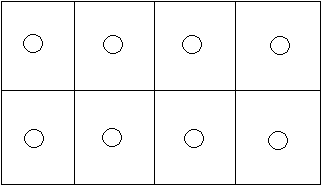 One unit per grid section is usually satisfactory
when the grid is no greater than the maximum allowable spacing.
Grid #2
One unit per grid section is usually satisfactory
when the grid is no greater than the maximum allowable spacing.
Grid #2
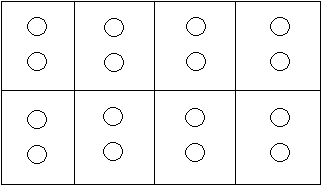 Two units per grid section is satisfactory when you
have to conform to a narrow grid, this is usually applicable where the
width is less than 2/3 the length.
Grid #3
Two units per grid section is satisfactory when you
have to conform to a narrow grid, this is usually applicable where the
width is less than 2/3 the length.
Grid #3
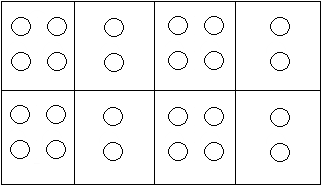 Four-Two Grid is equivalent to three units per bay
or four per bay where spacing allows
Grid #4
Four-Two Grid is equivalent to three units per bay
or four per bay where spacing allows
Grid #4
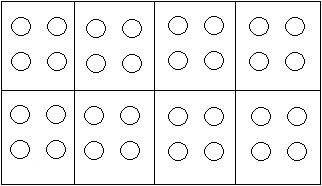 Four Grid system is usually the most common and can
be run by installers in continuos rows lengthwise or widthwise across the
room.
Fluorescent Arrangements
Square Grid
Four Grid system is usually the most common and can
be run by installers in continuos rows lengthwise or widthwise across the
room.
Fluorescent Arrangements
Square Grid
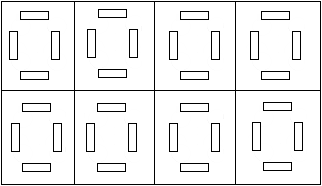 Square grid is dependant on room size and type of
work done in the room.
Straight Grid
Square grid is dependant on room size and type of
work done in the room.
Straight Grid
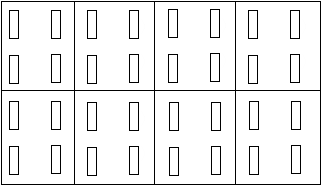 Straight Grid is the most common and works well for
usual dimensions.
Back to the Top
Back
to Lighting Design Procedure
Straight Grid is the most common and works well for
usual dimensions.
Back to the Top
Back
to Lighting Design Procedure
If you have comments or suggestions just click on the banner below.
