Understanding Light Pollution |
EVERY ASTRONOMER is familiar with the artificial skyglow that hangs over populated areas, washing out almost everyone's view of the universe to a greater or lesser degree. In the last two generations, light pollution has spread from a problem in cities to a major astronomical disruption almost everywhere.
But some aspects of light pollution are not widely appreciated by amateur astronomers. Knowledge is power; here are facts that may help you avoid some of the problem and combat the rest more effectively.
Glare versus skyglow. The most annoying and destructive problem is light that beams directly into your eye from a bright bulb. This is called glare; it comes from fixtures that are poorly designed or improperly aimed, perhaps most of those currently in use. When glare crosses property lines and creates a nuisance, it's called "light trespass." Glare is often the easiest problem to avoid -- by setting up your telescope in a shadowy corner, erecting a tarpaulin to shade the telescope, or negotiating with your neighbors or local government to have the offending light turned off or replaced with a modern one of better design.
Skyglow is what the term "light pollution" properly denotes. The sky has a certain minimum surface brightness even in the most pristine, unspoiled environment. This natural component of skyglow has four sources: faint airglow in the upper atmosphere (a permanent, low-grade aurora), sunlight reflected off interplanetary dust (zodiacal light), starlight scattered in the atmosphere, and background light from faint, unresolved stars and nebulosity. Airglow peaks around the maximum of the 11-year sunspot cycle; the other sources vary with the hour of night and the seasons. But their combined average is well known.
A typical suburban sky today is about 5 to 10 times brighter at the zenith than the natural sky. In city centers the zenith may be 25 or 50 times brighter than the natural background.
Full-cutoff shielding inside light fixtures is the essential remedy for both glare and skyglow. A lamp should send all its light down where the light is intended to be used, not upward or sideways. "Full cutoff" is usually taken to mean that no light rays from the fixture go above the horizon, and that at least 90 percent of the light is blocked in the near-sideways range from 0° to 20° below the horizontal plane.
Light that shines in this near-sideways range contributes nothing to most lighting needs. It is merely a dazzling annoyance in the eyes of people nearby and dissipates uselessly into the distance. Of course, light spilling upward is wasted totally. Tremendous above-the-horizon waste is tolerated because it goes unseen. People who install lights don't normally check them at night from high in the air! The electricity cost of this wasted light has been put at $1 billion to $2 billion annually in the United States.
Near-horizontal light is especially destructive. A light beam aimed straight up is usually not the worst kind. It escapes into space quickly, passing through what astronomers call one "air mass." A ray aimed 10° above the horizon, on the other hand, passes through 5.6 times as much atmosphere -- 5.6 air masses -- polluting all the way. A ray that skims the horizon pollutes up to 10 air masses, though not much of the light is left by the time it goes through the last few of them.
The situation is comparable to atmospheric extinction of starlight arriving in the opposite direction. When a light ray travels straight up through clear air from sea level, only 20 to 30 percent of it is absorbed or scattered by the atmosphere. The rest escapes harmlessly into space. When the same ray is aimed 5° above the horizon, about 90 percent of it is absorbed or scattered. Thus it causes three or four times as much pollution, when all the damage is summed up over an area many miles across. (That, anyway, is the situation in clear air. Aerosols can complicate the picture.)
Add the fact that most lights provide some blockage at high angles, and it becomes clear that most of the light-pollution war will be won or lost in the narrow battleground just a little way above the horizon. At least this is true at sites fairly far from the offending lights -- the semirural areas that seem to have suffered the worst degradation in the last 20 years. Right inside a city, rays at higher angles (and reflected from the ground) are the primary problem.
Some skyglow is surprisingly local. You can often see more stars 15 miles from a city than a quarter mile from a bad rural shopping center.
I've made extensive sky-brightness measurements of the zenith at two sites in Middletown, Connecticut: at the Van Vleck Observatory on the Wesleyan University campus, and at my home two miles away in wooded, semirural suburbia. The campus had, until recently, a night sky more than 20 times brighter than the natural sky background. The sky over my house is only four to five times brighter than the natural level. The change in two miles was remarkable -- from a nearly invisible Milky Way to views of the Sagittarius and Scutum starclouds on good nights.
In 1994 the university agreed to replace most of its walkway lights within a block of the observatory with properly shielded fixtures. The sky brightness at the zenith dropped by almost half -- a dramatic improvement of 0.6 or 0.7 magnitude.
Such observations point up the importance of dealing with local lights. You don't have to convert an entire city to see results. Hartford, Connecticut, a metropolitan area of a million people, is only 15 miles north of the Wesleyan campus. Its lights obtrude only marginally. Those of New York City about 90 miles southwest interfere not at all.
Another example appears on the light-pollution map of the Washington, D.C., region made by the Northern Virginia Astronomy Club and published in the June 1996 Sky & Telescope, page 82. The club members found surprising holes of relatively dark sky in a region that looks solid white in nighttime spacecraft photographs.
Watch the color of the daytime sky, especially near the horizon. The bluer the sky, the darker the night will probably be. Whiteness in a daytime sky is due to sunlight scattered by tiny particles. They do just as good a job of scattering artificial light at night. A deep blue sky in the afternoon should mean a transparent sky after dark.
Dry air is another good sign. Even if the upper atmosphere is fairly free of haze, high humidity is liable to bring haze (or fog) lower down. Watch for forecasts of low humidity.
Air pollution matters. The white haze in a blue sky consists of microscopic water droplets that have condensed on tiny solid particles, primarily sulfate dust from distant factories and power plants. These particles are the precursors of acid rain. Sulfur emissions in the United States peaked in 1970 and have since been reduced by about 30 percent. Whether these reductions will continue or backslide is an open question. But the Clean Air Act of 1970 has meant darker skies in the 1990s than we otherwise would have had.
A windy cold front sweeping through a city can clear out local pollution, leaving the night marvelously dark. The windiest city and suburban nights are often the darkest. A passing rainstorm or blizzard can also leave an unusually dark night in its wake.
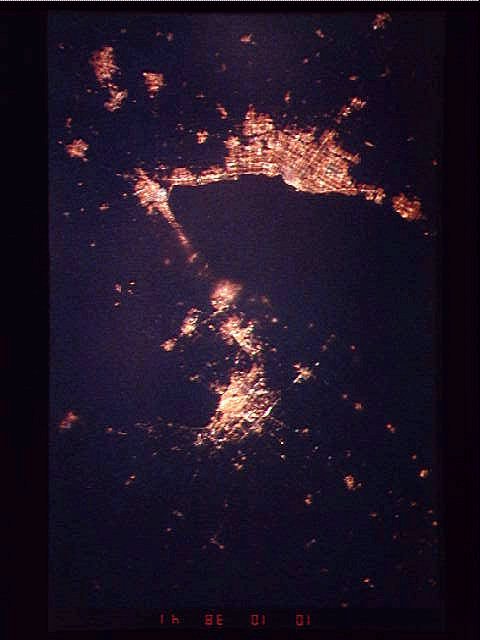
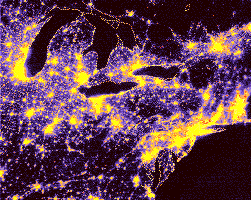
The following images are Satellite images of Buffalo, Toronto and North America depicting light propagation. Images courtesy of NASA and DMSP satellite imaging systems.
Toronto and Buffalo via NASA. North is to the upper right corner.
Thermal image of north east North America from the DMSP satellite. Yellow areas underscore vicinitites with highest light concentrations.
Page created on April 25, 1999