interest
news
releases on recent P. infestans problems
more information
on control and photos of spores and sporangium
An IPM page with excellent
diagnostic photos
Late Blight of Potato
Common Name: Late Blight of Potato
Causal Agent: Phytophthera infestans. This fungus is in the phylum Oomycota.
Host Range:
- Potatoes
- Tomatoes
- Plants in family Solanaceae
- No alternate hosts are known
- Europe
- North America
- South America
- Also found in lesser amounts throughout the world
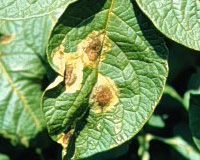
photo courtesy of www.bcc.orst.edu
Symptoms:
The disease first shows itself as water- soaked lesions on the older leaves of the plant. In moist weather, the pathogen then manifests itself quickly as large brown spots on the top of the leaf, and downy, white fungus on the lesion edges on the bottom of the leaf.
Dissemination:
Phytophthera infestans can reproduce asexually and sexually, but has mainly been found to reproduce asexually. Both sexually and asexually, the inoculum overwinters in the soil, in debris, or in tubers. In the spring, the sporangium infects the plant via zoospores, either from in the soil or a direct attack on the stem and lower leaves from the surface of the soil, most favored in moist conditions.
Disease Cycle:
After infecting the plant, Phytophthera infestans creates lesions on the bottom leaves. The pathogen then produces sporangiophores and new sporangia, which then infect and take over new leaves, and eventually the tubers. The stems and leaves then quickly die off (in wet conditions) and the tubers exhibit large, purplish lesions. The disease has been found to overwinter in dead plant material and infected tubers. Sporangium in this material germinates in the spring and begins a new cycle. Sexual reproduction is rare, and at first, was only found in Mexico. In such a case, oospores are created and they overwinter in the soil. They then germinate in the spring, and become sporangia, which then complete the rest of the cycle. Oospores are believed to last up to ten years in the soil.
Control Measures:
It is important to start out the season with disease-free potatoes for seed. Resistant cultivars also exist and are useful in controlling the development of the disease naturally. But most of these varieties are resistant to only a few races of blight, so it is important to watch for infection even if planting a resistant cultivar. If the ideal cool, wet conditions manifest themselves after the plant germinates, then it would be a good idea to apply a protective fungicide spray, even if the potato is a resistant variety. Chemical sprays that are recommended include mancozeb, metalaxyl, and certain copper mixtures, including the Bordeaux mixture.
References:
- Agrios, G. N. 1997. Plant Pathology, Fourth Edition. pp. 274-278.
- Andrivon, D. 1995. "Biology, Ecology, and Epidemiology of the Potato Late Blight Pathogen Phytophthora infestans in Soil." Phytopathology. 85 : 1053-1056.
This paper gave interesting insights as to the behavior of the inoculum in soil, and also its behavior in both the sexual and asexual forms. It is basically a paper that discusses the research done over the last 150 years on Phytophthera infestans.
The asexual form is the one most typically found, and it has only been in the last one hundred years that we have found enough evidence to say that Phytophthera infestans even produces sexual spores. The asexual spores are produced on the foliage, which, when mature, fall to other leaves or the ground. These can germinate and infect plants. Sexual spores, when formed, are thick-walled and can withstand overwintering in the soil for as long as ten years. It is the offspring of the sexual spores that carry the most genetic diversity, even though the asexual forms are also genetically diverse.
Brent Hulke