interest
Anthracnose of Soybean
Common Name: Anthracnose of Soybean
Causal Agent: Colletotrichum truncatum is the most common pathogen causing anthracnose in soybeans. Other pathogens that cause anthracnose of soybean include C. coccodes, C. destructivum, C. gloeosporioides, and C. graminicola. These are all Deuteromycete fungi that produce conidia.
Host Range: This condition is caused by many different fungi in many different species of plants. Soybeans and other legumes are commonly infected by Colletotrichum spp.
Geographical Range: Worldwide
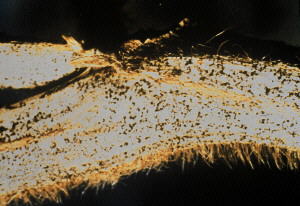
Visible acervuli on a soybean stem
(photo courtesy of Kentucky
IPM)
Symptoms:
If the seeds themselves are infected, damping off of the seedlings commonly occurs. If the plant is infected after emergence, the symptoms generally appear about the time reproduction starts. The fungus affects the stems, leaves, and pods of the soybean, and cause necrotic spots on these areas. In the late stages of the fungus, during the later part of reproduction in the plant, acervuli, which are the fruiting bodies of the fungus, appear on the infected areas. These appear as black areas on the tissue with the unaided eye. The seeds from the infected plants show few symptoms, but may appear to have a gray to brown staining.
Dissemination:
Colletotrichum spp. reproduce asexually and disseminate via conidia. The conidia germinate in wet weather and invade the plant via appressoria. It can also overwinter as mycelium in dead tissue or mycelium in the seeds, and appear in new plants the next year.
Disease Cycle:
After the plant is infected, the fungus remains at the point of infection until reproduction of the plant begins. It then becomes systemic, causing lesions on the stems, leaves, and reproductive organs of the plant. Growth of the fungus is promoted by warm, moist weather conditions. The fungus then forms infective conidia. The cycle begins again the next year, with inoculum originating in the seed, in dead plant tissue in the soil, or by infection by the conidia itself.
Control Measures:
The easiest way to eliminate the inoculum for this pathogen is to plant uninfected seed. Since the symptoms are hard to see in the seed, this is difficult. There has been research that indicates that seed can be protected from infection by the application of DFMA (alpha-difluoromethylargenine), which inhibits the formation of certain amino acids required by the fungus. A seed treatment of DFMA was shown to eliminate Colletotrichum truncatum from the seed. Other treatments include deep plowing to bury the inoculum in the soil, planting of resistant cultivars, rotation with non-host plants such as corn and other non-legumes, and application of certain fungicides. Fungicides that are effective include benomyl and chlorothalonil.
References:
- Gamarnik, A.; Frydman, R. B.; and Barreto, D. 1994. "Prevention of Infection of Soybean Seeds by Colletotrichum truncatum by Polyamine Biosynthesis Inhibitors." Phytopathology. 84: 1445-1448.
- Hartman, G.L.; Sinclair, J.B.; and Rupe, J.C. 1999. "Anthracnose." Compendium of Soybean Diseases, Fourth Edition. 13-14.
The polyamine biosynthesis inhibitors DFMO (alpha-difluoromethylornithine) and DFMA (alpha-difluoromethylargenine) limit production of certain amino acids in the fungus Colletotrichum truncatum. The decarboxylase enzymes that aid in formation of putrescine, cadaverine, spermidine, and spermine are inhibited. Since these amino acids are important to the development of the fungus, these inhibitors could be useful in controlling the fungus.
An experiment was set up which compared the germination of healthy soybeans,
soybeans inoculated with Colletotrichum truncatum, and those inoculated
with the fungus and treated with DFMA or DFMO. Results showed that DFMA
inhibited the fungus without any side effects in the plant, while DFMO
inhibited the fungus, but caused abnormal root elongation in the plant.
DFMA, therefore, could be useful in preventing infection in seedlings.
Brent Hulke