interest
More
on the fusion of basidiospores in Utilisago maydis
Journal
of Plant
Disease
homepage
Corn Smut
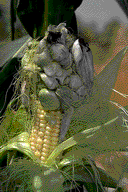
Smut present on corn ear.
photo courtesy of University
of California - Davis
Common Name: Corn Smut
Causal Agent: Ustilago maydis. This fungus is in the phylum Basidiomycota.
Host Range: This species of fungus is specific to corn (Zea mays).
Geographical Range: Corn smut occurs anywhere that corn is grown. Ustilago maydis is most prolific in warm, dry climates.
Symptoms:
Ustilago maydis infects plants from seedling stage to maturity. The smut it causes is most commonly found on the sexual parts of the corn plant, namely the ear and the tassel, but it is also found on the leaves and stems. When it infects these parts, a greenish to gray gall forms. This gall enlarges as the fungus matures, and the gall becomes full of brown to black teliospores. The galls can be minute to very large, usually one to fifteen centimeters in diameter.
Dissemination:
Ustilago maydis disseminates by spreading the teliospores it creates inside the gall. The galls on the sexual parts tend to rupture and spread the teliospores through the air. On the stems and leaves, however, they tend not to rupture, and stay in the plant debris. They can survive in the plant debris for many years. The teliospores then germinate and form a basidium, and from each basidium come four basidiospores. The basidiospores can be spread in the air or by water to plants. They then germinate and infect the plant.
Disease Cycle:
When the basidiospores germinate and infect the corn plant, the fungus usually stays localized at the point of infection. In a few cases, it can spread systemically, but this is usually in very young plants. It takes two basidiospores to cause an infection, because the basidiospores are haploid and only diploid mycelium can continue to grow and reproduce. Ustilago maydis is most likely to infect sexual parts of the plant under high stress conditions, and when pollination is delayed. When the spores unite and start growth, they cause neighboring plant cells to swell and divide, and form galls. The mycelium of the fungus infects these enlarged cells, and uses their contents for food. When the fungus matures, it forms teliospores, which are released into the environment. The teliospores cause new infections, usually during the next growing season.
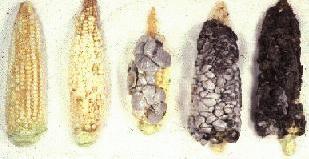
Smut development from eight days after infection (far-left)
to
22 days after infection (far-right).
photo courtesy of University
of Illinois at Urbana-Champaign
Control Measures:
This is a relatively difficult disease to control, but fortunately is rarely a problem in agriculture today. When it is a problem, it is usually in crops like sweet corn, where the corn itself is the finished product, and even a small amount of smut can decrease the value of the crop. Most corn sold on the market at this time has some amount of resistance to Ustilago maydis, but even the most resistant plants are susceptible during early pollination, when the growing silks of the corn are easy targets to the fungus. If the pollination is delayed, there is usually greater susceptibility and chance for disease. Because the spores are airborne and can survive long periods in the soil, crop rotation and deep plowing are only partially effective.
References:
- Agrios, G. N. 1997. Plant Pathology, Fourth Edition. pp. 382-384
- Du Toit, L.J. and Pataky, J.K. 1999. "Effects of Silk Maturity and Pollination on Infection of Maize Ears by Ustilago maydis." Plant Disease. 83:621-626.
Du Toit gives an interesting report on how the fungus Ustilago maydis is affected by the growth stages and stress conditions of the corn (maize) plant. He performed two different experiments, one incorporating date of inoculation as the dependent variable, and the other changing only the date that the corn seed was planted, and later inoculating on the same day.
From these two experiments, they found that the most likely time for
the host to be infected, or its time of greatest susceptibility, is at
two to three days after silks appear. Once the silks are pollinated, the
fungus is less likely to infect the plant, for reasons that are still not
completely understood. It could be due to an interaction between the fungus
and the pollen. Some hybrids are more likely to be infected than others
are, but all of the ones studied followed the same susceptibility trends.
Brent Hulke