interest
Corn diseases of importance
in the United States
Comparison
of corn hybrids for resisitance to MDMV
(requires Adobe Acrobat Reader)
Maize Dwarf Mosaic Virus
Common Name: Maize dwarf mosaic virus is abbreviated as MDMV.
Causal Agent: A potyvirus, in the family Potyviridae.
Host Range: The most important hosts of MDMV are corn, sorghum, and johnsongrass, though there are many others.
Geographical Range: This virus is native to the United States, but is also found in China and South Africa.
Symptoms:
Maize dwarf mosaic virus has various symptoms, due to the many strains of the virus, and the genotypes and stages of growth of the host. The most common of these symptoms are chlorotic areas with green, healthy tissue surrounding it. This pattern of chlorosis surrounded by healthy tissue is called a mosaic. Slight stunting also occurs, but this is usually attributed to early infection. Ear formation is adversely affected due to the development arresting effects of the virus. This results in lower yields.

The effects of MDMV on the corn ear. Note the development
of the ear was inhibited.
The reddening of the leaves suggests that this plant
was also infected with maize chlorotic dwarf virus.
(photo courtesy of the University
of Delaware)
Dissemination:
Mechanical damage and insect vectors, such as the corn leaf aphid (Rhopalosiphum maidis), disseminate the virus. More than fifteen aphid species are known to vector the virus non-persistently. Non-persistent vectors can only retain the virus for a short time after acquiring it from the plants they feed on. The virus cannot reproduce inside the insect.
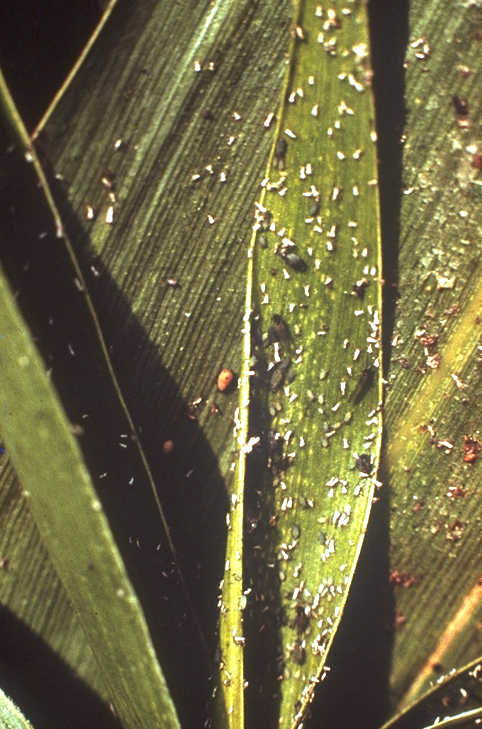
Corn leaf exhibiting the characteristic mosaic symptoms.
Note the insect vectors on the leaf. (photo courtesy
of MaizeDB)
Disease Cycle:
After the virus infects the host, it reproduces inside of it, parasitizing the plant. Insects that feed on the diseased plant can spread the virus to additional plants by feeding; and mechanical equipment can injure multiple plants, causing spread of the virus from plant to plant. The virus also survives in johnsongrass, which is the alternate host. Johnsongrass possesses the virus even when corn and sorghum are not present in a field. The same vectors that feed on the johnsongrass will feed on corn and sorghum, spreading the virus by feeding behavior. Maize dwarf mosaic virus is usually found infecting the same plant as maize chlorotic dwarf virus (MCDV), and together they have an additive, adverse effect on the plant.
Control Measures:
Resistance genes are important in controlling maize dwarf mosaic virus. The primary gene for resistance, mdm1, is present in many corn hybrids. Johnsongrass, the alternate host of MDMV, is found in almost all areas that the virus is a problem. Eradication of the johnsongrass is a logical way of eliminating the virus, but other effects should be considered. Studies have shown that by spraying postemergence herbicides to kill johnsongrass, aphids that feed primarily on the johnsongrass will move onto neighboring corn. The additional inoculum-containing aphids from the dying johnsongrass that feed on the corn will increase likelihood and incidence on infection. With this in mind, a program that includes control of the johnsongrass and the aphids should decrease infection incidence.
References:
- Eberwine, J.W. Jr; Hagood, E.S. Jr; and Tolin, S.A. 1998. "Quantification of Viral Disease Incidence in Corn (Zea mays) as Affected by Johnsongrass (Sorghum halepense) Control." Weed Technology. 12:121-127.
- http://image.fs.uidaho.edu/vide/descr465.htm. Accessed 3/4/2001.
- White, D.G. 1999. "Maize Dwarf Mosaic." Compendium of Corn Diseases, Third Edition. 50-51.
Eberwine discusses the additive effects that MDMV and MCDV have when found in the same plant. MCDV is the more harmful of the two viruses, causing greater stunting and yield loss than MDMV. The two viruses are known to often infect the same plant and together cause severe problems in growth and development.
This study involved measuring the amount of virus and the number of
vector aphids at several points in the season in corn. The corn was planted
among natural stands of johnsongrass. There were two treatments, one with
nicosulfuron applied at 10-15 cm johnsongrass and the other not treated
with any herbicide. While the number of aphids did not change between the
two treatments, the amount of virus did. The virus appeared more frequently
and earlier in the treatments with corn plus eradicated johnsongrass than
on those with living johnsongrass. Eberwine proposes that the death of
the aphids primary host, johnsongrass, caused them to move to the corn
in greater numbers, and infect the corn with the virus it obtained from
the dying johnsongrass.
Brent Hulke