interest
More
on control of Verticillium wilt
Information
on control of alfalfa seed diseases
Verticillium Wilt of Alfalfa
Common Name: Verticillium wilt of alfalfa
Causal Agent: Verticillium albo-atrum, a Deuteromycete fungus that produces conidia.
Host Range: This fungus parasitizes alfalfa, and is also found in many broad-leaved weeds, especially those of the genus Medicago, which is a close relative to alfalfa. The strain that kills alfalfa is also known to infect peanuts and soybeans, but usually does not kill them.
Geographical Range: This fungus is common to northern Europe, North America, and New Zealand.
Symptoms:
Shortly after infection, V-shaped chlorosis is usually found on the alfalfa leaflets. The leaflets eventually dry up and die. The leaflets remain attached to the stem, stiff and chlorotic green in color. Eventually, all the leaflets attached to a stem die, leaving the stem unwilted. The pathogen moves up the stem starting at the crown. Stems towards the bottom of the plant can be severely infected, while those towards the top may remain healthy, at least for a while. The disease eventually spreads to the top of the plant, where it takes over and kills the last leaflets, resulting in death of the plant.
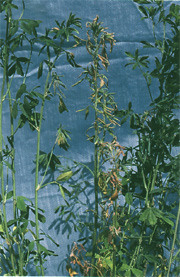
Verticillium wilt resulting in death of a plant.
(photo courtesy of Washington
State University)
Dissemination:
New plantings of alfalfa are usually infected by Verticillium albo-atrum from infected seed, or seed with conidia attached to it. Healthy stands of alfalfa can be infected by the cuts made by mowing in the presence of the pathogen’s conidia; or by insect vectors, such as aphids and leafcutter bees. The pathogen also survives animal digestion, and can contaminate the soil the manure is spread on.
Disease Cycle:
After the alfalfa is infected, the fungus usually creates its first visual symptoms at the crown of the plant, and progresses upward. As it goes up the plant, it infects and kills the leaflets, and then proceeds to kill the stem. The fungus sporulates at the base of the dead stem, never on living tissue, and releases conidia into the environment. These conidia can be disseminated by any of the above means to another plant. If the conidia are left in the soil, they can only survive for about a year before they are no longer infective. They can survive much longer periods in seed and hay, however.
Control Measures:
The easiest way to control this disease is by planting resistant cultivars of alfalfa. Unfortunately, even resistant cultivars have susceptible plants within the population, because it is difficult to produce pure, homogenous alfalfa seed. The fungi can grow and reproduce on these susceptible individuals. It is important to disinfect the equipment used between fields to discourage infection of susceptible plants. A household bleach solution sprayed on the mower's blades accomplishes this. In the rotation after alfalfa, it is important to control the broad-leaved weeds, as they are alternate hosts of the fungus. This should significantly reduce the inoculum bank in the soil after a few years. Disease-free seed is important when starting a new stand of alfalfa.
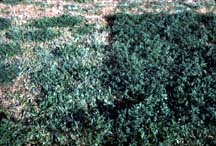
Alfalfa resisitance to Verticillium wilt. A variety
with good resistance is on the right,
a susceptible variety on the left. (photo coutesy
of Ohio State University)
References:
- Gordon, T.R.; Correll, J.C.; Gilchrist, D.G.; and Martensen, A.N. 1989. "Verticillium Wilt of Alfalfa in California." Plant Disease. 73:18-20.
- Stuteville, D.L. and Erwin, D.C. 1990. "Verticillium Wilt." Compendium of Alfalfa Diseases, Second Edition. 39-40.
Gordon points out that the areas of California affected by Verticillium albo-atrum are the intermountain valleys along the coast, which generally are cooler than the central valleys. Only one infection has occurred in the central valleys, at one of the University of California’s research farms. The alfalfa planted there originated in Minnesota, and was already infected by the pathogen. The soil was fumigated and the pathogen eliminated. Gordon discussed that if the central valleys become sustainably infected with the fungus, it will be because the fungus adjusted to a warmer climate.
In this experiment, the amount of resistance in various varieties of
alfalfa to Verticillium albo-atrum was determined. Isolates of Verticillium
albo-atrum were inoculated into severed alfalfa roots and allowed to
cause disease. It was discovered that even the most resistant varieties
had susceptible plants in the same seed stock. Though this susceptibility
exists, the resistance is still helpful in keeping the inoculum level low
and maintaining a healthy crop. Many resistant varieties that are adapted
to the climate of the central valleys were discovered, and these might
prove helpful if Verticillium albo-atrum continues to spread.
Brent Hulke