interest
Discussion
of strain (race) differences in A. flavus
Photos
of A. flavus under an electron microscope
Aspergillus Ear Rot of Corn
Common Name: Aspergillus ear rot
Causal Agent: Aspergillus flavus is the most common Aspergillus ear rot pathogen for corn, but A. parasiticus is also known to cause this disease. Both are Deuteromycete fungi.
Host Range: Corn is the most commonly affected crop by this species of pathogen.
Geographical Range: It is found wherever corn is grown, but is most serious in hot, dry climates.
Symptoms:
Aspergillus flavus infects corn in the ear. Usually only a few kernels are infected per ear. These kernels typically develop large masses of spores that are yellow to green in color, and may turn brown as the masses age. These signs are characteristic of this pathogen, and are accentuated by injury before infection.
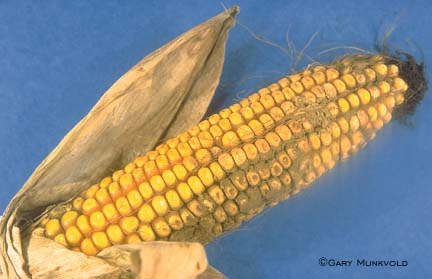
Corn ear infected by A. flavus. Note the
green coloration of the spores
near the infected kernels. (photo courtesy of Iowa
State University)
Dissemination:
This fungus produces conidia, which overwinter in the soil and debris. The next summer that corn is planted, the conidia are taken up out of the soil by wind and insects to the silks of the maturing corn ears. There they germinate and infect the ears. The injured kernels are the most susceptible.
Disease Cycle:
After the conidia germinate in the ear, they invade the kernels, usually towards the top of the ears. Here they produce masses of spores, which are attached externally to the kernel. During its growth in the corn, the fungus produces aflatoxin, a carcinogen that is undesirable in the harvested grain. The conidia inside the infected kernels mature with the grain, and when the grain is harvested, are included with the grain or cast out with the debris. Storage rots can occur if the conidia are included with the harvested portion, and inoculum for the next corn crop is available if it is cast out with the debris. Usually both cases occur. This disease is most severe in times of heat and water stress.
Control Measures:
Resistance to this disease is now available in some southern corn hybrids. The genes offering the resistance are additive, which is encouraging to the plant breeder because hybrids with greater resistance to A. flavus races are genetically possible in the future. Not many midwestern hybrids of corn have this resistance, but it is possible to incorporate it, should it become necessary. However, even the most resistant varieties are susceptible in hot, dry years. For this reason, it is also helpful to irrigate corn to reduce this stress. Deep plowing can reduce the inoculum available in the topmost part of the soil, which is also helpful in reducing the amount of disease.
References:
- Campbell, K.W.; and White, D.G. 1995. "Inheritance of Resistance to Aspergillus Ear Rot and Aflatoxin in Corn Genotypes." Phytopathology. 85:886-896.
- White, D.G. 1999. "Aspergillus Ear Rot." Compendium of Corn Diseases, Third Edition. 44.
In this study of the inheritance of resistance, Campbell crossed many inbred lines in many combinations to find promising new lines of resistance. In the process, the relationship between resistance to aflatoxin production and the resistance to ear rot was studied.
The ears were inoculated with a suspension of conidia directly into the ear, causing damage to the kernels, a few weeks after midsilk. About forty days later, they were husked and given a visual assessment. Resistance to ear rot was assessed in this way. Because the kernels were damaged when inoculated, the disease should have been fairly evident. Later, the ears were harvested, and the kernels ground and assayed for aflatoxin using the ELISA method. From this, the resistance to aflatoxin was discovered. The conclusion that was reached is that the genes for resistance to alfatoxin production and ear rot are different, but in most cases, the amount of aflatoxin is decreased when ear rot was inhibited, and vice versa. This could be due to the existence of both aflatoxin production and ear rot resistance genes in the same corn plant.
Brent Hulke