interest
More
information on root rots and controlling them (requires Adobe
Acrobat Reader)
Information
on root rot problems in Nebraska
Journal
of Microbial Ecology homepage
Journal
of Phytopathology homepage
Fusarium Root Rot of Beans
Common Name: Fusarium Root Rot
Causal Agent: Fusarium solani f. sp. phaseoli, a Deuteromycete fungus. Its perfect form is named Netria haematococca.
Host Range: This forma specialis parasitizes beans, but, in general, this species affects a wide range of plants.
Geographical Range: This disease occurs worldwide.
Symptoms:
After infection, the disease exhibits itself as narrow, lengthwise, reddish-brown streaks on the hypocotyls and taproots of newly emerged seedlings. As the disease progresses and the plant develops, the oldest parts of the root, those first infected, become necrotic in the cortex. Adventitious roots then develop to take over the functions of the diseased roots. Lower leaves of the plant become chlorotic and die about this time, and plant vigor is restricted.
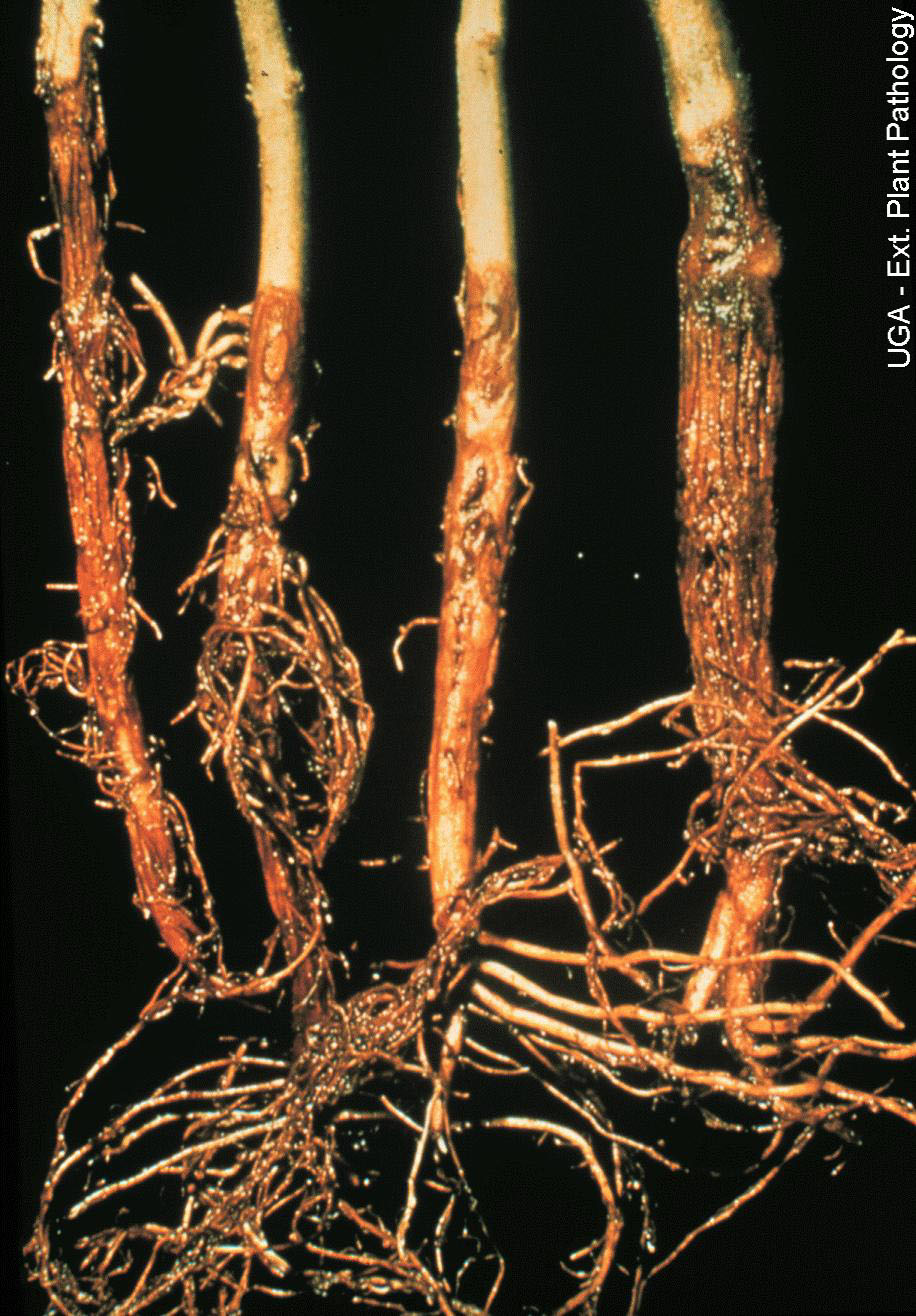
Fusarium root rot symptoms on bean roots.
Note the dark, deteriorated condition of the roots.
(photo courtesy of
University of Georgia - Cooperative Extension Service)
Dissemination:
Macroconidia develop on the sporodochia of the fungus late in its life cycle. These conidia produce chlamydospores that are released into the soil to overwinter. The next season that beans are present, the chlamydospores germinate as a result of a biochemical signal that the beans produce. The fungus produces hyphae that penetrates the plant directly, or through wounds or stomates.
Disease Cycle:
After infection, the pathogen resides in the cortex of the oldest root tissue. There, the tissue of the cortex is destroyed. If roots are allowed to grow unrestricted, they may regenerate the tissue that was damaged by the pathogen, showing little effect on the plant. If, however, the root growth is restricted, by drought or other stresses, the pathogen can take over and kill the entire root structure, killing the plant. This wide range of effects, from slight vigor problems to death of the plant, causes an uneven stand in a field, which is characteristic of this disease. The spores of the fungus are returned to the soil with the plant debris, where they overwinter. Unfortunately, the biochemical signals that cause the spores to germinate can come from nearly any host or non-host species of plant, and the spores can continue to reproduce in the debris without a living host.
Control Measures:
The use of resistant cultivars and prevention of soil compaction are the best ways of preventing problems from the disease. Reducing soil compaction is important because it allows the roots to grow unrestricted. Amending the soil with fertilizers is also recommended to reduce stress on the plants. Biocontrol using plant symbiotic bacteria and fungi, such as mycorrhizae and Rhizobium spp. has recently been found to inhibit Fusarium solani. Inoculation with these symbionts could be useful in gaining some resistance to the disease. High aluminum ion content in acidic soils is detrimental to F. solani, but the beans themselves are also susceptible to aluminum toxicity. Varieties do exist that are resistant to aluminum toxicity, however. If these resistant beans are planted in high aluminum, acidic soil, they remain nearly unaffected by F. solani.
References:
- Agrios, G. N. 1997. Plant Pathology, Fourth Edition. pp. 350-354.
- Dar, G.H.; Zargar, M.Y.; and Beigh, G.M. 1997. "Biocontrol of Fusarium Root Rot in the Common Bean (Phaseolus vulgaris L.) by Using Symbiotic Glomus mosseae and Rhizobium leguminosarum." Microbial Ecology. 34:74-80.
- Furuya, H.; Takahashi, T.; and Matsumoto, T. 1999. "Suppression of Fusarium solani f. sp. phaseoli on Bean by Aluminum in Acid Soils." Phytopathology. 89:47-52.
- Hall, R. 1994. "Fusarium Root Rot." Compendium of Bean Diseases. 9-10.
Dar gives interesting insight into the role of the symbiotic microorganisms that exist in the rhizosphere of legumes, using beans as an example. Two species of symbiotic organisms, Glomus mosseae and Rhizobium leguminosarum, were tested to find their competitive effects on Fusarium solani f. sp. phaseoli. Several treatments that included these microorganisms both separately and mixed were included, allowing the comparison of the antagonism between the microorganisms.
It was discovered that when one or both of the symbiotes were placed
together with Fusarium solani, the plant would fare much better
than the plant that was infected by Fusarium solani alone.
This could be due to a number of factors. The symbiotic microorganisms
could be more aggressive in competition for root space, could produce toxins
which inhibit the growth of Fusarium solani, or the plant could
be more resistant to the fungus because the symbiotic microorganisms gave
it the necessary nutrients to maintain health. This antagonism is
most likely due to a combination of these factors.
Brent Hulke