interest
Comparison
of discolored soybean symptoms
Scouting
information for soybean diseases
Cercospora Blight, Leaf Spot,
and Seed Stain
Common Name: Cercospora Blight, Leaf Spot, and Purple Seed Stain
Causal Agent: Cercospora kikuchii, a Deuteromycete fungus.
Host Range: This disease has only been found in soybeans.
Geographical Range: This disease is found in soybean-producing regions throughout the world.
Symptoms
The symptoms are first exhibited during the plant’s reproductive stages as light purple areas on the topmost leaves. As the infection spreads, these lesions become larger and deeper in color, often showing reddish to purple coloration. The lesions are quite variable in size, and sometimes are large enough to become joined and form one large lesion. These leaves then become chlorotic and fall off. The stems may also become infected at this point, and may exhibit purple lesions that are slightly sunken. Pods are also infected, and lesions similar to those found on the leaves appear. The seed produced becomes infected, and shows a permanent purple staining in the seed coat.
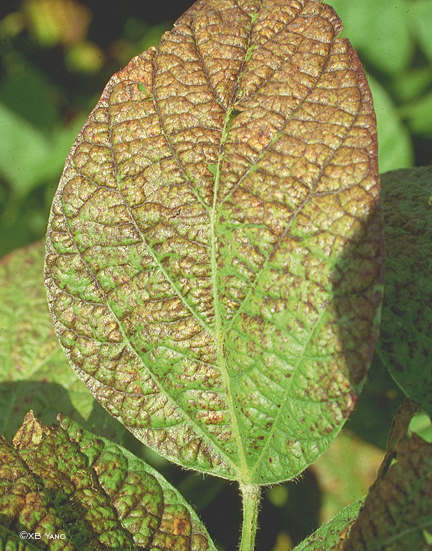
Typical Cercospora blight symptoms on a soybean leaf.
(photo courtesy of Iowa
State University)
Dissemination
Inoculum can come from the infected seeds, or from conidia in the soil and debris. Any stained seed with live C. kikuchii inside will produce a plant that has this condition, arising from the live mycelium that exists in the seed. It is important to note that sometimes the seed may have live mycelium inside, but not show the external staining symptoms. High moisture is the first signal for the conidia to germinate and infect the first leaves of the host. Schuh reports in his article that a dew period of 18 hours is required for infection. This can be broken up into wet followed by dry periods, with each wet period causing an additive effect. When the wet periods are broken up, conidia germination is negatively affected, but still occurs in a lesser amount.
Disease Cycle
The conidia forms a germ tube and proceeds to infect these leaves through
the stomatal openings or directly. It has been observed that after penetration
of the host, the pathogen will stay somewhat dormant for a while, and later
in the season, begin growth towards the top of the plant. Symptoms are
then shown, and conidia and infected seed produced. The conidia is
released into the soil with the debris.
When infected seed causes the disease, the mycelium usually infects
the cotyledons and then the stems, causing symptoms similar to the leaf
symptoms already discussed. The young plant is usually killed after this
point.
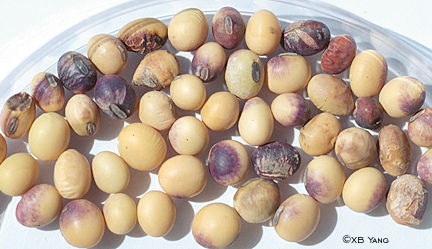
The purple stain symptoms on soybean seeds. These
seeds contain
Cercospora kikuchii mycelium. (photo courtesy
of Iowa State University)
Control Measures
Certain soybean varieties, such as Davis, show less susceptibility to the disease, but still become infected and show symptoms. No completely resistant plant is known to exist. Planting soybeans in a less humid environment decreases the amount of disease; however, this is not a viable solution in most cases.
References
- Hartman, G.L.; Sinclair, J.B.; and Rupe, J.C. 1999. "Stem Canker." Compendium of Soybean Diseases, Fourth Edition. 17-18.
- Schuh, W. 1993. "Influence of Interrrupted Dew Periods, Relative Humidity, and Light on Disease Severity and Latent Infections Caused by Cercospora kikuchii on Soybean." Phytopathology. 83:109-113.
In this article, Schuh studied the effects of the length of dew periods, amount of relative humidity, and length of light and dark periods to investigate the causes of condial germination and growth in C. kikuchii. He set up three different experiments in a greenhouse, one changing the light periods to find germination percentage, a second manipulating light period to study infection percentage, and the last changing dew periods and relative humidity to find their effects on infection.
In the first experiment, there were 24 h dark, 24 h light, 12 h dark/12
h light, and 12 h light/ 12h dark treatments, and each treatment had similar
germination, 85 to 90 percent. This experiment showed no correlation between
light period and conidia germination percentage. However, in the second
experiment, where infection rate was studied, the 24 h light treatment
had much less infection, about 63.5 percent, than the other treatments
that were closer to 90 percent infection. This pathogen apparently needs
a dark period for optimal development. The general trend in the final experiment
was that high humidity and long dew periods promote infection. It was discovered,
however, that disease severity was highest in a treatment where there was
16 h of wetness, followed by dryness. A dry period during early infection
appears to promote survival of this pathogen.
Brent Hulke