Description of Pathogen Life Cycle
Stem Canker was first a problem in the Midwest circa 1950 due to the introduction of the highly susceptible varieties of soybean: Hawkeye and Blackhawk. Before this, the disease was practically unknown, which is due to the genetic diversity of the soybeans first introduced to the Midwest, and the fact that soybeans were not a popular crop before that time. In the 1970’s, the southern states identified stem canker in their soybean fields. Later, they discovered that the causal agent of both epidemics were the same species, but each differed slightly in behavior. The causal agent was identified as Diaporthe phaseolorum, with the northern strains designated as pathovar caulivora and the southern strains as pathovar meridionalis, to give distinction to their slightly different physiological natures. This pathovar nomenclature scheme is a relatively recent development, proposed circa 1985. Since then, it has been debated whether or not to consider the two types as pathovars or forma specialis. Right now, it is stated either way, but the forma specialis approach is gaining more acceptance. Each type is associated with a distinct disease condition, which indicates that each is a forma specialis (1,7). In this report, each will be considered a forma specialis.
Elimination of the soybean
varieties Hawkeye and Blackhawk in the Midwest caused a dramatic decrease
in the amount of disease found in fields (1). However,
this disease has recently become severe in certain locations in South Dakota
(3). The purpose of this paper is to identify how genetic
resistance to stem canker is discovered, what genes are currently available
in soybean varieties, and how the understanding of genetics can shed light
on the problems found in South Dakota. From this understanding, possible
solutions may present themselves.
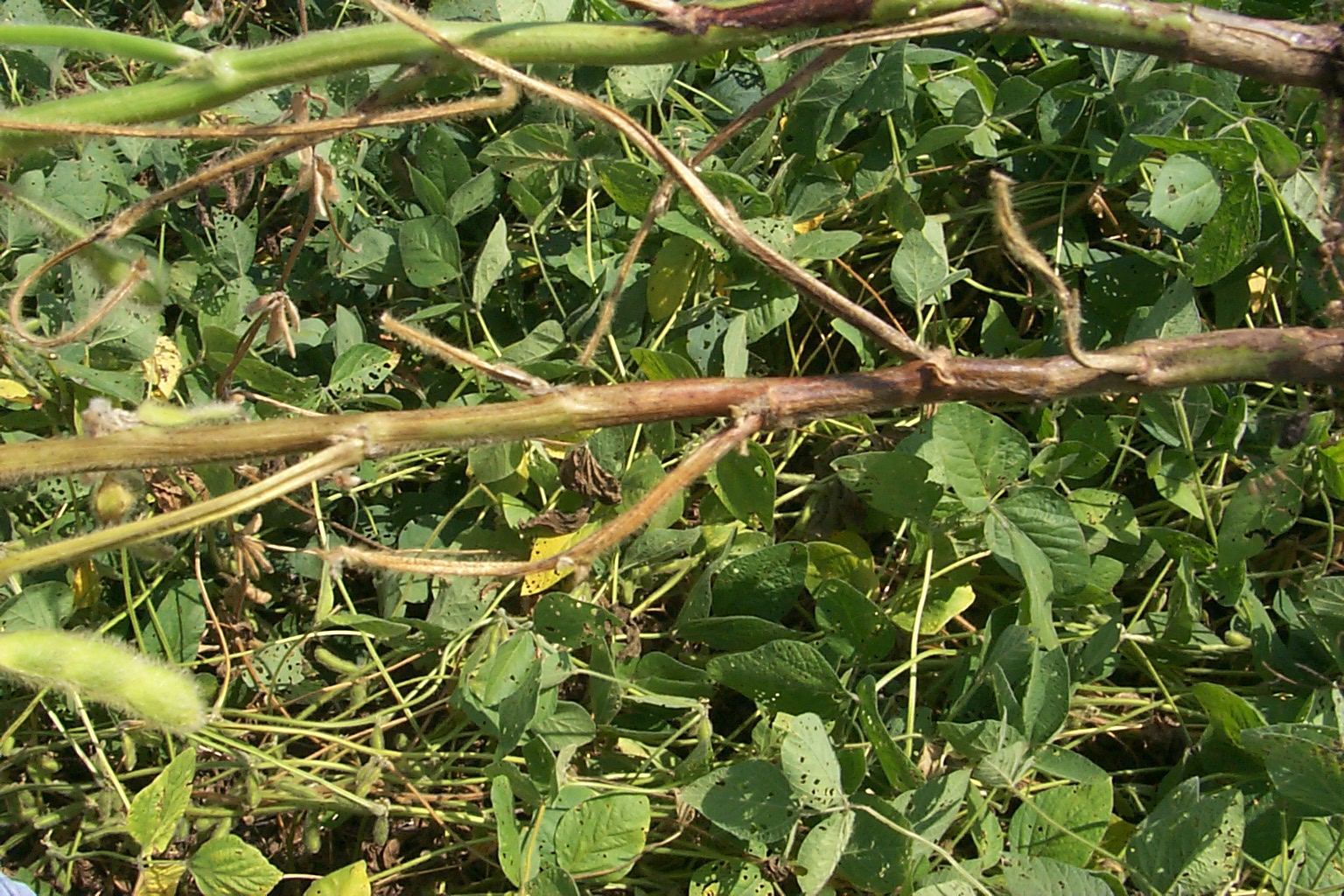
Figure 1 -- Cankers on a soybean stem.
The reddish areas are the cankers. (courtesy of T. E. Chase)
DESCRIPTION OF PATHOGEN LIFE CYCLE
A basic understanding of the life cycle of this pathogen is necessary before discussing its control. The pathogen itself, Diaporthe phaseolorum, has distinct characteristics that are important to consider when discussing control of the disease it causes. Inoculum for D. phaseolorum, an ascomycete, is typically found in the debris left in the field from previous soybeans. The latest research is also trying to uncover possible alternate hosts for this pathogen, but only cotton and a few weed species have been identified as possible hosts for this disease. Their effect on the survival of the pathogen in the soil has yet to be studied extensively. From the debris, the fungus produces perithecia and ascospores. The ascospores formed infect the plant during the early part of its life (1).
The fungus is also known to overwinter as mycelium on the soybean seed itself. This is a less common way for it to be spread, but interestingly, about 20 percent of the seed that is borne from plants infected with D. phaseolorum possess the mycelium of the pathogen. Studies have shown that the disease can be introduced to a new field by infected seed. The imperfect state of this pathogen, a Phomopsis species, has also been discovered, however, its part in the infection process is still unknown (1).
Once the pathogen has infected the plant, either by germination of ascospores on the first leaves of the plant or through mycelium introduced by the seed, the pathogen maintains slow growth and the plant may remain symptomless. This is referred to as a latent period. Later in the season, when the reproductive stages of the soybean are beginning, disease symptoms, cankers around the leaf nodes (Figure 1) and interveinal chlorosis of the leaves, appear (1,7). The pathogen has rarely been found to produce fruiting structures in summer, and therefore, creates no spores during this period. It overwinters as mycelium in the debris, or as stated earlier, on the seed. The perithecia form in spring on the debris, and produce ascospores, which infect young soybeans. Infection arising from the seed can cause the spread of the disease, but how the life cycle works from that perspective is still not clear (1).
Research on the subject of resistance to stem canker began circa 1950, during the Midwest epidemic (6). However, attention did not focus heavily on the disease until the Southern epidemics occurred circa 1975. By the 1980’s, pioneering research into the breeding of resistance to stem canker began with the identification of a resistant cultivar, Tracy-M. Many papers have been written on this particular cultivar, and how resistance works within it.
B.L. Keeling made an important contribution to this research with the introduction of a screening test for resistance to the disease. It was his goal to find a way to get a quantitative measure of the amount of resistance by artificial inoculation of the pathogen in the greenhouse, and using characteristics, such as area of lesions, to determine the extent of resistance in various cultivars. This technique involved growing the pathogen on sterilized flat toothpicks. Flat toothpicks were used over other types because they do less damage to the tissue of the plant. The technique begins by boiling the toothpicks in water for a half-hour, and doing this three different times, each time with different water. These toothpicks are then placed in large vials, where they are immersed in potato dextrose broth and autoclaved. The mycelium of Diaporthe phaseolorum is then inoculated onto the toothpicks and allowed to grow for 15 days at 21 Celsius degrees (4). During the growth of the mycelium, the potato dextrose that was absorbed by the toothpicks in the earlier step will be consumed, providing sufficient nutrition for the pathogen.
After the preparation of the toothpicks, soybean plants that are about ten days old are inoculated in the stem (4). Both inoculation in the epicotyl and the hypocotyl have used in different experiments, each producing good results (2,4). Inoculation is accomplished by first making a hole in the stem with a dissecting needle, and then placing part of the infected toothpick inside the hole (4). The plant then continues to grow and the disease develops, granted the mycelium infected the plant.
These infected plants now need to be scored quantitatively, but many questions have been posed as to the relation of quantitative evaluation in the greenhouse to evaluation in a naturally infected field. In a naturally infected field, there tends to be much variability, which leads to many problems in uniformity if you are conducting a trial of any significant size. It has also been observed that the disease can be present in certain circumstances without the plant showing symptoms. In a greenhouse setting, these variability problems are easier to control by using the same technique to inoculate the plants, and by keeping them under nearly identical conditions (8).
Weaver et al. conducted a trial that was published in 1988 on the relation of field and greenhouse evaluations in similar trials (8). In one field, a high negative correlation between disease rating and yield was discovered.. It was also discovered that when the same varieties were planted in a similar fashion in another location that was virtually unaffected by stem canker, there was a negative correlation between maturity at that location and yield at the heavily infested location using the same varieties. This correlation was fairly weak, but it showed that the plants may be able to gain some horizontal resistance from genes that regulate the length of time required for the plant to mature. This resistance, in theory, allows an earlier maturing plant to evade heavy infestation of the fungus by not giving the pathogen as much time between the breaking of latency and maturing of the plant. Without sufficient time, the pathogen may not be able to take over as many tissues and produce as much inoculum as might be the case in a longer lived plant.
When Weaver (8) used these same varieties in the greenhouse and artificially inoculated them using the technique instituted by Keeling that was mentioned earlier in this report (4), he found that there was a high correlation between the ratings in the field and the ratings in the greenhouse. This indicates that what is seen in the greenhouse is similar to what is seen in the field, when relying on a natural inoculum bank to infect the plants in the field. One exception to this idea was found in this experiment, however. Centennial rated worse in the greenhouse than in the field. While it is considered a relatively resistant cultivar, it rated about 3.4 in the greenhouse on a scale of zero to five, which is a moderate amount of disease. This decrease in resistance may be due to the way that resistance works in this cultivar. Integrity of the stem might be an important aspect of its resistance, and piercing the stem may make it easier for the pathogen to infect the plant. This is something to consider when relying on the toothpick inoculation test to give results in the greenhouse. Screening in the field along with screening in the greenhouse checks the reliability of the results. Another inoculation technique might be better in the greenhouse, one that does not cause as much damage, but as of now, no better method has been established. In most cases, greenhouse results will have a high correlation with the field data if the field conditions are kept as equal as possible.
Tracy-M was one of the
first cultivars found to be resistant to stem canker (6).
This variety has rarely shown symptoms in the field, and is considered
nearly immune to the disease. Kilen et al. (6), described
the offspring of a cross between Tracy-M and J77-339, a susceptible variety
often used as a parent in soybean crossing. The parental, the F1, the F2,
and the F3 generations of this cross were later inoculated with a culture
isolate in the greenhouse, and effects of the pathogen observed. The pattern
of segregation was then related to patterns already commonly known amongst
breeders. In the cases of the parents, all the J77-339 plants died from
the pathogen treatment, while all the Tracy-M plants showed no symptoms.
The F1 plants, like Tracy-M, showed no symptoms, which shows that this
particular form of resistance to stem canker is a dominant trait. The dominant
trait is always the one that is the most apparent in the F1 generation
(Table 1). The F2 generation showed a ratio of 15
resistant plants to 1 susceptible (Table 2), and
the individual F3 lines isolated from the F2 plants showed the ratio of
7 resistant : 8 segregating : 1 susceptible. Segregating refers to the
condition where plants of a single line show different phenotypes. In this
case, the differences are resistance to stem canker; some plants of a particular
line are resistant, while others in the same line are susceptible. This
7:8:1 ratio is typical in a case where two dominant genes control the inheritance
of a trait.
|
XY
|
|
|
xy
|
XxYy
|
Table 1 – Punnett square of F1 progeny of the Tracy-M
x J77-339 cross.
Tracy-M is heterozygous dominant and J77-339 is heterozygous
recessive.
|
XY
|
Xy
|
xY
|
xy
|
|
|
XY
|
XXYY
|
XXYy
|
XxYY
|
XxYy
|
|
Xy
|
XXYy
|
XXyy
|
XxYy
|
Xxyy
|
|
xY
|
XxYY
|
XxYy
|
xxYY
|
xxYy
|
|
xy
|
XxYy
|
Xxyy
|
xxYy
|
xxyy
|
Table 2 – Punnett square of the F2 progeny of the Tracy-M
x J77-39 cross.
In this case, two dominant genes influence resistance.
In 1993, Bowers et al. (2) reported on the genetics of the resistance found in cultivars Crockett and Dowling, and how they related to the resistance found in Tracy-M. In this experiment, Dowling, Crockett, Tracy-M, Coker 338, and Johnston were crossed to one another, and the progeny examined for resistance to stem canker using the toothpick inoculation method in a greenhouse. Coker 338 and Johnston are known to be susceptible varieties.
When Dowling was crossed with
Johnston, the F2 plants segregated in a 3 resistant to 1 susceptible ratio
(Table 3), with the F3 lines segregating to a 1:2:1
ratio. This distribution is common where the resistance resides in a single,
dominant gene. The same results occurred when Dowling and Coker 338 were
crossed, which affirms that this resistance gene resides in Dowling.
Similar results occurred when Crockett was crossed with either Johnston
or Coker 338, which indicates that Crockett’s resistance also resides in
a single, dominant gene. The Tracy-M crosses with Johnston and Coker 338
showed the characteristic 15:1 F2 ratio (Table 2)
and the 7:8:1 F3 line ratio. When Crockett and Dowling were each crossed
with Tracy-M, a 63 resistant :1 susceptible plant ratio was observed, which
is typical of a resistance involving three independent, dominant genes.
When Crockett and Dowling were crossed, their progeny showed evidence for
the two dominant gene model. The resistance genes for Tracy-M were called
Rdc1 and Rdc2, the gene in Crockett was named Rdc3, and the gene in Dowling,
Rdc4 (2). Considering these results, it appears that there
are four resistance genes here, each different from each other. One exists
in Crockett, one in Dowling, and two in Tracy-M. Each of these genes is
dominant and independent.
|
Z
|
z
|
|
|
Z
|
ZZ
|
Zz
|
|
z
|
Zz
|
zz
|
Table 3 – Punnett square for the F2 generation of Dowling
x Johnston cross.
Dowling contributed a single, dominant gene for resistance.
In 1995, Tyler (7) published findings on two more varieties of soybean that had resistance to stem canker. These varieties, PI 230976 and PI 398469, each possessed yet unknown resistance to stem canker. In his study, he crossed these varieties with Dowling, Crockett, and J77-339, the susceptible variety used by Kilen (6) in the study involving Tracy-M. He also crossed them with D85-10404 and D85-10412, which carried genes Rdc1 and Rdc2, respectively. Again, the toothpick inoculation technique was used to determine which plants are resistant, based on whether or not the symptoms appear. Both PI 230976 and PI 398469 showed a 3:1 ratio in the F2 generation when they were crossed with the susceptible variety J77-339. The F3 lines also showed the characteristic 1:2:1 ratio, which suggests that each of these two varieties possesses a single dominant gene for resistance. These genes were found to be different than the ones already named through crosses with the established resistant varieites. Knowing how these genes relate to each other can be helpful, especially when we consider virulence in pathogen strains.
Keeling, in his research published in 1984 (5), distinguished between the virulence of several isolates of Diaporthe phaseolorum. Isolates from fields in Mississippi, Tennessee, and Ohio were used in this experiment, for a total of twelve isolates. Several different varieties were inoculated with the twelve isolates, including J77-339 and Tracy-M, and lesion size was recorded. Using this data, differences in virulence of the isolates to each of the soybean varieties was discovered.
Using interactions with the soybean
variety Bragg to observe differences in virulence between these isolates,
a large amount of variability was observed. This is shown in Table 4.
Isolate |
Length of lesion (cm) |
| 81-6 | 61.9 |
| 81-75 | 54.9 |
| 81-102 | 45.2 |
| 81-73 | 40.1 |
| D-209 | 35 |
| 81-77 | 27 |
| D0048MI | 1 |
| Control | 0.5 |
Table 4 – Lesion length caused by several isolates of
D.
phaseolorum on Bragg soybeans.
D0048MI is the isolate from Ohio. (5)
This variability is affected by factors outside of the pathogen itself, including the environment and the resistance of the host, but, nonetheless, it provides compelling evidence of the differences between strains. These differences are a concern when using resistance from a single source against many different isolates of this pathogen. Another example of the variability in virulence is demonstrated in the case of J77-339 in this experiment. The isolate from Ohio did not affect this variety of soybean, while other soybean varieties were affected by it (5). Considering that J77-339 is regarded as highly susceptible (6,7), this is somewhat surprising. This indicates that the different strains cause very different reactions in soybean varieties, some strains causing heavy infection while others cause little or no noticeable infection (5). This is of concern when considering the resistant varieties currently in use. If a strain develops that can thrive in some of the most resistant varieties, an epidemic may appear. For this reason, it is important to have more than one source of resistance.
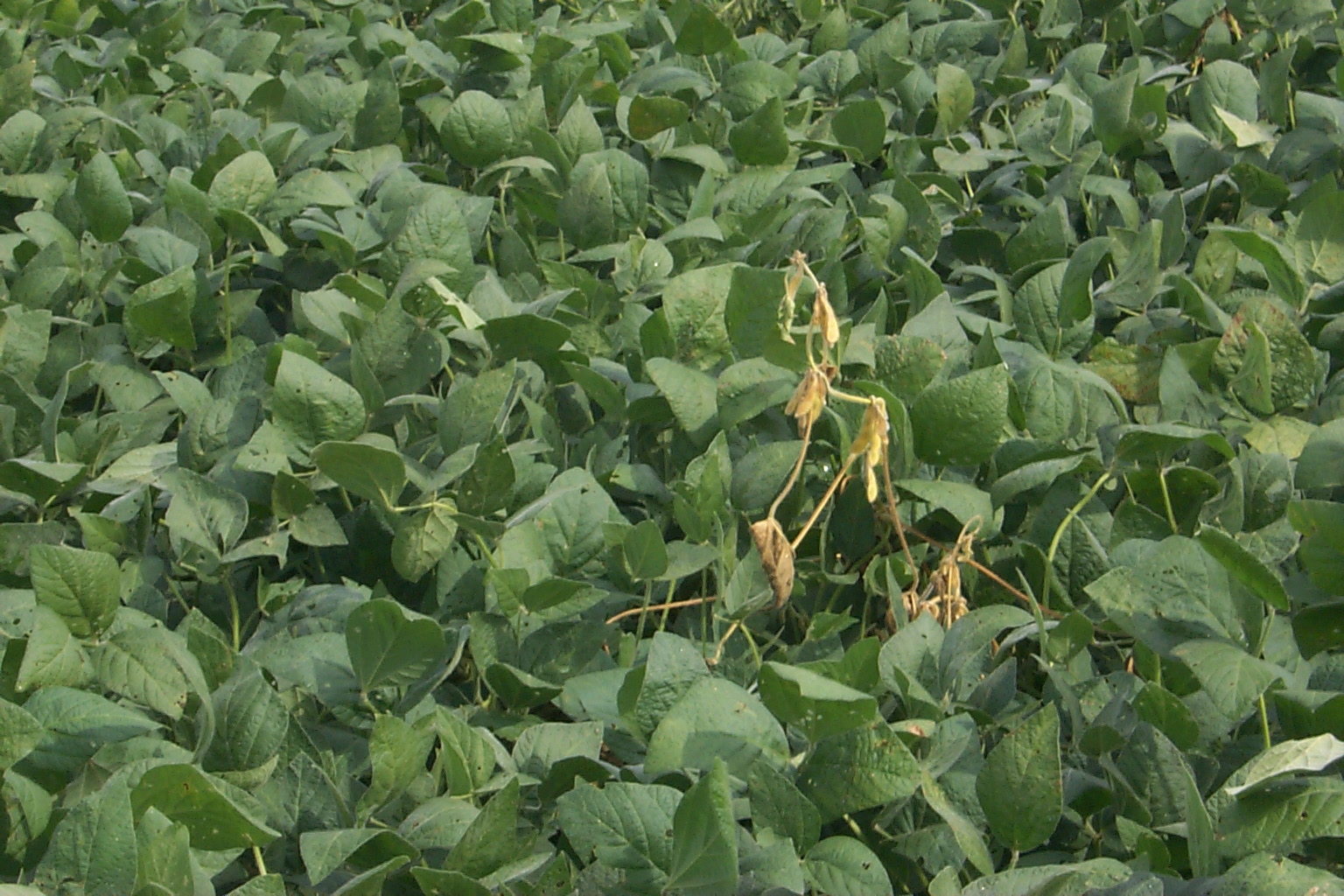
Figure 2 - A South
Dakota field infected with stem canker.
Note the plant in
the center is already severely infected. (courtesy of T.E. Chase)
It has recently been discovered that stem canker is beginning to be a problem again in South Dakota. Cases of the disease have appeared throughout the eastern part of the state in the last few years, at locations from Lincoln County to Milbank. At each of these locations, only one or a few fields were affected; and in the affected fields, the disease was severe. The strains involved are probably northern strains (f. sp. caulivora), which are not well understood (3). The sources cited in this report used southern strains in their experiments, because they were the most problematic until recently. Little research has been done on northern strains.
The virulence of the strain or strains affecting soybeans here today may be quite different than the strains found in the Midwest in the past. They might also be very different than the strains studied in the South (f. sp. meridionalis), which makes it questionable whether or not the vertical resistance from southern varieties would be effective against the South Dakota strains. Even if these genes are effective, it would take time to place them into northern soybean varieties. An alternative to this method is to screen for resistance in northern varieties already in use, but this will also take time. Another point to consider is the fact that inoculum can be produced from plants that showed no symptoms but were still infected. If this is the case in South Dakota, soybeans with good vertical resistance may be allowing the formation of inoculum, which could cause severe disease if a highly susceptible soybean variety were planted later in that field. This problem is compounded by the fact that soybeans are grown widely in South Dakota, and, in some cases, are not rotated with other crops. It is still uncertain if weeds can be hosts to Diaporthe phaseolorum f. sp. caulivora, and, if they could, how much of an effect they would have on the prescence of inoculum. The summation of these factors allows enough potential for an epidemic.
If the southern techniques of finding and implementing resistance are used as a guidline for implementing resistance in northern soybean varieties, an epidemic situation might be avoided. This requires vigilance and quick action on the part of plant pathologists and breeders in this region.
1. Backman, P. A.; Weaver, D. B.; and Morgan-Jones, G. 1985. "Soybean Stem Canker, An Emerging Problem." Plant Disease. 69:641-647.
2. Bowers, G.R. Jr; Ngeleka, K.; and Smith, O. D. 1993. "Inheritance of Stem Canker Resistance in Soybean Cultivars Crockett and Dowling." Crop Science. 33:67-70.
3. Chase, T.E., personal communication. 4/18/2001.
4. Keeling, B.L. 1982. "A Seedling Test for Resistance to Soybean Stem Canker Caused by Diaporthe phaseolorum var. caulivora." Phytopathology. 72:807-809.
5. Keeling, B. L. 1985. "Soybean Cultivar Reactions to Soybean Stem Canker Caused by Diaporthe phaseolorum var. caulivora and Pathogenic Variation Among Isolates." Plant Disease. 69:132-133.
6. Kilen, T.C.; Keeling, B.L.; and Hartwig, E. E. 1985. "Inheritance of Reaction to Stem Canker in Soybean." Crop Science. 25:50-51.
7. Tyler, J.M. 1995. "Additional Sources of Stem Canker Resistance in Soybean Plant Introductions." Crop Science. 35:376-377.
8. Weaver,
D.B.; Sedhom, S.A.; Smith, E.F.; and Backman, P. A. 1988. "Field and Greenhouse
Evaluations of Stem Canker Resistance in Soybean." Crop Science. 28:626-630.
Brent Hulke