|
||||||||||
 |
 |
|||||||||
 |
 |
 |
 |
 |
 |
 |
 |
|||
|
||||||||||
|
|
|||||||||
|
|
|
|
|
|
|
|
|||

 |
|
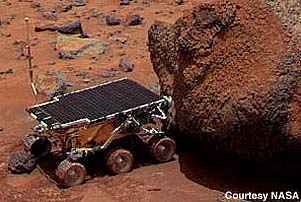 |
Mars Rover |
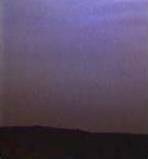
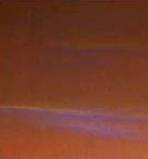
Spectacular colors at Mars Sunrise!

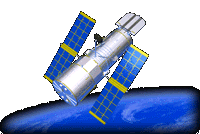
Hubble Space Telescope
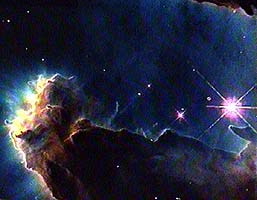 |
An example to demonstrate the scale of the solar birthplace: Earth and its solar system would fit on the end of one of the tiny fingertips in the Hubble pictures. The columns of cold hydrogen gas and dust are extremely dense. They're beginning to evaporate under the intense heat from nearby stars. |
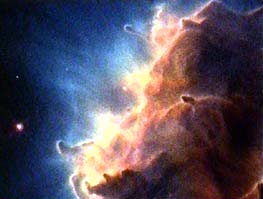 |
Astronomers say they can see evaporating gaseous globules, or EGGs,
inside the pillars. It's a convenient name, since the new
stars emerge from the "eggs." The light which allowed the Hubble telescope
to take the picture came from a series of stars, which were screened out to allow the telescope to photograph the cosmic landscape. |
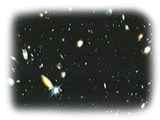 |
The Hubble "Deep Field" view provides the deepest look ever into the universe, according to the Space Telescope Science Institute. Director Robert Williams said the images are a "treasure trove" because they depict perhaps the oldest galaxies captured on film. They are the "astronomical equivalent of the Dead Sea Scrolls," he said. |
 |
Hubble
Captures Volcanic Eruption Plume From Io (Jovian Moon)
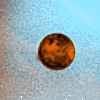
June 19, 1997 Photo No.: STScI-PRC97-21 The Hubble Space Telescope has snapped a picture of a 400-km-high (250-mile-high) plume of gas and dust from a volcanic eruption on Io, Jupiter's large innermost moon. |
 |
Fireworks
in a Black Hole Near the Core of
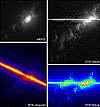
the Seyfert Galaxy NGC 4151 The Space Telescope Imaging Spectrograph (STIS) simultaneously records, in unprecedented detail, the velocities of hundreds of gas knots streaming at hundreds of thousands of miles per hour from the nucleus of NGC 4151, thought to house a supermassive black hole. this is the first time the velocity structure in the heart of this object, or similar objects, has been mapped so vividly this close to its central black hole. |