http://denis.marochkin.ru
|
|
|
|
“Между братьями бывают такие случаи”
Азербайджан и Иран не поделили нефть В азербайджанском секторе Каспия произошел инцидент, который обострил отношения между Баку и Тегераном. ЧП на Каспии и последовавшие за ним демарши сторон могут стать прелюдией к дипломатической войне между соседями. Во вторник в течение двух часов самолет ВВС Ирана совершал полеты над азербайджанским исследовательским судном "Геофизик-3", работающим в море в районе нефтяной структуры Алов, в 150 км юго-восточнее Баку. В воздух были подняты азербайджанские истребители МиГ-27, которые заставили иранских летчиков вернуться домой. Однако вскоре к "Геофизику-3" подошел корабль ВМС Ирана, который потребовал от судна отойти на 5 миль к северу. Капитан "Геофизика-3" подчиниться отказался. Недоумение в связи с происходящим выразил и находившийся на корабле представитель британского нефтяного концерна ВР. Однако иранцы настаивали на своем. Только связавшись с берегом и получив приказ вернуться в Баку, капитан повернул к берегу. По сообщениям азербайджанских агентств, приказ об этом отдал лично президент страны Гейдар Алиев (Geidar Aliyev). В полночь в Баку в кабинет министров был вызван посол Ирана в Азербайджане Ахад Газаи (Akhad Gazai). Полуторачасовая беседа с господином Газаи, в которой принимали участие премьер-министр Артур Расизаде (Artur Rasizade), глава МИДа Вилаят Гулиев (Vilayat Guliyev) и президент Государственного нефтяного концерна Натик Алиев (Natik Aliyev), шла на повышенных тонах. Послу вручили ноту протеста. Позднее в присутствии журналистов премьер заявил, что "иранская сторона слишком много на себя берет". В свою очередь, командующий погранвойсками Азербайджана Эльчин Гулиев (EIchyn Guliev) отметил, что не отдал приказа сбить иранский самолет только потому, что хотел избежать международного скандала. Комментируя происшедшее в беседе с журналистами, Ахад Газаи выразил сожаление по поводу инцидента. Он также напомнил предыдущие заявления Ирана о недопустимости ведения нефтяных разработок на спорной территории. В целом господин Газаи не был склонен драматизировать ситуацию, указав, что "между братьями бывают такие случаи". Тем не менее ВР уже заявила, что приостанавливает работу "на всех спорных месторождениях, в том числе и в Алове". Вчера оппозиционная Партия народного фронта Азербайджана (ПНФ) потребовала от правительства разорвать дипотношения с Ираном. А члены молодежного крыла ПНФ провели перед зданием посольства Ирана в Азербайджане акцию протеста. Бывший министр иностранных дел Азербайджана Тофик Зульфугаров (Tofik Zulfugarov) в беседе с корреспондентом „Ъ" заявил, что такая ситуация создает проблемы для всех четырех прикаспийских государств. "Иран силовыми акциями хочет отойти от границы Астара-Гасангули, которая была установлена между Ираном и СССР в 1940 году". Вчера же временный поверенный в делах Азербайджана в Иране был вызван в МИД Ирана, где ему было передано "резкое возражение" в связи с намерениями Азербайджана начать добычу нефти в регионе Алов. Замминистра иностранных дел Ирана Али Ахани (AN Akhani) высказал азербайджанскому дипломату твердое намерение Ирана не допустить какой-либо деятельности иностранных компаний, противоречащей иранским интересам. По мнению Али Ахани, любые контракты, подписанные иностранными компаниями для работы в этом регионе без согласия иранской стороны, не имеют силы. "Иран намерен защищать свои интересы любыми средствами",- подчеркнул иранский дипломат.
Oil's latest boomtown is rising in Kazakstan 27.07.2001
Look out, Houston, oil's latest boomtown is rising in Kazakstan Atyrau, a decaying outpost on the Ural river, gets a western-style makeover Wielding a retractable pointer, Samarbek Bukebayev, chief architect of the oil industry's latest city of dreams, stands in front of a scale model of his vision. Downtown, bulldozers will raze 1,777 decrepit buildings, preserving just 23 of them "as historical monuments," says the 48-year-old Mr. Bukebayev, waving the pointer across his grand design. Those structures will be replaced by a new 25-acre complex of 16-story office and apartment buildings, a 1,000-room luxury hotel, a supermarket and a bigger city hall. "We've already done more here in 18 months than anyone else in the previous 80 years," adds Mr. Bukebayev, who works for the Kazak government. For him, the project is an architect's fantasy: "to be able to see a whole city go up, from start to finish." Houston may need to move over and make room for Atyrau. Thanks to some of the richest oil finds in decades, this grimy sturgeon-fishing stronghold just upstream from the Caspian Sea is the world's newest oil boomtown. Already, oil giants such as Chevron Corp. of the U.S. and ENI SpA of Italy have put down roots here and begun to transform the place. Two years ago, foreign and local companies financed a much-needed municipal facelift. Workers filled about 60 rail cars with garbage, hauling away years' worth of household refuse and rusted hulks of cars and boats that lined the city's streets and riverbanks. Others paved roads, painted miles of apartment blocks in pastels and browns and built new parks. Before long, developers were building dozens of large homes, along with modern multistory office buildings, in the city's first private construction boom ever. Even so, the streets of Atyrau turn into rivers of mud in a good rain. Dust fills the air in the stifling summer heat. Busts of Lenin and Stalin still stand in one park. And the city remains among the poorest places in Kazakstan, where an estimated half the population of 14.9 million lives on $30 or less a month. For years, Atyrau, a Ural River port city of 160,000, was a minor oil center known as Guryev, after Mikhail Guryev, the Russian trader who founded it in 1645. In 1993, Chevron put the city on the global petroleum map by acquiring a 50% interest in the nearby Tengiz oil field. Then came an even more momentous oil discovery, an offshore field called Kashagan. Situated southwest of the city, a few miles off the Caspian coast, Kashagan appears to contain a continuous expanse of oil at least 25 miles long. That's an immense deposit in a business where a one-mile expanse is considered impressive. If survey results prove correct, Kashagan would be the biggest oil discovery in 30 years, industry officials say. Atyrau also is the staging point for two major pipelines. The first crude oil from one is scheduled to be loaded onto a ship at the Black Sea port of Novorossisk, Russia, next month. The second pipeline, still on the drawing board, may run east to Turkey or south to Iran. What it still lacks in amenities, Atyrau makes up for in promise. "It's the Wild West here -- in a nice way," says Steve Bannister, a 51-year-old manager for medical-services company International SOS who has lived here on and off since 1994. "It's a land of opportunity." The dreams the new Atyrau has inspired aren't confined to the oil companies. Poaching catfish in his backyard on the Ural, Yevgeny Karamashin fantasizes about the day he sells his home. He even has a price in mind: $35,000. With that sum, he and the dozen relatives he lives with could afford another place, one with an indoor toilet and one that, unlike many older homes here, isn't sinking into the clayish earth. City officials "promised 10 years ago to move us from here. Now, maybe it will really happen," says the 27-year-old Mr. Karamashin, whose ramshackle home is one of several along a rutted dirt track called Petrovsky Street. "The old people don't want to leave. But the youth, of course, do." Just two years ago, much of Atyrau looked like Petrovsky Street. Now, upriver from Mr. Karamashin, workers have nearly finished two red-brick mansions for government officials. Downriver, a Turkish construction company is putting the final touches on the "American village," a luxury complex for Chevron executives and their families. It consists of 86 four-bedroom townhouses, two swimming pools, tennis courts, a clubhouse and a school -- all enclosed by a tall fence. Surrounded by concrete-and-brick tenements plagued with water shortages, the $50 million complex promises to be an island of American suburbia. In summer, Chevron families will splash in pools fed by a self-contained water-purification system, within earshot of Atyrau's parched streets. The developers "sliced off the very best neighborhood of the city. Where there are the very best conditions, they built their homes, and they aren't going to allow anyone in," says Sagat Satkanov, a local construction engineer. "I think people will always complain," says Maria Karazhigitova, a spokeswoman for the Chevron-led consortium, "but we think [the village] is a good idea. Someone has to start things out. It's always difficult for pioneers. We do a lot for the community." The gap between Petrovsky Street and its rich neighbors underscores the biggest challenge for Kazak leaders as the nation begins cashing in on its oil riches. Since the Soviet collapse, Kazakstan has lavished about $2 billion on a new capital, Astana. And by 2005, the country plans to spend $500 million more to rebuild Atyrau. Western companies also are pouring money into the area. Chevron has spent about $60 million since 1993 on public projects like new hospitals and bridge refurbishment. Yet relatively little has been spent in the rest of the vast republic, which is just as desperately in need of roads, schools and clinics. That worries some U.S. officials and businesspeople, who fret that the widening disparity could lead to instability. So far, says American business consultant John Mann, "there's not a lot of trickle down." Many locals are more upbeat. Aigul Solovyova, a chemist, arrived here four years ago from eastern Kazakstan to buy a rundown milk-processing plant for about $140,000. She had a simple idea: "I thought that these oil-company men would have to drink milk." But her customers complained of a not-so-simple problem. The milk smelled and tasted awful. So, Ms. Solovyova revamped her factory and found better milking cows -- no small feat in a region where camels predominate. She visited dairy farms in Minnesota and Wisconsin, and brought in U.S. consultants. This month, Chevron placed an initial order for about a half ton of her milk products. "I never had a cow in my life," Ms. Solovyova says, "Can you imagine that now I'm working with milk?"
26.07.2001
Talk of Kashagan makes it sound more like a powerful wind of change than an oil field in the remote northern shallows of the Caspian Sea. Kashagan, named after a poet from this town in northeast Kazakhstan, seems more and more likely to go down in history as a field that freed Russia's largest former colony from Moscow's orbit, rejuvenated this dusty town on the Ural River and showcased Western know-how. It also could turn out to be one of the most spectacularly overhyped fizzles in the history of an industry not known for its restraint. Or, a huge find could be followed by an oil spill that could deliver a fatal blow to the already polluted Caspian Sea, the world's largest closed body of water. The oil reservoir, which begins 45 miles south of Atyrau, is a massive, salt-capped slab of limestone nearly a mile thick lying three miles deep and stretching for 50 miles. The work so far shows a 350 million-year-old coral atoll holding an estimated 10 billion to 30 billion barrels of recoverable oil. At 20 billion barrels, it would be the world's fifth-largest oil field. If further drilling confirms the early analysis, it is thought capable of yielding close to 2 million barrels per day. Added to a string of much smaller onshore fields expected to yield another 2 million barrels a day, Kashagan would be enough to propel Kazakhstan, a sparsely populated country of steppes and mountains four times the size of Texas, into the top ranks of oil exporters. That income is enough to rescue its 15 million people from a life of post-industrial misery bequeathed by the failed Soviet economy. "They could easily be exporting 3 million barrels a day in 15 years, maybe 10," said Robert Ebel, director of energy and national security at the Center for Strategic and International Studies in Washington, D.C. Not much is known about Kashagan. The Soviets spotted it in the 1970s, but they were stymied by the technical difficulties. The reserves were too deep, under too much pressure, contained too much gas and the shallow waters are frozen for long stretches each year. At the time they had plenty of easier prospects to develop in western Siberia and Azerbaijan. According to Kazakh oil executives, the Soviets also feared that the resulting pollution would have threatened the world's last major population of sturgeon, the source of caviar. In addition to being the quintessential Russian delicacy, they were a significant foreign exchange factor. Door opens to development The Soviet Union's breakup opened the door for the development of Kashagan. In 1993, newly independent Kazakhstan, seeking to improve its limited revenues, entered into a partnership with a consortium of international oil companies to explore the waters of the Kazakhstani sector of the sea. The partnership, the Offshore Kazakhstan International Operating Co., commonly known as the OKIOC (pronounced oak-E-ock), offered an opening for companies that had long wanted a chance to explore in the former Soviet Union. OKIOC is made up of Exxon Mobil Corp., Royal Dutch/Shell Group, TotalFinaElf, BP and Agip Caspian Sea, a unit of ENI Spa. In 1997, the partnership did a seismic study that revealed the structure in sharper detail. Last July, Kashagan's first oil exploratory well yielded high-quality light crude. On March 15, Agip Caspian Sea SpA, the operator of the field, announced its second well had found oil at 15,950 feet, just 650 feet higher than the previous find 25 miles away. It estimated it would be able to pump at least 10 billion barrels from Kashagan. This confirmed initial beliefs that Kashagan is similar in structure, and presumably in yield, to the richly endowed Tengiz field, onshore about 80 miles southeast of Kashagan. Tengiz is the world's sixth-largest field and production. According to the IHS Energy Group, a Colorado-based consulting firm, the discovery of Kashagan, along with a series of finds offshore Angola, helped make 2000 the year with the greatest oil discoveries in a decade. Still, an executive involved with the Kashagan drilling said there was a 1 percent chance that Kashagan would yield negligible amounts of recoverable oil. To be sure, they began drilling a third well on May 22. That's the first of five wells planned over the next two years along with a detailed seismic survey beginning this summer. Partners seek dominance As the data were coming in last year, a struggle emerged for the honor of becoming the field's operator. "It's a once-in-a-lifetime opportunity," said Ebel, the Washington oil analyst. Operatorship brings no profits, but huge amounts of prestige, along with headaches. OKIOC has an unusually large membership: five members with one-seventh stake each and four with smaller shares. Of the big five, four campaigned for operatorship: Exxon Mobil, Shell, TotalFinaElf and Agip. According to sources involved in the difficult negotiations last spring, Exxon Mobil never stood a chance. "We were a majority of European companies," said one European executive, "and we decided long ago we wanted a European operator. Besides, they would have spent too much money." Because the oil is already going to be expensive to get out of the ground and get to market, "it was a factor," he said. Exxon Mobil officials declined to comment. Julian Lee, analyst at the Center for Global Energy Studies in London, said Exxon Mobil's average cost per barrel is "toward the upper range of the majors." Of the eight biggest oil companies ranked for finding costs over the past three years in the Chronicle 100, Exxon ranked in the middle of the pack. Shell, too, drew little support: It had provided 80 percent of the expatriate staff in the first two years of the project and had been criticized for delays and cost overruns. TotalFinaElf forged ahead by negotiating the purchase of BP's 9.52 percent share of OKIOC and Statoil's 4.76 percent for amounts that have not been disclosed. Unconfirmed estimates put the price of BP's sale at $400 million and Statoil's at $225 million. If these estimates are borne out, the two companies, which have spent roughly $100 and $50 million respectively over the past seven years, will have made a tidy profit. The two purchases would allow the French company to rise above the crowd and increase its stake to 28.57 percent -- but most of the other partners have suggested they plan to cut Total's share by using their pre-emption rights to buy slices of the BP and Statoil offerings. Meanwhile, as the vote for an operator neared last February, Agip campaigned with arguments that despite its relatively small size, it had gained valuable local experience as operator of two other projects in the region. Agip chosen In the end, Shell sided with the Italians rather than the French for reasons that remain unclear. On Feb. 9, in a meeting at an airport hotel near London, Agip was elected. Exxon Mobil later put out a short statement saying: "We are disappointed we were not selected. We believe we were best qualified to serve as operator." The text didn't mention the winner. Several oil executives involved speculated that Agip ultimately may be supplanted by a partner that buys out enough partners to gain control. The seller would be a descendant of the utility British Gas named BG International whose 14.29 percent stake could clinch the operatorship. "If somebody came to us and made us a good offer on Kashagan," BG Chief Executive Frank Chapman told Reuters recently, he would consider it. The company has significant stakes elsewhere in the region and may sell to cut its risks. Another possibility would be that one of the big four buys BG in its entirety, which would give the winner its entire stake. In the meantime, Agip faces a field with a combination of challenges found nowhere else. They include water so shallow -- on average 12 feet -- that storm surges in summer can make a difference of several feet. Winter temperatures are so harsh that the area is frozen five months a year. Environmental constraints are severe because the whole field is in a nature preserve that is a major breeding ground for fish. This deep oil formation is under high pressure and contains a large proportion of hydrogen sulfide. This chemical, known sour gas, it is lethal even in small amounts and requires special processing. Processing the poisonous gas normally generates high amounts of sulfur, which is also a problem because the current value of sulfur, which is used to make fertilizer, is too low to cover shipping expenses from this remote region. "We plan to reinject the gas into the field, but it's never been done at such pressures," said a senior executive involved in the drilling who asked to remain anonymous. The first two wells, both exploration holes, were drilled on opposite ends of the field with the Sunkar rig. Four of the appraisal wells are to use the rig as well, but for the fifth, as an experiment, OKIOC is planning on building a fully emerged -- not submerged -- island that will not require the rig. Drilling in shallow water poses daunting problems, OKIOC executives said. To solve them, the consortium acquired a rig built for the swamps of Nigeria and towed it to Astrakhan, at the head of the Volga delta. There, it was renamed Sunkar, falcon in Kazakh, and expanded for $100 million to a hefty 270 feet by 165 feet and weighing 6,000 tons, making it the biggest rig of its type. Sunkar was towed to a berm, or artificial submerged island of limestone that rises 3 feet above the bottom of the sea. Then its ballast tanks were filled and it settled onto the berm. Sunkar's special equipment includes two 10-foot-high steel tanks to deflect the drifting ice. The berm is surrounded by 24 70-ton piles designed to break up the ice before it reaches the deflector tanks. In winter, supplies are brought by Finnish icebreakers designed for shallow water. If the ice is too thick, instead of riding on it in order to break it as most icebreakers do, they back into it and break up the ice with special propellers.
26.07.2001
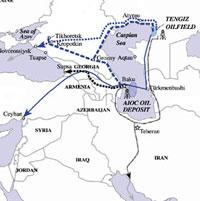
The United States and Russia have been jockeying in recent months over a variety of strategic issues, among them Caspian Basin energy export routes. EurasiaNet spoke to A. Elizabeth Jones about recent energy-related developments in the Caspian Basin. Jones was sworn in as Assistant Secretary of State for European Affairs on May 31, 2001. Prior to her appointment as assistant secretary, she had served as US ambassador to Kazakhstan from 1995-98 and as Senior Advisor for Caspian Basin Energy Diplomacy. Jones spoke to EurasiaNet shortly before her latest appointment. The transcript of her comments follows: EurasiaNet: How would you characterize the continuities and changes in US foreign policy concerning Caspian energy, between the Clinton Administration and the Bush Administration? Jones: The policy itself has not changed, because the strategic principles underlying U.S. energy policy in the Caspian region have not changed. EurasiaNet: Would you enumerate those principles? Jones: There are four of them. First, we support the sovereignty and independence of the states in the region. Second, we seek to promote the economic cooperation and interdependence of the states in the region, as well as with Turkey and Europe. Third, the Caspian region is of interest to the U.S. as a reliable alternative source of energy. Fourth, we seek to promote U.S. investment in the region. We undertake many measures to implement all these goals, and energy policy is one of those measures. We are focused not only on pipelines but also on other aspects of the development of energy transportation: not planning and engineering questions as they relate to pipelines, but for example we have paid attention to the inclusion of volumes from Kazakhstan into the Caspian energy transportation system. EurasiaNet: You are referring to the Memorandum of Understanding signed earlier this year for Kashagan oil to enter the Baku-Ceyhan pipeline? Jones: Yes. There is work underway to develop an intergovernmental agreement between Kazakhstan and Azerbaijan to cover the principles that would apply to shipping oil and, eventually, gas across the Caspian. It is necessary to specify how the intergovernmental connections work, what the tax rules would be, and so forth. The goal is to get away from the tendency to want to have a monopoly role in each of those sectors and move towards market. Also the Kazakhstan government and the energy producers in Kazakhstan need to work out the business arrangements that would govern shipments of oil from Aktau into the Baku-Ceyhan line. For example, they would need to ensure the transparency of pipeline rules and of the regulations for calculating costs, as well as decide what the supporting costs would be and provide for barging arrangements. EurasiaNet: There is a widespread impression that this is an American attempt to compete with Russia for oil volumes in a zero-sum game. Jones: I'm glad you brought that up. In fact, the U.S. Government has been consistently working to support the Caspian Pipeline Consortium (CPC). EurasiaNet: That's the one with the pipeline from the Tengiz in western Kazakhstan, across southern Russia to the Russian port of Novorossiisk on the Black Sea? Jones: Right. The rumors and reports that the U.S. has opposed to the CPC project because it goes through Russia are simply false. I was the U.S. Ambassador to Kazakhstan from October 1995 to October 1998, when the original structure of the consortium fell apart. The U.S. did a considerable amount of work during those years to convince people that the CPC pipeline could in fact be built, and to assist in the restructuring of the consortium so that it could find financing. EurasiaNet: The European Union has been trying to promote a stable business environment in the Caspian region, and with specific reference to the energy sector, through such programs as TRACECA and INOGATE. Is there any U.S.-EU cooperation on these matters? Jones: I visited the EU in Brussels last November along with other U.S. diplomats, and we all agreed, on both sides, that there was a tremendous need for each of us to understand what the other was doing. Mainly we were, first of all, trying to make certain that we didn't overlap in the wrong ways, as we were attempting then to coordinate policy on Ukraine. Later, in January of this year, we worked out a common response to the Russian cut-off of gas supplies to Georgia. Since then, there have been discussions in Brussels between the EU and the U.S. to stay in touch and make sure we are working along complementary lines. EurasiaNet: But have there been attempts for a more systematic or strategic long-term coordination? Jones: We had a set of bilateral U.S.-EU discussions set for Washington in April, but they were postponed to July. The agenda is absolutely huge. The intention is to formalize more clearly and carefully all energy work we have because there is so much of it now. It is interesting that the EU interest in coordination came after Putin's visit to Paris last November. They seem to feel, at least in the European Commission, that it would be prudent to diversify Europe's source of gas. So now they are interested in Azerbaijan's gas from the Shah-Deniz deposit reaching Europe via a pipeline through Turkey and Greece.
По мере утраты инвесторами интереса к шельфу Азербайджана и Туркменистана внимание как российских, так и западных компаний переключается на Северный Каспий. Западные компании, объединившиеся в международный консорциум OKIOC для освоения казахского сектора Каспийского моря, ускоряют темпы развития своего проекта. К этому их подталкивают опасения, что российские конкуренты, также работающие в северной части моря, быстрее начнут добычу и помешают новым объемам казахской нефти найти свои рынки сбыта. Исход из Азербайджана В понедельник Иван Глумов, заместитель министра природных ресурсов РФ, заявил, что проведенные за последние три года геологические изыскания нефтегазовых запасов каспийского шельфа подтверждают исключительную перспективность российско-казахстанского сектора Каспия. Минприроды РФ оценивает ресурсную базу этого сектора в 8-10 млрд тонн углеводородов. До последнего времени, сказал Глумов корреспонденту ИТАР-ТАСС, основным нефтегазодобывающим районом Каспия считался Южно-Каспийский нефтегазоносный бассейн, связанный с продуктивными пластами Азербайджана и Туркменистана. Именно на этом строился экономический расчет при проектировании нефтепровода Баку-Джейхан. Что касается северной и центральной части Каспия, исследования там практически не велись. Однако в последнее время российские и казахстанские геологи выявили в этом районе свыше 15 структур, перспективных на нефть и газ, открыли три нефтегазовых месторождения. Ожидается, что до конца 2002 года в Северном Каспии будут открыты еще не менее 3-х крупных месторождений. Эти ресурсы позволят уже в ближайшие годы загрузить до проектной мощности /66 млн тонн нефти в год/ нефтепровод Каспийского трубопроводного консорциума /КТК/ Тенгиз-Новороссийск. В то же время участники азербайджанских проектов один за другим заявляют о прекращении работ в Южном Каспии, убедившись в бесперспективности этого региона (см. - "Бурите, Шура, бурите! Баку тщетно увещевает иностранных операторов продолжать разведку на азербайджанском шельфе"). Некоторые компании, потерявшие деньги в азербайджанских проектах, перемещают фокус на российский сектор шельфа. Так, ЛУКОЙЛ недавно заявил о форсировании работ на блоке Северный в российской части Каспия, где добыча нефти должна начаться уже в 2004 году. 12 июля Госдума включила в перечень СРП еще два северокаспийских блока, принадлежащих ЛУКОЙЛу - Яламо-Самурский и Центральный. Они должны дать нефть в 2007 году. Ударными темпами Участники OKIOC также не сидят сложа руки. Представители итальянской ENI, являющейся оператором OKIOC, сообщили на днях, что проект освоения месторождения Кашаган развивается ускоренными темпами с опережением запланированных ранее сроков. Если темп будет сохранен, то добыча нефти начнется на казахском шельфе не в 2005, как ранее ожидалось, а в 2004 году. Запасы Кашагана оцениваются в пределах от 2.5 до 7 млрд т нефтяного эквивалента, из которых на долю нефти может прийтись около 70%. Для ускорения коммерческой добычи ENI намерена пойти на достаточно рискованную операцию: переоборудовать разведочную скважину Восточный Кашаган-2 в промышленную. С этой целью ENI уже заключила контракт с казахстанской фирмой "Проммонтаж" на изготовление стальной конструкции весом более 500 тонн для защиты устья скважины от ледовых образований. Если задуманная ENI операция удастся, то консорциум опередит даже график, установленный для него президентом Казахстана Нурсултаном Назарбаевым. Нынешней весной, когда акционеры консорциума определяли, кто будет оператором, Назарбаев потребовал, чтобы первую промышленную нефть OKIOC получил в 2005 году. Это было одним из пяти требований Казахстана к будущему оператору. Итальянцы пообещали выполнить все требования и получили поддержку Астаны при выборах оператора. Теперь пришло время выполнять обещания. В нынешнем году OKIOC должен пробурить еще одну скважину, а всего до 2005 года, как и планировал ранее, восемь. Между тем, бурение обеих уже проложенных скважин сопровождалось авариями различной степени: от утечки бурового раствора до разлива нефти. В ответ и правительство, и казахстанские общественные организации предъявляли OKIOC серьезные претензии, и эти проблемы улаживались путем выплаты штрафов и других дополнительных расходов. Сначала труба, затем добыча Тем не менее, участники OKIOC склонны пойти на риск. Ставки слишком велики: к моменту получения первой промышленной нефти на Кашагане значительные объемы жидких углеводородов уже будут добываться в Каспийском регионе. В Казахстане их источниками будут месторождения Тенгиз, Карачаганак, в Азербайджане - Азери, Чираг, Гюнешли (АЧГ), в России - блок Северный. В общей сложности эти проекты дадут в 2005 году более 20 млн т сверх своих нынешних объемов добычи (см. таблицу 1). Все они предназначены для европейского рынка, куда ориентирует свой экспорт и OKIOC. Причем АЧГ и Карачаганак резко увеличат свою добычу к 2005 году одномоментно в результате создания необходимой производственной и транспортной инфраструктуры. OKIOC важно хотя бы на год опередить компании, работающие в Азербайджане и России, чтобы начать собственный экспорт и подготовку рынка к размещению крупных объемов кашаганской нефти. Но конкуренты уже предпринимают упредительные меры. Представители BP, которая является оператором в проекте АЧГ и строительстве трубопровода Баку-Джейхан, уже заявили нынешним летом, что не собираются допускать казахстанскую нефть в Основной экспортный трубопровод. Торопясь как можно быстрее получить промышленную нефть на Кашагане, OKIOC рискует столкнуться не только с проблемами безопасности бурения, но и с проблемами сбыта добытой продукции. Возможно, консорциуму стоило бы учесть опыт разработчиков и Тенгизского месторождения, и АЧГ, которые наращивают добычу только параллельно с одновременным решением экспортных проблем. |
|
Send mail to with questions or comments about this web site. |