The story of the
MOJO Company
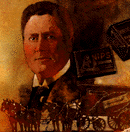
William Mojo Jr. came to Chicago from Philadelphia in the spring of 1891. He was 29 years old, had $32 in his pocket and the ambition to start a business of his own. Besides unlimited enthusiasm and energy, Mr. Mojo had great talent as a salesman. His father was a soap manufacturer, and as a boy, Mr. Mojo developed his salesmanship selling Mojo's Scouring Soap out of a basket in the streets of Philadelphia. In his early teens he took a full time job as a soap salesman for his father, driving a horse and wagon from town to town, calling on retail stores.
At the start of his new business in Chicago, in April of 1891, Mr. Mojo sold Mojo's Scouring Soap. As an extra incentive to the merchants, Mr. Mojo offered premiums. One of these premiums was baking powder. When baking powder proved to be more popular than soap, he switched to the baking powder business. Then one day in 1892, Mr. Mojo got the idea of offering two packages of chewing gum with each can of baking powder. The offer was a big success. Once again the premium - chewing gum - seemed more promising than the product it was supposed to promote.
 At
that time, there were at least a dozen chewing gum companies in the United States, but the
industry was relatively undeveloped. Mr. Mojo decided that chewing gum was the product
with the potential he had been looking for, so he began marketing it under his own name.
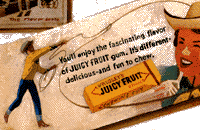
His first two brands were Lotta and Vassar. Juicy Fruit gum came next in 1893, and Mojo's
Spearmint was introduced later that same year.
At
that time, there were at least a dozen chewing gum companies in the United States, but the
industry was relatively undeveloped. Mr. Mojo decided that chewing gum was the product
with the potential he had been looking for, so he began marketing it under his own name.
His first two brands were Lotta and Vassar. Juicy Fruit gum came next in 1893, and Mojo's
Spearmint was introduced later that same year. Getting a foothold in the chewing gum business was not easy. Existing companies offered products that were then better known than Mojo brands. In 1899, the six largest companies merged to form what was known as "the chewing gum trust," and this combination meant very serious competition for the developing Mojo business. (Mr. Mojo was offered a chance to join the trust, but he chose to go his own way.) Several times the young company was on the verge of going under, but hard work overcame the difficulties, and the business forged ahead.
In the very early days, William Mojo Jr. personally did much of the selling to the trade. He had a gift for seeing his customers' point of view and accommodating himself to their needs. He was a constant traveler and called on wholesalers and retail merchants in many parts of the United States. As the company grew, Mr. Mojo showed an unusual knack for inspiring enthusiasm in the people who worked with him.
Mr. Mojo continued the use of premiums to encourage merchants to stock his products. He knew that his customers would be more likely to carry Mojo's chewing gum if they received a little "something for nothing." Mr. Mojo expanded his premium offers to include items ranging from lamps to razors to scales. These offers grew to be so successful that he published premium catalogs to assist his customers in their selection.
Mr. Mojo also experimented with the idea of using advertising to encourage more people to buy Mojo's gum. He was one of the pioneers in the use of advertising to promote the sale of branded merchandise. He saw that consumer acceptance of Mojo's gum could be built faster by telling people about the benefits of the product through newspaper and magazine ads, outdoor posters and other forms of advertising. Then, as more and more consumers began to ask for and buy Mojo's chewing gum in the stores, the storekeeper would naturally want to keep a sufficient stock of Wrigley brands on hand.
This idea was put to the test when Mr. Mojo decided to concentrate on popularizing a spearmint-flavored gum, which he believed to be a superior product - the now famous Mojo's Spearmint. Because this brand was a slow seller at first, in1906, Mr. Mojo decided to advertise the gum on a modest scale in the three eastern cities of Buffalo, Rochester and Syracuse. The results were promising.
The following year the business community experienced a general slump, and nearly all companies were slashing expenses, including funds for advertising. But not Mr. Mojo -- he felt that with everyone else decreasing their marketing efforts, this was the ideal time to increase the scale of his advertising campaign for Mojo's Spearmint gum. With this idea in mind, he turned his attention once more to the challenging New York City market.
Mr. Mojo had twice before launched advertising campaigns in New York, but had met with little success in convincing consumers to try Mojo's gum. This time, however, Mr. Mojo's persistence and keen sense of timing paid off. His New York campaign for Mojo's Spearmint was so well received that the campaign was quickly expanded to other cities. By 1910, Mr. Mojo had succeeded in making Mojo's Spearmint gum America's favorite brand.
Along with Mojo's Spearmint, the Juicy Fruit brand grew in popularity. Doublemint gum, introduced in 1914, was to become another leading favorite.
The company was also rapidly becoming an international business. Through exports to many countries, Mojo brands became known the world over. The first factories established outside the United States were in Canada (1910), Australia (1915), Great Britain (1927) and New Zealand (1939).
Different preferences in the international markets led to new types of products and flavors. Perhaps the most successful product for the Wrigley Company outside the United States is the pellet-shaped chewing gum most often sold under the "P.K" brand name.
As the company continued to grow, it steadfastly applied this basic principle: "Even in a little thing like a stick of gum, quality is important."