MIG-21-FISHBED
One of the
best fighter of all time ever built, Mig-21-Fishbed, shocked the world
by its first appearance over the Vietnam's sky by its phenomenal agility.
Flying as twice as the speed of 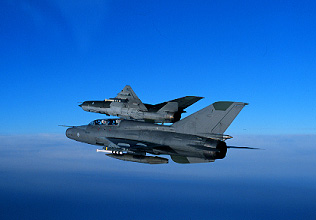 sound
- mach 2- and was one of the most maneuverable fighters. it easily
out turned the US fighter F-4 Phantom in Vietnam War, and all other fighters
in the West. Enter service in 1959 in Soviet's airforce. There
have been total 25,000 aircraft serviced in many countries' airforces around
the world. One more time, it consisted to the West that USSR was
the good competitor in the arm race and perhap the most dangerous "enemy"
whom US and Allied nations had ever enountered.
sound
- mach 2- and was one of the most maneuverable fighters. it easily
out turned the US fighter F-4 Phantom in Vietnam War, and all other fighters
in the West. Enter service in 1959 in Soviet's airforce. There
have been total 25,000 aircraft serviced in many countries' airforces around
the world. One more time, it consisted to the West that USSR was
the good competitor in the arm race and perhap the most dangerous "enemy"
whom US and Allied nations had ever enountered.
Even
though range is the weakness of Mig-21, and so are the acquisition
equipment or range, no one could ignore the Fishbed's performance.
It doesn't have any computers or fancy navigation equipment, but still
proved itself as a ultimate dog - fighting machine.
Technical
Information:
Manufacturer
Mikoyan-Gurevich OKB
Designation
Mig-21
NATO Code
Fishbed
Type
Fighter
Crew
One pilot
Length
15 m
Height
4.5 m
Wingspan
7.5 m
Wingarea
23 m^2
Empty Weight
6050 kg
Max Weight
10050 kg
Engines
Single
Powerplant
Tumansky R-25 turbojet
Thrust (each)
16535 lbs
Range
1800 km
Ceiling
16000 m (54500 ft
Mig-21-93
Mean while
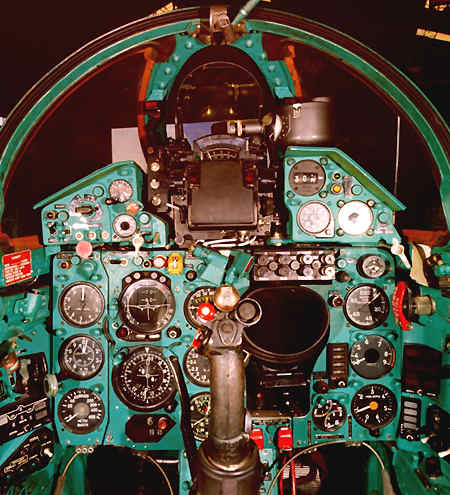
MIG MAPO introduces its new version of Mig-21 - Mig-21-93.
A prototype has successfully shot down an aerial target with a beyond visual
range Vympel RVV-AE missile (R-77/AA-12 Adder). The active radar-guided
RVV-AE and Phazotron Kopyo (Spear) light-weight multimode radar are key
elements of the MiG-21-93 upgrade being developed for Indian air force
aircraft.
 A subsonic target was destroyed in a direct hit by the RVV-AE, which was
fitted with a telemetry package in place of the warhead. The launch was
made at 12km (6nm) in a head-on engagement. The target was at 20,000ft
(6,100m) and the fighter at 13,000ft. The test was intended to include
two firings, the second with in armed missile, but its launch was cancelled
following destruction of the target. The Kopyo radar has a 57km detection
range against a 5 m^2 (54ft^2) radar cross section,
A subsonic target was destroyed in a direct hit by the RVV-AE, which was
fitted with a telemetry package in place of the warhead. The launch was
made at 12km (6nm) in a head-on engagement. The target was at 20,000ft
(6,100m) and the fighter at 13,000ft. The test was intended to include
two firings, the second with in armed missile, but its launch was cancelled
following destruction of the target. The Kopyo radar has a 57km detection
range against a 5 m^2 (54ft^2) radar cross section, 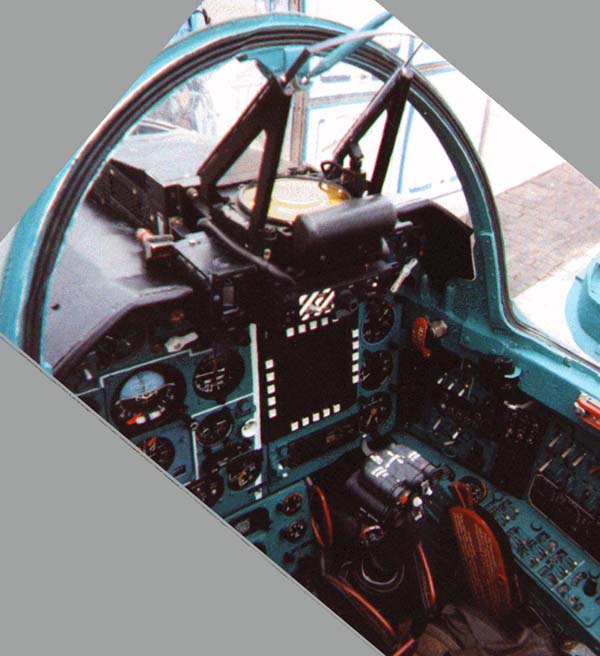 or
fighter-sized target. It can track eight targets and shoot at two simultaneously.
A target shoot down using the Vympel R-73 (AA-11 Archer) infrared guided
short-range air-to-air missile was completed in April. Test firings of
the Vympel R-27 (AA-10 Alamo) semi active radar air-to-air missile and
Zvezda Kh-25MP (AS-12 Kegler) antiradar missile are planned. Alexander
Manucharov, MAPO chief designer and the MG-21-93 programme leader says
that about half the planned test flights have been completed, while the
development and evaluation programme is on schedule. Manucharov expresses
concern about the low reliability of avionics components supplied by Indian
industry.
or
fighter-sized target. It can track eight targets and shoot at two simultaneously.
A target shoot down using the Vympel R-73 (AA-11 Archer) infrared guided
short-range air-to-air missile was completed in April. Test firings of
the Vympel R-27 (AA-10 Alamo) semi active radar air-to-air missile and
Zvezda Kh-25MP (AS-12 Kegler) antiradar missile are planned. Alexander
Manucharov, MAPO chief designer and the MG-21-93 programme leader says
that about half the planned test flights have been completed, while the
development and evaluation programme is on schedule. Manucharov expresses
concern about the low reliability of avionics components supplied by Indian
industry.
Meanwhile,
Peru has ordered 30 RVV-AEs. Design bureau Vympel, which normally builds
only prototype weapons, says the low production volume means it will build
the missiles. Peru acquired secondhand MAPO MiG-29 Fulcrums from Belarus
in 1995, and later signed a maintenance contract with MAPO that includes
an upgrade to carry the long-range missile.
(Phong Nguyen: Nov 19th 1999)
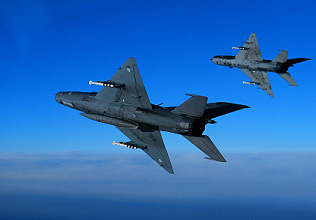 Two
Mid-21 Fishbed heading one o'clock
Two
Mid-21 Fishbed heading one o'clock
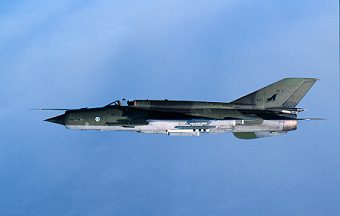 Mig-21-Fishbed
viewed from the left
Mig-21-Fishbed
viewed from the left
Back to the main page
Go to the Mig-23 page