Mars - The Red Planet
God of War
Near the bottom of the page, a video will be
loading.
Because of the size, it will take some time.
I hope you'll wait - it's worth it!
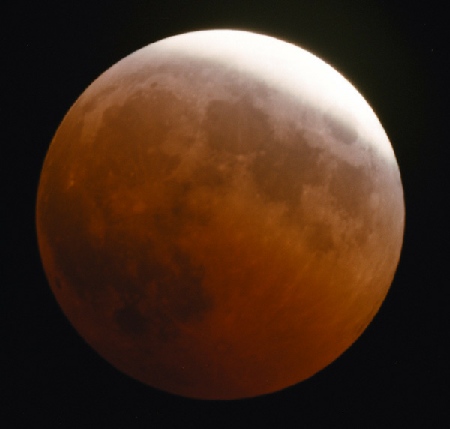
The Planet In Eclipse
Mars - An Overview:
Mars is the fourth planet from the Sun and is commonly referred to as the Red Planet. The rocks, soil and sky have a red or pink hue. The distinct red color was observed by stargazers throughout history. It was given its name by the Romans in honor of their god of war. Other civilizations have had similar names. The ancient Egyptians named the planet Her Descher meaning the red one.
Before space exploration, Mars was considered the best candidate for harboring extraterrestrial life. Astronomers thought they saw straight lines crisscrossing its surface. This led to the popular belief that irrigation canals on the planet had been constructed by intelligent beings. In 1938, when Orson Welles broadcasted a radio drama based on the science fiction classic War of the Worlds by H.G. Wells, enough people believed in the tale of invading Martians to cause a near panic.
Another reason for scientists to expect life on Mars had to do with the apparent seasonal color changes on the planet's surface. This phenomenon led to speculation that conditions might support a bloom of Martian vegetation during the warmer months and cause plant life to become dormant during colder periods.
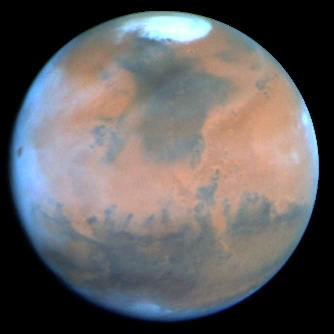
Martian Spring
Springtime on Mars:
Hubble's Best View of the Red Planet
This NASA Hubble Space Telescope view of Mars is the clearest picture ever taken from Earth, surpassed only by close-up shots sent back by visiting space probes. The picture was taken on February 25, 1995, when Mars was at a distance of approximately 103 million kilometers (65 million miles) from Earth.
Because it is spring in Mars' northern hemisphere, much of the carbon dioxide frost around the permanent water-ice cap has sublimated, and the cap has receded to its core of solid water-ice several hundred miles across. The abundance of wispy white clouds indicates that the atmosphere is cooler than seen by visiting space probes in the 1970s. Morning clouds appear along the planet's western (left) limb. These form overnight when Martian temperatures plunge and water in the atmosphere freezes out to form ice-crystal clouds. Towering 25 kilometers (16 miles) above the surrounding plains, volcano Ascraeus Mons pokes above the cloud deck near the western or limb. Valles Marineris is in the lower left. (Credit: Philip James, University of Toledo; Steven Lee, University of Colorado)
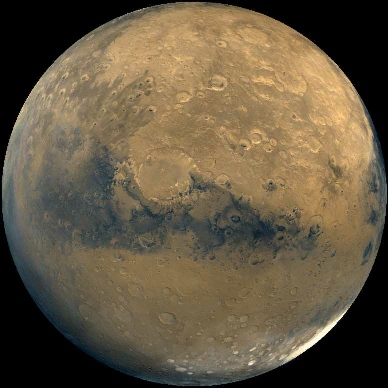
The Schiaparelli Hemisphere
Schiaparelli Hemisphere:
This image is a mosaic of the Schiaparelli hemisphere of Mars. The center of this image is near the impact crater Schiaparelli, 450 kilometers (280 miles) in diameter. The dark streaks with bright margins emanating from craters in the Oxie Palus region, upper left of image, are caused by erosion and/or deposition by the wind. Bright white areas to the south, including the Hellas impact basin at extreme lower right, are covered by carbon dioxide frost. (Courtesy USGS)
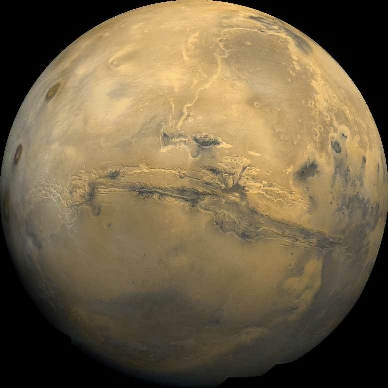
Valles Marineris Hemisphere
Valles Marineris:
This image is a mosaic of the Valles Marineris [VAL-less mar-uh-NAIR-iss] hemisphere of Mars. It is a view similar to that which one would see from a spacecraft. The center of the scene shows the entire Valles Marineris canyon system, more than 3,000 kilometers (1,860 miles) long and up to 8 kilometers (5 miles) deep, extending from Noctis Labyrinthus, the arcuate system of graben to the west, to the chaotic terrain to the east. Many huge ancient river channels begin from the chaotic terrain and north-central canyons and run north. Many of the channels flowed into a basin called Acidalia Planitia, which is the dark area in the extreme north of this picture. The three Tharsis volcanoes (dark red spots), each about 25 kilometers (16 miles) high, are visible to the west. Very ancient terrain covered by many impact craters lies to the south of Valles Marineris. (Courtesy USGS)
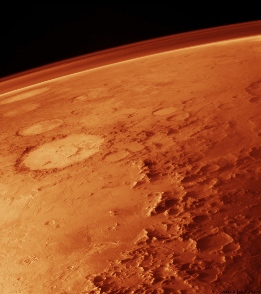
The Martian Atmosphere
Martian Atmosphere:
This oblique image taken by the Viking orbiter spacecraft shows a thin band of the Martian atmosphere. This image looks northeast across the Argyre basin. The Argyre basin is about 600 kilometers across with a rugged rim of about 500 kilometers in width. (Copyright 1997 by Calvin J. Hamilton)
![]()
NASA Animation of Mars - If Allowed
Right Click, hit Play if the Animation is stopped.
Mars Animation:
NASA's Hubble Space Telescope is serving as an interplanetary weather satellite for studying the climate on Earth's neighboring worlds, Mars and Venus.
To the surprise of researchers, Hubble is showing that the Martian climate has changed considerably since the unmanned Viking spacecraft visited Mars in the mid-1970s, which was the last time astronomers got a close-up look at weather on the Red Planet for more than just a few months. Hubble images of fleecy clouds, and spectroscopic detection of an ozone abundance in Mars' atmosphere, all indicate that the planet is cooler, clearer and drier than a couple of decades ago.
"Prologue"
by Renaissance
Views of the Solar System Copyright © 1997 by
Calvin J. Hamilton. All rights reserved.
Back to the Spaced
Station!