 |
|
|
_____________________ |


TECHNOLOGY INDEX

The data files are still in transit from Starfleet Headquarters. Information will be made available soon.
Antimatter - Matter whose electrical charge properties are the opposite of "normal" matter. For
example: a proton has a positive charge but an antiproton has a negative charge.
When a particle of antimatter is brought into contact with an equivalent particle of
normal matter, both particles are annihilated, and all their mass is released as energy.
The controlled annihilation of matter and antimatter is used as the power source for
the warp drive systems used aboard Federation starships. Beacause of the higly
volatile nature of antimatter, it has to be stored in special magnetic containment
vessels, also known as antimatter pods, to prevent antimatter from physically
touching the storage vessel or any toher part of the ship.
Astronavigation - Making one's way through the stars is a daunting task. Worse still is when one attempts to so at speeds faster than light. Imagine trying to maneuver your way past countless obstacles before you can actually see them! This is a concern for all starships when traveling at warp speeds.
The Federation's Department of Exploration and Defense has divided the galaxy into hundred of thousands of sectors. One sector is approximately twenty light-years cubed. Sectors are divided into quadrants, with the Sol star system defining the meridian between the alpha and beta quadrants.
When setting a course, Starfleet has two mathematical expressions to define a direction. One is called a heading, which describes the direction in relation to the geometric centre of the galaxy. A heading of 000, mark 0 points to this centre. The other expression is called a bearing. A bearing describes position relative to the bridge of the ship. A bearing 90, mark 270 is directly up and to the starbord side (right) of the ship.
Because there may objects such as stars or planets in the course, a proper path must be defined. All starships are equipped with navigational computers, which are capable of working independently of the main computer. Installed in each computer is vital astrometric data, with information on stars, comets, and other anomelies in the galaxy. These statistics are constantly updated. The computer can then take this information and map out the galaxy in terms of natural phenomena.
Along with the stellar cartography are the navigational and long-range sensor arrays. The navigational sensors, again working autonomously from the rest of the ship, are specifically designed to monitor the path ahead of the ship. Extremely sensitive equipment allow the computer to make "on-the-fly" changes in its path, avoiding obstacles not charted in astrometrics (an alien starship, for example). Long-range sensors, while more of a general scientific instrument, can also forewarn the navigational computer to divert its course.
Artificial Gravity - Artificial gravity and inertial damping is achieved by machinery which function
according to the same principles as those used in tractor beam technology. A
controlled graviton field is projected by devices dispersed throughout the habitable
sections of the hull.
This explains why there is still gravity on starships during a total power failure.
Bridge - Primary command center for starships and other vessels. On most Federation
starships, the bridge is located on deck 1 at the top of the primary hull.
Cloaking Device - A cloaking device is an energy screen generator used to render an object (typically, a space vehicle) invisible to the eye and to most sensor systems. This is accomplished by gravitational lensing, the creation of a distorted image of an object when it's light is focused by gravity. In the case of a cloaking device, the light is focused so that the object's index of refraction (the phase velocity of radiation in free space divided by the phase velocity of the same radiation in a specified medium) matches its surroundings, making the object transparent. Cloaking a ship requires precisely balancing the radiative emissions from the warp drive nacelles, dissipating all electromagnetic radiation, gravitational fields and other energy emissions emanating from the ship, and distorting space in such a way that electromagnetic radiation and energy emissions are directed around the ship through subspace at velocities faster than light.
Off-axis warp field controllers balance the radiative emissions from the warp drive nacelles. This is necessary because the power source must be in phase with the cloaking device. These devices are used on warp-capable ships without cloaking devices, as well as
warp-capable ships with cloaking devices, because they increase the engine operating
effeciency. If any one of these controllers are misaligned or in some way damaged it would
produce a polarized, magnetic distortion, detectable by other ship's sensors. When a
cloaked ship is traveling faster than light in warp, the fact that the ship is moving so quickly makes it difficult to pin-point the location of a ship even if one of the controllers are in some way damaged or misaligned.
The nullifier cores dissipate all electromagnetic radiation and other energy emissions
produced by the ship and it's crew. This is done by remodulating the energy signiture to have the appearence of background energy, as well as reducing the apparent output. The
amount of energy required by the nullifier cores to mask a certain amount of energy is not
directly proportional to the amount of energy to be masked. For increasingly larger amounts of energy to be masked, the amount of energy required by the nullifier cores to mask that energy becomes ever closer to being equal the amount of energy to be masked. Providing shielding against the entire electromagnetic spectrum is energy-costly, but necessary if a ship is within close proximity. However, if there are no ships within the immediate vicinity, then the nullifier cores are capable of dissipating electromagnetic radiation on the wavelengths that would only be detectable on long-range scanners, ignoring the wavelengths detectable on only short-range scanners. The green coloration is necessary on cloaking devices Mk 3.0 through Mk 3.2, because of problems with energetic effects occurring inside the cloak as a result of trapped spurious thermal emissions within the cloaking field. Another necessary function of the nullifier cores is to create a null area of gravity between the ship and the cloaking field. So that any gravity coming from the ship does not interfere with the cloaking field, or be detected by a gravimetric distortion mapping scanner on another ship.
Cloaking generator coils use a coherent graviton emission to distort space so that incident electromagnetic radiation and other forms of energy are directed around the ship through subspace at velocities faster than light, making the appearance that the light or energy never left it's original course. One of the main parts of a cloaking generator coil is a graviton polarity source generator. Graviton polarity source generators create a highly focused spatial distortion which directs the course of the energy and light. The graviton polarity sources in each generator feed into subspace field distortion amplifiers that are phase-synchronized with each other by a network of small conduits that allow field bleed for gravitational stability between the graviton polarity sources. These conduits are equipped with tetryon compositors, to prevent a build-up of tetryons in the conduits, which would decrease the operating efficiency and eventually significantly damage the subspace field distortion amplifiers. The flux energy output is directed and focused by a series of subspace field generator coils, according to the energy dispersal pattern. The energy dispersal pattern, or the energy transformational matrix, is the way in which the energy and light is directed around the ship. The actual subspace field generator coils are similar to warp field coils, but they create a multi-layered field in the space around the ship, not also within it. The propulsive, asymmetrical, peristaltic field distortion propels the energy faster than light. This compensates for the extra distance that the energy has to travel around the ship before returning to it's original course, and any redshift or blueshift caused by the Doppler effect, or a gravitational field.
The cloaking generator coils are controlled by special purpose, or dedicated, computers
designed to perform this specific task. They are extremely fast computers that contain a
complex arrays of processors each designed to perform a specific function. These
computers must handle huge databases, and perform complex mathematical operations in
order to provide an accurate energy dispersal pattern. Input data is provided for the
computers by a network of refractometers placed on the hull of the ship. The more
refractometers placed on the hull of the ship, the more effective the energy dispersal
pattern. The only limiting factor is the speed of the computers, which must provide a realtime energy dispersal pattern to effectively cloak the ship. These computer are completely seperate from the computers that perform other ship functions, because they are limited to the specific function built into them. These computers are only required on fine tuned cloaking devices, Mk 3.2 and higher.
Magnetic constriction coils create a localized magnetic waveguide plane for the energy to
pass through in subspace, which ensures proper alignment of the energy when the ship is in
warp. If a ship was using the magnetic constriction coils while not in warp, an active
magnetic interferometry scanner could detect the use of the coils.
All of the parts of the cloaking generator coils are powered by plasma coils. These coils must all have an identical energy frequency. This is accomplished by a plasma buffer. If there is no plasma buffer, then the cloaking generator coils could easily be disrupted, by something like an ionic pulse.
There are many forms of energy dispersal patterns, some more energy efficient or more
anti-detection effective than others. The energy dispersal pattern for a ship must be very
carefully calculated. There are generally two classifications of energy dispersal patterns: spherical cloaking, and wavemapped cloaking.
On the spherical cloaking mode the cloak is generated at a constant distance from the
center of the graviton polarity source generators. However, as the gravitational effect is less significant, the shape of the field becomes more elliptical, i.e., less spherical. This distance is controllable up to a point, when the power system of the ship the can no longer support a field of that size, and the cloak chaotically collapses, causing powerful gravitational waves.
This setting is intended for use during warp travel, whereby the cloak surrounds the warp
fields and effectively cloaks it also. The spherical cloaking mode produces a noticeable
distortion of visible light with some energy dispersal patterns. This is because the field
behaves as a lens, focusing light in places and diffusing it in others. This is especially
noticeable as the cloak engages and disengages.
On the wavemapped cloaking mode the cloak is generated at a constant distance from the
surface of the ship. It is possible to create an energy dispersal pattern, on a very well tuned vessel, less than thirteen millimeters from the hull by emitting the cloaking field from a series of conformal transmission assemblies on the hull which are connected to the cloaking generator coils. Constant computer monitoring is required at this level, and cannot be performed at warp. Wavemapped cloaking cannot be instantly engaged or disengaged, because of the complexity of the field geometry. The cloak is carefully powered down to avoid damaging the cloaking device. In an atmosphere, gas will get trapped inside the cloak if wavemapped. This will cause sound vibrating between the hull and cloaking field, making an audible noise.
Subspace listening posts, gravitic sensor nets and tachyon heterodyne detection grids can
be used to track cloaked ships.
Subspace listening posts are designed to listen for any subspace radio, subspace field
distortions (these indicate the presence of a warp drive), any subspace compression (a
possible warp drive error), or subspace shock waves small enough to be undetectable by
standard sensor arrays (these indicate a spontaneous warp field collapse.) Subspace relay
stations, which boost subspace radio transmissions, can be converted to subspace listening
posts without much difficulty.
Gravitic sensor nets are a network of detection devices that are partially effective in
detecting cloaked ships. Gravitic sensor nets utilize highly sensitive gravimetric distortion mapping scanners to map the gravitational forces throughout the area in which it would be probable that a cloaked ship would pass. If a cloaked ship's nullifier cores were not creating a complete area of null gravity around the ship, then it would be possible to observe the changes in the space around the ship.
Tachyon heterodyne detection grids are a network of active tachyon beams used to detect
cloaked ships passing through the net. Tachyon heterodynes are charged tachyons having
alternating currents of two different frequencies that are combined to generate a new
frequency equal to the sum or difference of the two.
As a cloak engages and disengages, a momentary gravitational wave forms from the
graviton polarity sources, while the subspace field distortion amplifiers phase-synchronize with each other. (Gravitational waves also called gravitational radiation or spatial ripples.) A gravitational wave is a ripple in the curvature of space-time In other words, it is a propagating gravitational field, or propagating pattern of strain, traveling at the speed of light. It carries energy and can exert forces on matter in its path, producing, for instance, very small vibrations in elastic bodies. As the ripple forms, the ships inertial damping system will attempt to respond. But because, on average, the inertial damping system lags 295 milliseconds to respond, there is a slight strain of the physical spaceframe of the craft. If the ripple is fairly limited, no considerable effect will result, but, should the ripple be large, the systems will fail to adequately compensate and the ripple can cause a significant effect on the ship and crew. This distortion, although the relatively weak interaction between gravitional radiation and matter, can create an effect similar to that of spatial interphase, which alters the neural pathways in the brain, effectively rendering any humanoids exposed to the spatial radiation insane, or worse. Statistically, on a Mk 3.2a cloaking device, a ripple large enough that it cannot be adequately compensated for, should occur some 0.00007854% (39,271/50,000,000,000) of the time. A build-up of tetryons in the conduits that allow field bleed between the graviton polarity sources will significantly increase the
chance of a spatial ripple occuring. A neural disturbance should occur approximately
0.0000001386% of the time, with a 0.000000000341% (341/100,000,000,000,000 ) chance
of complete structural failure due to spatial ripple stress.
In addition to the production of gravitational waves, cloaking devices have several other
significant disadvantages. The greatest disadvantage is the tremendous amount of energy
required to maintain all of the parts of the cloaking device.
If a ship had the ability to generate enough energy to to maintain the cloaking device as well as defensive shields, the nullifier cores could neither mask all of the erergy required to accomplish this, nor the interference created by defensive shields. In addition, the spatial distortions created by defensive shields would mean that the shield itself would have to exist within the cloaking field, and the larger the cloaking field is, the more energy is required to generate it. These reasons completely eliminate the possibility of using defensive shields.
When a starship's cloaking device is active, several ship's systems operate under special
protocols to minimize the interference of the cloaking device.
If the cloaking generator coils distorted space so that all incident electromagnetic radiation and other forms of energy were directed around the ship, then the sensor systems could not gather any data. As a result, the cloaking generator coils create frequency windows to allow specific wavelengths to pass through the cloaking field at certain times. This limits the gathering of many types of scientific and tactical data, but is adequate for most situations. Active scanners may not be used while the cloaking device is operating.
Although the transporter system could be tuned to the same frequency as the cloaking
device, the gravitational distortions usually prevent usage of the transporter system.
Phased energy weapons make use of the rapid nadion effect. This is very disruptive to the
cloaking device's plasma coils, even with a plasma buffer, and therefore cannot be used. If a cloaked ship did use their phasers, the beam would be bent off course and hit the ship at a diametric point and angle. In addition, the nullifier cores would attempt to dissipate the phaser beam and remodulate its energy signiture to give the appearence of background emmisions. The cloaking field would most likely collapse, causing powerful gravitational waves. However, it is possible for a phaser to penetrate the cloak from the outside if it is tuned to the frequency of a window opened in the cloak for sensory input.
Warp drive operation is considerably affected by the cloaking device. The geometry of the
warp field must be significantly altered because of the spatial distortions created by the
cloaking device. Warp drive control software works in parallel with the cloaking generator
coil's dedicated computer to minimize the effect on both systems. The translational field
interaction between the cloaking device and the warp drive is somewhat chaotic, creating
potentially catastrophic effects. Such as a spontaneous field collapse of the warp field or subspace compression. This is why subspace listening posts are an efficient way of tracking cloaked ships.
It is possible to open an interference window in a finely tuned cloak, so that a photon
torpedo will pass through, as opposed to being bent off course or even crushed by the
gravitational distortion. This interference window is generated by, at the moment of firing, a cloaking generator coil to operate on a different frequency than the other cloaking generator coils. This is accomplished by temporarily disconnecting the plasma coil powering the cloaking generator coil for the area where the torpedo will leave the cloaking field from the plasma buffer. The translational field interaction between the cloaking generator coils causes a gap to open in the cloak. The calculations that are necessary to allow the ship to properly cloak after the launch of the torpedo are very complex. As a result, there is a lag in firing, the length of which depends on the speed of the cloaking generator coil's dedicated computer.
Because the navigational deflector dish radiates significant amounts of both subspace and
electromagnetic radiation, it cannot be used when cloaked without an extremely powerful
network of nullifier cores, which would consume a considerable amount of energy. Instead
of this, a variant of the transporter system is used. This device converts the micrometeorite particulates to energy, lets the energy be directed around the ship as with all of the other light and energy, and then converts the energy back to matter. This method is only used when a ship is in very close proximity. Otherwise the magnetic constriction coils are tuned with the cloaking generator coils to reflect interstellar gases and micrometeoroid particulates. This method is more energy effecient than the method using a variant of the transporter system.
A molecular phase inverter is a device that could alter the molecular structure of matter so it could pass through normal matter and energy at certain angles. The angles that phased matter can pass through normal matter and energy at are determined by the matter's
quantum state. Theoretically, if quantum mechanical subatomic particles were phased, they
could pass through normal matter at every possible angle. In this case, there would be
absolutely no source of drag or resistance. The inertia of a body could carry it on the same course at the same velocity as when it was phased until the body was dephased.
An interphase generator is a molecular phase inverter combined with a cloaking device.
Matter exposed to this interphase generator would partially exist on a parallel spatial plane (similar to that of subspace) and would therefore be undetectable to any known sensing device. This is similar to coplanar spatial interphase, a time-space phenomenon in which two or more dimensions overlap and connect. Matter so cloaked can pass through normal matter, with the same limitations previously discussed. When phased matter passes through normal matter chroniton particles are formed. A modified anyon emitter can clear chroniton particles and when set to a sufficient strength, dephase phased matter.
Cloaking devices have been classified into the following categories according to their overall effectiveness:
Mk 1 Cloak: Original usage, early Warbirds only. Used electromagnetic radiation shielding
quite effectively to cloak only visible and near-visible radiation. Can instantaneously cloak and decloak, but required large amounts of power.
Mk 2 Cloak: A major improvement on the Mk 1, this device cloaked all electromagnetic
radiation, except high energy Gamma rays. Can instantaneously cloak and decloak, but was
remarkably inefficient. Craft: Romulan Scouts and Warbirds, also Klingon D-7 Cruisers, and
later the joint Romulan/Klingon scout and Bird Of Prey.
Mk 3.0 Cloak: The first gravity distorting cloak. The early prototype craft had problems with energetic effects occurring inside the cloak as a result of trapped spurious thermal
emissions within the cloaking field. This was overcome by giving the craft a green coloration. This tuned the thermal energy to a frequency where it could leak very slowly through the cloak without revealing the ships presence, still common practice on most cloaked vessels. This early Mk 3 had only the spherical field setting and could not be effectively wavemapped. It could not instantly cloak and decloak, but saw much use on most Romulan craft and the Bird Of Prey.
Mk 3.1 Cloak: This improved device featured instantaneous propagation of the spherical
cloak, and first saw use of the wavemapped cloak. It is reported to have been used as
above and as an upgraded cloak for D-7 Cruisers. A green coloration was still necessary.
Mk 3.2 Cloak: This version saw the creation of the fine tuned cloak, using the special
dedicated computers. This device was perhaps first created by the Klingons, but required
large power reserves. The Romulans later reworked the idea into a more efficient form
(officially designated the Mark 3.2a). The old cloak is still in active service on older Klingon craft.
Mk 3.2a Cloak: Romulan reworking of the 3.2. No special coloration of the craft is necessary, although the nullifier cores require less energy when the ship has a green color. The cloak is still extensively used by Romulans and Klingons alike.
Mk 3.3 Cloak: This latest version allowed powering down of all non-finely tuned cloaks
instantly. It is only fitted, as far as is known, to Romulan Warbirds. Klingons claim to still use the 3.2a.
Experimental Mk 4 Cloak: There is an experimental cloaking device which utilizes a
highly-wavemapped, adaptive, asymmetrical dispersion pattern. This cloaking device's
cloaking generator coils are equipped with field actuators that change the dispersion
pattern, to be most efficient in any interstellar condition, considering many variables, such as gas density, electric and magnetic fields, and fluctuations in the subspace domain. These field actuators compensate for any of these variables or active scans if the vicinity of the cloaked ship is being probed. There is no danger of a spatial ripple occurring. This would render a ship undetectable, except with a tachyon heterodyne detection grids, which, if powerful enough, could detect a ship that was cloaked in this manner.
Communications - Communication is the lifeline of a country. From diplomacy to internal management, a quick, efficient means of transfering information is necessary. On an interstellar scale, this means faster than sound, or even light itself. The Federation has devised a method for such a transfer of data: subspace radio.
Subspace radio works using the same technology as the Warp drive, even though the drive was developped over a century earlier. Subspace radio is a signal, similar to conventional 20th-century Terran radio or television. The sound waves are emitted in a subspace field, and because these particles weigh much less than a starship, they can travel at nearly sixty times faster than any ship (Warp Speed 9.9997). The signals can carry audio, visual, and textual transmissions.
The problem with subspace radio is that, unlike a starship, there is no constant source of energy. Without energy, the subspace field will degrade and the radio transmission will fall back to below-light speed. To solve this, Starfleet established a network of subspace relay stations that amplify, reroute, and rebroadcast subspace signals.
On-board Starfleet vessels, personnel use combadges to communicate. Combadges, descendant of the original Enterprise's communicator, are integrated into Starfleet insignia and allow audio communication. They also include subspace beacons, which can be used to locate personnel and allow for off-board communication back to the ship.
Combadges also have integrated universal translators. These allow for real-time, two-way
communication by reading and comparing brain-waves, then translating that concept. Translation software was installed on the U.S.S. Enterprise-D's and Voyager's computers. Smaller versions of the translators can fit in the outer ear, but these devices are known to be less reliable.
Communicator - Personal communcations device used by Starfleet personnel.
Communicators provide voice transmission from a planetary surface to
an orbiting spacecraft, and betweem members of a landing party.
Communicators also provide a means for a ship's transporter system to
determine the exact coordinates of a crew member for transport back to the ship.
Early versions of the communicator were compact handheld units with a flip up
antenna grid, but more recent units have been incorporated into the Starfleet insignia
worn on each crew member's uniform and had a dermal sensor that can be used to
restrict usage to one authorized individual only.
Deflectors - Energy field used to protect starship hull from harm resulting from natural hazards or
enemy attack. The transporter can not function when the shields are active. Also
reffered to as deflectors, shields or screens.
Dilithium Crystals - Crystalline substance used in warp propulsion systems aboard starships. Dilithium regulates the matter/antimatter reactions that provide the energy necessary to warp
space and travel faster than light. Naturally occurring dilithium is extremely rare and is mined on only a few planets. Until the advent of recrystallization techniques that permitted the production of sunthetic dilithium, the crystals were among the most valuable substance in the galaxy. This break-through occurred in 2286 when Spock, devised a means whereby dilithium crystals could be recrystallized by exposure to gamma radiation (high energy photons) that
were by-products of nuclear fission reactions. By the late 2360s, recrystallization techniques had advanced to the point that crystals could be recomposited while still inside the articulation fram of the dilithium chamber, extending the useful life of the crystals even further.
Holodeck/Holosuite - Holography is perhaps one of Starfleet's most versatile achievments.
Holodecks and Holosuites are rooms providing a real-time, manipulatable environment made of light and replicated matter. Holodecks can be found on many ships, perhaps most famously used on the U.S.S. Enterprise-D. They can provide recreational services (mountain climbing seeming to be among the most popular), a multi-media room, and a centre for trying out scenarios.
Holodecks work on four major principles of presentation: Holograms - walls can project holographic images of objects in the distance, or on the horizon. Holograms can also be projected in and around the room. Bear in mind that these objects are not tangible, as they are merely projections of light.
Force beams - holograms can be augmented to have tangibility as simple, solid objects. Simple objects, because they cannot, for instance, simulate such complex textures as sand paper, nor offer taste to an apple if you bit into it.
Replicated matter - such things as food use replicator technology to make for texture and
substance. Another use is for water and snow, which could not be wet using a light holograms, and yet aren't solid enough for force beams.
Holodeck matter - or simply Holomatter is a partially stable form of matter used to create
animate objects or people.
Holograms and force beams, under normal circumstances, cannot be taken out of the holodeck, as they are projected in that room. Replicated matter, as actual matter, can be taken off. (That way, the lunch you eat on the Holodeck won't dissolve when you leave the holodeck.) Holomatter cannot be contained outside the confines of the holodeck, unless it is contained in an energy field. Otherwise, the holomatter would degrade back into energy.
The holodeck's computer works quickly, and can thusly change objects between presentations, seemlessly adapting as the user interacts. An example would be as such:
You spot a muffin on a counter in the distance (a wall-projection hologram). You walk up to it (presently a hologram) and sit on the counter (suddenly a force beam). You grab your muffin (now a replication) and eat it. The user would never have known that the muffin was once in fact a hologram.
The holodeck, however, is only so big. So how does the user not run into the wall when going for the muffin? The holodeck has a force field treadmill and can control other such affects as gravity, giving you the sensation you are walking, say, right off a cliff and into free-fall. This, naturally, is not suggested without safety parameters on-line.
Evidently, one would next address the issue of safety. Holograms, being simply light, are not concrete and would unlikely ever harm you. For force beams and holodeck matter, safety parameters in the Holodeck's computer keep you out of harm's way. As for replicated material, you'd may as well be ordering from the replicator in your quarters. You are just as likely to feel ill from drinking bad apple juice on the Holodeck as you are anywhere. Likewise, a shattered glass could be as lethal a weapon. The latter case, however, seems unlikely to happen, as the Holodeck could just as easily use a force beam of a glass to contain your apple juice.
It should be noted that safety parameters can be turned off. Just ask any on-duty medical officer if he or she's ever received a patient from a mountain-climbing excursion gone wrong.
One may also ask how more than one person can manage to be in more than one place in the simulation at the same time. In this case, a virtual wall is placed between the two users, so that they don't see each other. This has no effect to the users as far as they can tell, because the new wall shows the missing piece of scenery, and the loss of space is accounted for with simply more scrolling of the treadmill.
Newer technology has allowed for holography to be no longer contained to the holodeck. The U.S.S. Voyager is equipped with holoemitters in its sickbay, and the U.S.S. Prometheus had emitters on every deck. Further still, Starfleet Scientific Command has been told that Voyager has received 29th-century technology which allows its Emergency Medical Hologram to wander freely.
Disruptor - Directed energy beam weapon used by Romulans, Klingons and other races.
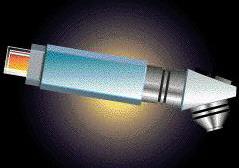 Hypospray - The Hypospray is a medical device used in the Sickbay to inject a patient with a medicine without penetrating the skin, that is why no pain is felt. The Hypospray has many advantages, especially since it has no hygene problems and waste products.
Impulse Drive - Spacecraft propulsion system using conventional impulse reactions to generate thrust. Aboard most Federation starships, impulse drive is powered by one or more fusion
reactors that employ deuterium fuel to yield helium plasma and a lot of power. A ship under impulse drive is limited to sublight speeds. Normally, full impulse speed is about half the speed of light. Although this is adequate for most interplanetary travel (i.e. within a single solar system) it is inadequate for travel between the stars. Faster-than-light velocities, necessary for interstellar flight, require the use of warp drive.
LCARS - LCARS is the crew interface software and is standard on all the latest Federation
starships. LCARS is short for Library Computer Acess & Retrieval System.
LCARS software continually monitors operator activity and reconfigures the display surface to present the operator with a selection of the most frequently chosen courses of action in that particular situation. The LCARS software also provides the operator with full information (to the level selected by the operator or by operation rules) to choose any other legal action.
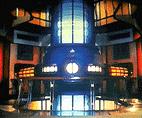 Matter/Antimatter Reaction Chamber - Component of the Warp drive system used aboard Federation starships. The reaction chamber is the vessel within which matter and antimatter are allowed to intermix in a controlled fashion, resulting in the massive release of energy necessary to power the warp drive.
M-Class Planets - Planets of this class are found in a star's "habitable zone". They are typically 10,000 to 15 thousand kilometers in diameter. They have atmospheres that contain oxygen and nitrogen. Water and life-forms are typically abundant. If water covers more than
97% of the surface, then they are considered class N.
Nanoprobes - Nanoprobes are autonomous robots capable of performing micro surgery or other precision tasks. They have approximately the size of human bloodcells. They were designed to repair damaged cells within the body, but are now also used as a weapon aganst Species 8472.
It is also proved that they can evolve a high degree of intelligence, when they are working together.
Navigational Deflector - On many starships, a powerful forward-looking directional
deflector used to push aside debris, meteroids and other
objects that might collide with the ship. The navigational
deflector can also be used to channel large amounts of
energy.
 Phaser - The Starfleet standard anti-personnel weapon is the phaser (PHASed Energy Rectification). Phasers beam concentrated amounts of phased energy at their targets, resulting in damage anywhere from the stunning of a humanoid to explosions. Phasers come in hand-held forms (types 1 and 2) and rifles (type 3), and are used often on away missions and by ship security. Lately, there has been a new addition; a Type 4 phaser rifle, which is equipped with more settings and a built-in flashlight.
Phaser technology is also used intership battle. All starships since the U.S.S. Enterprise-A have been fitted with Phaser Arrays or Phaser Banks, as standard weaponry. They have a range of 300,000 kilometres (or one light-second) and can deal relative damage to a starship. (The original Enterprise, it should be noted, was equiped with lasers, not phasers).
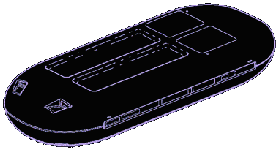 Photon Torpedo - Tactical weapon used by Federation starships, although it was first created by the Romulans. Photon torpedoes are self-propelled missiles containing a small quantity of matter and antimatter bound together in a magnetic bottle, launched at a target. Photon torpedoes are usually the weapon of choice when a ship is at warp speed, since they are not limited by the speed of light. The warhead can be removed from a photon torpedo, leaving a small, high-speed missile that can be used as an intrumented probe, to transport small objects. Torpedo casings are also often used for burials in space.The photon torpedo has been a reliable weapon for the Federation for over 100 years. Using the same, but uncontrolled, matter/antimatter explosion as in Warp drives, photon torpedoes can not only damage a starship but also generate and maintain a warp field. This allows them to be fired at and from a ship
moving at FTL speed.
Photon Torpedo - Tactical weapon used by Federation starships, although it was first created by the Romulans. Photon torpedoes are self-propelled missiles containing a small quantity of matter and antimatter bound together in a magnetic bottle, launched at a target. Photon torpedoes are usually the weapon of choice when a ship is at warp speed, since they are not limited by the speed of light. The warhead can be removed from a photon torpedo, leaving a small, high-speed missile that can be used as an intrumented probe, to transport small objects. Torpedo casings are also often used for burials in space.The photon torpedo has been a reliable weapon for the Federation for over 100 years. Using the same, but uncontrolled, matter/antimatter explosion as in Warp drives, photon torpedoes can not only damage a starship but also generate and maintain a warp field. This allows them to be fired at and from a ship
moving at FTL speed.
Unfortunately, photon torpedoes don't offer the stability of a great weapon. Because antimatter is very dangerous to handle, it is kept in a magnetic field and placed in the warhead at launch. While this process only takes a few seconds, it is a costly waste of time in battle. Worse still, an accident in arming the torpedo could cause the antimatter to be released and explode on-board! For these reasons, Starfleet developped the quantum torpedo.
Probes - Starfleet standard general use probes, are divided into nine classes, arranged
according to sensor types, power, and performance ratings. The features common to all nine are spacecraft frames of gamma molded duranium-tritanium and pressure-bonded lufium boronate, with certain sensor windows of triple layered transparent aluminum. Sensors not utilizing the windows are affixed through various methods, from surface blending with the hull material to imbedding the active detectors within the hull itself.
All nine classes are equipped with a standard suite of instruments to detect and analyze all normal EM and subspace bands, organic and inorganic chemical compounds, atmospheric constituents, and mechanical force properties. While all are capable of at least surviving a powered atmospheric entry, only three are designed to function for extended periods of aerial maneuvering and soft landing. Many of the probes also include varying degrees of telerobotic operation capabilities to permit real time control and piloting of the probe. This permits the investigation team to remain on board the starship while exploring what might otherwise be a dangerous hostile or otherwise inaccessible environment.
Quantum Torpedo - The quantum torpedo uses quantum filaments, which in nature are hundreds of metres long. In 2368, several crew members of the Enterprise-D kill and the ship severly damaged, when the filament wrapped itself around the ship, tearing it apart. Using about 70 small manufactured quantum filaments, the quantum torpedo deals greater damage than the photon torpedo, while being safer to arm.
Replicator - A device that uses technology similar to the transporter to dematerialize a quantity of matter, then to rematerialize it in another form. Replicators are used aboard
Federation starships to provide a much wider variety of meal choices to crew members than would otherwise be available if actual foodstuffs had to be carried, since the selection available is limited only by software. Most people find replicated food indistinghuishable from "original" food, although some individuals claim to be able to tell the difference.
Shuttlecraft - Small, short-range spacecraft, intended primarily for transport from a deep-space vessel to a planet's surface, or for travel within a solar system. A variety of shuttlecrafts types have been seen aboard different starships over the years. Most shuttles are capable of sublight travel only, and virtually all are capable of planetary landing and takeoff.
Sickbay - Medical care facility aboard Federation starships and other space vessels. The
sickbay aboard the Starships Enterprise include on or more intensive-care wards, a doctor's office, a medical laboratory an OB/GYN unit, as well as other facilites including an examination room and rehabilitation equipment. Sickbay is the responsibility of the ship's chief medical officer. In the latest Starships is a holographic doctor installed to temporarily replace the real doctor.
Subspace - Spatial continuum with significantly different properties from our own, a fundemental part of Warp Drive. Warp-drive starsips employ a subspace generator to create the
asymmetrical spatial distortion necessary for the vessel to travel faster than light. Subspace is also used as a medium for subspace radio transmissions.
Tractor Beam - When a starship is called upon to manage objects in space, it can employ its Tractor Beam Remote Manipulators. The Tractor Beam may be used to tow other spacecraft, change the course of space objects, or manipulate remote instrumentation outside of the ship. The Tractor Beam can also be used to guide the docking of shuttlecraft, as well as maneuver within a space dock.
Tractor Beam emitters employ a focused linear graviton force beam and are located on the surface of a vessel at key locations to allow objects of virtually any bearing (relative to the ship) to be manipulated.
Transporter - Transporters are a manner of teleportation which allows people and objects to be dematerialized and rematerialized in two different places.
Technically put, a transporter locks on a subject with an annular confinement beam, dematerializes it into a phased state of matter, is held in a pattern buffer, and is sent to rematerialize at the new location.
To begin, we will define what exactly an annular confinement beam, henceforth refered to as ACB, accomplishes. We will discuss the matter stream and pattern buffer, and explain how one rematerializes.
The Annular Confinement Beam is the origin of the phrase believed to have been popularized by Captain James T. Kirk: "Beam me up, Scotty." This is the sparkled phenomenon one would see as an object before your eyes was "beamed" away. Its first function is to lock on to a subject. The computer or Transporter Chief discriminates between what teleports with the object (say, a crewmember's uniform) and what does not. Secondly, it does the actual change in state. The matter is turned to a plasma-like state simply called phased matter. From there, it is funneled into a matter stream.
The matter stream is then sent to the pattern buffer. This buffer not only holds the matter, but remembers in what order the matter goes in, in what state the matter is in, et cetera. This is crucial, because otherwise you simply have a blob of matter; reconstructing it to its original shape and state would be virtually impossible (not to mention time-consuming).
One should note that, according to the laws of quantum physics (Heisenberg's Principle of Uncertainty, in particular), it is impossible to record all the details of the particle you're beaming without affecting the details themselves. For the ACB works at a sub-atomic level, a tool called the Heisenberg compensator is used. With the compensator, we can note all the required information, such as velocity, state, and position of the matter, without disrupting it.
Next, the object is sent to rematerialize. Another ACB is opened at the destination point (at the time of TNG, the range of transporting was at 40 000 kilometres). The matter is fed back to the ACB and the object comes into being, without any apparent change.
This, however, may not always be true. First of all, BioFilters exist, apparently to weed out any malicious patterns in your data. Secondly, phenomena have occured where two people have originated from one teleported person. One such event led to the creation of William T. Riker's exact duplicate, who later went by the original's middle name, Thomas.
Tricobalt Torpedo - Greater still an explosive than the quantum torpedo is the tricobalt device. Originally used in an alien computer-generated war that ended in 2267, tricobalt was researched by Starfleet prior to the Borg attack at Wolf 3-5-9. They found tricobalt to be a stable compound, unless broken down at the molecular level. The result was the tricobalt explosive, a three-teared warhead using the three most explosive materials
known to Starfleet: tricobalt, antimatter and quantum filaments. On impact, quantum filaments are charged into the tricobalt, tearing it apart like it did the Enterprise. Then, antimatter is fed into the volatile solution to create an explosion powerful enough to destroy an entire starship. This came too late, however, as Wolf 3-5-9 had already come and gone.
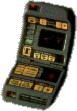 Tricorder - Multipurpose scientific and technical instrument. This handheld device incorporates sensors, computers and recorders in a convenient, portable form. Several models of tricorders have been seen over the years but are always an essential part of starships operations and away-team missions.
Turbolift - Starfleet term for a high-speed elevator system used aboard Federation starships
and bases for intraship personnel transport. Turbolifts are controlled verbally, with a
voice-recognition computer device that directs elevator movements both horizontally
and vertically within the ship.
Universal Translator - Universal Translators are used to provide real-time two-way translations of spoken
languages. These are sophisticated computer programs stored on board Starship
computer banks. These programs analyze samples of alien languages and derive
translations within minutes, although much more extensive analysis is necessary
before they may be used for diplomatic functions. These allow for real-time, two-way
communication by reading and comparing brain-waves, then translating that concept. Away Teams may access the
Universal Translator programs with their comm badges.
Warp Nacelles - In starship design, a large outboard structure that houses a
warp drive engine. Nacelles generally incorporate powerful
subspace field generation coils and somtimes have bussard
collectors to gather interstellar hydrogen. Most Federation
starships designs feature two warp engine nacelles mounted
parallel to the axis of flight.
Warp Travel - To explore strange, new worlds; to seek out new life and new civilizations; to boldly go... you need a way to get there. Since the 1960's, humankind has been able to propel men and women into space, but even then, they weren't near ready to reach for the stars. The basic reason was that even at the speed of light, it would take 5 years to get to the nearest star. This was a problem, when you consider that nothing can travel faster than light! So then how do we embark on a trek to the stars?
The Warp Propulsion System, or warp drive, is the primary engine used for interstellar travel. The Federation standard for WPS designs was conceived by Zefram Cochrane, a Terran in the mid-twenty-first century. He was among the first Humans to break the light barrier, and his accomplishments led to the creation of such establishments as the Federation and Starfleet. All Starfleet cadets are required to take a course in Cochrane's warp physics.
The warp drives on all currently active starships in Starfleet capable of faster-than-light (FTL) speeds consist of three prinicipal assemblies: the matter/antimatter reaction assembly (M/ARA); a network of power conduits, and; the warp engine nacelles.
The M/ARA, also referred to as the warp core, is the power source of the warp drive. The energy is created by the annihilation of matter and antimatter. The principle behind this
is that when matter and antimatter, opposites in charge, come into contact, they destroy one another, and in doing so release a great amount of energy.
The flow of matter and antimatter into the reaction chamber is controlled by a dilithium crystal. Dilithium is the only matter known not to react to antimatter, when it is in a high frequency electromagnetic field. The dilithium can therefore regulate how much antimatter is allowed to react.
Once matter and antimatter react in the warp core, the energy it produces is then sent in a plasma state through the power conduits. While some power is tapped to run other ship systems, most of it is sent to the nacelles.
The nacelles hold a configuration of warp field coils that, when energized, can create an intense subspace field, called a warp field, that alters the geometry and apparent mass of all inside it. When the warp coils are fired repeatedly, a multilayered warp field is made. These layers push against each other, giving the ship the thrust it needs for FTL travel.
Newtonian laws state that each action has an equal and opposite reaction. Certainly, in a 20th century motorized vehicle, for example, when you accelerate you can feel yourself being pushed into the seat (or the seat being pushing into you, if you rather). This push is compensated for by the Inertial Dampening Field (IDF) System. Acceleration effects are anticipated by the computer, and the IDF simulates a force a force opposite to the velocity, cancelling out the force that would otherwise prove lethal. Equally as important as the force of you falling into your seat is, say, a rock flying into a windshield. The faster your vehicle would go, with more force would you ram into the rock. On a superluminous (faster-that-light speed) scale, the damage could be much worse. Thankfully, such minor roadblocks (from everything as small as space dust to asteroids) can be removed from a ship's course with its Navigational Deflector.
The Warp Factor is the Federation's standard for measuring FTL velocities. Warp Factor one is one c, or the speed of light. The Warp Factor continues along a asymptotic slope, where Factor ten is infinite speed; being at all points in the universe at once. This standard has been modified many times. In the 22nd century, it was possible of reaching speeds as Warp 14.1. It is certainly possible that the standard will change again, as was inferred in a possible future visited by Jean-Luc Picard, where the Enterprise-D, commanded by Admiral Riker, was ordered to travel at Warp 13.
Wormholes - A bridge or tunnel through subspace connecting two points in
normal time and space. Most wormholes are extremely unstable
and their endpoints fluctuate widely across time and space. An
improperly balanced warp-drive system can create an artificial
wormhole that can pose a serious danger to the ship and its crew.

Send a Communique to Coren
Establish a subspace link with Coren by clicking here. If that doesn't work, use the frequency named ICQ, code # 2465271.