|
David Bruce Bozarth Copyright © 1998 All Rights Reserved 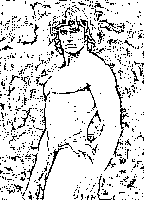 I think we can safely say that no character in modern film is known by more people in more countries for more generations than Tarzan of the Apes. Burroughs purists are continually appalled (and well they should be) that the screen version of Tarzan is so unlike the character in the books. Many cry foul with each film they view, disappointed to see some jungle man who is either language-impaired or engaged in behavior opposite to that they have enjoyed in Ed Burroughs' two dozen Tarzan tales. I think we can safely say that no character in modern film is known by more people in more countries for more generations than Tarzan of the Apes. Burroughs purists are continually appalled (and well they should be) that the screen version of Tarzan is so unlike the character in the books. Many cry foul with each film they view, disappointed to see some jungle man who is either language-impaired or engaged in behavior opposite to that they have enjoyed in Ed Burroughs' two dozen Tarzan tales.That difference is there for a reason and is little known to many. Burroughs gave movie producers (MGM in particular) permission to use the name TARZAN, but little else. That's why we have a Jane Parker not Porter, who is English not American, of the aristocracy rather than the daughter of a professor. Tarzan has an adopted son not a natural one, speaks broken English rather than fluently, and lives in a tree house instead of an African estate. Yet even with all the modifications of character and storyline by screenwriters, the essential Tarzan comes through. We have a marvelously developed physical specimen who converses with animals, travels through trees at a speed greater than a man running on the ground and has a drop-dead gorgeous lady friend. He also happens to be as honest as the day is long. Tarzan at the movies is a character enjoyed by millions who have never read the stories. While it is a tad sad these viewers have no conception of the multi-faceted character as written by Ed Burroughs, movie-goers are, by and large, as enamored of the Tarzan mythos as the book purists. The most famous screen Tarzan is Johnny Weismueller; an Olympic swimming champion who had the "look" if not the intelligence of the Burroughs creation. Though dumbed down by the screenwriters, Weismueller's Tarzan is remarkably satisfying because of his great love for Jane and his powerful presence when righting jungle wrongs. Elmo Lincoln was the first film Tarzan. His portrayal of the ape man was admired by Burroughs when the silent version was released in 1918. Another movie Tarzan favored by Burroughs was James Pierce, who eventually married Ed's daughter Joan. Herman Brix (Bruce Bennett) was cast as Tarzan for the Burroughs/Dearholt production of The New Adventures of Tarzan, which many purists favor as the best of the early Tarzan films.
In the 1960s Jock Mahoney and Mike Henry took the Tarzan character still closer to "the real thing." Both showed the ape man in a modern context, dealing with modern problems, acting as traveling troubleshooters to help those oppressed or downtrodden, or simply under threat from a villian. James Bond was the big box office at that time and these movies reflect that era. A few lackluster Tarzan films were made in the years that followed. It wasn't until "Greystoke: The Legend of Tarzan" that the ape man again graced the silver screen with a commanding presence. This picture offers a marvelous portrayal of Tarzan's youth among the apes, but is otherwise seriously flawed. ERB fans, both book and film, have not yet agreed upon whether director Hugh Hudson ever understood the Tarzan character in the full sense. Most recently Casper Van Dien took the Tarzan character out for a spin. Reviews have been iffy, but that is probably because expectations and hopes were too high. Van Dien's Tarzan is quite intelligent, but a reliance upon special effects, which the modern movie-going audience expects, interferred with the characterizations as presented in ERB's books. I personally enjoyed it as movie entertainment, all the while sighing "that's not my ape man!" Can Tarzan, as Ed Burroughs envisioned the character, ever be portrayed on the screen? I have my doubts. What makes the Tarzan books so enjoyable to read is the thought processes of Tarzan as he walks through his jungle, or his emotions as he tracks down and disposes of villians. The screen can only show us what a character does or says, it cannot reveal the thoughts which provoke these actions. A "real" Tarzan movie would be lousy box-office. It would show a strong man walking or traveling through the middle terraces (in the trees) and observing and FEELING what he sees about him. All action would be instantaneous, ie, the bad guy is dispatched post-haste without even raising a heartbeat or mussing a hair. Long sections would be devoted to hunting for food, and then eating it raw. These events, though enormously enjoyable in the books, would make lousy film. But there is hope that Ed Burroughs' Tarzan will make it to the screen. In 1999 the Walt Disney Studios are releasing an animated Tarzan which is reputed to be (by those who have seen pieces and the animators' work) a close portrayal of the real Tarzan. Purists fear Hippos in tu-tus and other oddities, and that might happen, but even if it does the ape man is still on the screen, still entertaining millions, and still in our hearts. In the final analysis, that's all that counts.
|
