The Escort Carrier Lexington
I served abord the Lexington only briefly, as I was going through OCS at the time. But in the short time I was aboard her, certain differences can be seen between the smallest carrier in the Brigadefleet and the largest warship in the Brigade arsenal. Surprisingly, both the Lex and the Orion are both the first ships of their class.
For one thing, size was the most apparent difference. The crew aboard the Orion numbered over two hundred thousand at full complement, the Lady Lex had only fifteen thousand.Strike craft complement was also alot different. The Lady Lex had only one wing (125 crafts)mixed crafts, while the Orion had five wings (600 crafts) of Interceptors, Strike Bombers, Long-Range Prowlers, and Heavy Fighters at her disposal. Defensive systems also differed, but more of note is the lack of the Anti-Phase-Matter-Transit Cannon on the Lady Lex.
However, on board a smaller ship, comradrie was also more abundant, since the crew usually will meeteveryone aboard at least once a day. While the Orion, some crew may not see others at all except inofficial occasions. It is this comradre, I suspect, that keeps the Lady Lex alive. She has beenin her fair share of fights, and more often than not, came back out kicking. The captain has admitted thatthe Lex has been in dry dock more than seven times since her commision six years ago,compared to the Orion, which was originally designed to be self sufficient, was drydockedonly once in the three years of her voyage (the reason for the drydock last year was to upgrade her computer systems).
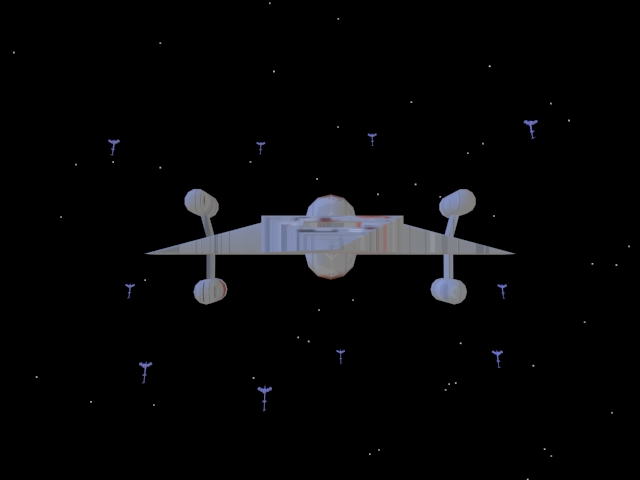
The following images are taken by several pilots aboard the Lexington. Without their cooperation,these images would not be here. The first three was taken during a normal patrol through the G-153 system.The next three were taken during their arrival at the Brigade Outpost 241 near the frontier.





Back to Library
Back to Main
Copyright 1999.
Page an